 United States
 India
India United Kingdom
 Australia
 Canada
 Nigeria
 Others


 Learning Saint
You must be using multiple applications that automatically suggest your next pick. For example, the e-commerce website that you use for shopping recommends products for your next pick based on your previous preferences or choices. This is not it; you must have noticed that your phone sometimes helps you finish the sentence that you are writing. These small or barely visible things are made possible using Machine Learning. This article will act as a guide for you in understanding what is Machine Learning in easy and understandable language without any confusing jargon.
What do you understand by machine learning?
At the basics of machine learning, there lies a core definition that says, 'Machine learning is a way for computers to learn and modify themselves at a certain task by simply studying examples related to it, instead of being provided with a specific set of rules.
A standard computer program operates like a recipe. You must be wondering how, right? Well, in a traditional computer program, a person writes exact steps, and the computer simply follows them without changing even a single word.
Machine Learning makes it the other way round. Instead of drafting exact steps, engineers input huge amounts of data into the computer, and the system studies and understands the examples in order to identify the right patterns. Once it spots the patterns, it starts to apply them in different scenarios or situations that it has never seen or encountered before.
So, in the simplest language, machine learning is a way of teaching computers to identify patterns in the given datasets and decide on the basis of that. The system improves its capability of making decisions the more examples it is fed.
What are the most important building blocks of Machine Learning?
If you are interested in properly understanding machine learning, you must break down the process into its core building blocks.
The following are the main building blocks of machine learning:
- Data: Data refers to raw text, numbers, or any other type of information that is fed into the computer to learn from.
- Features: Features are simply the specific details that lie within the data. They are important for the task, like the size of the house when you have to predict the price, or the words present in the email when you are detecting spam.
- Algorithm: An algorithm refers to the method that is used to study the data and identify patterns. With each different problem, it is better to use a different algorithm.
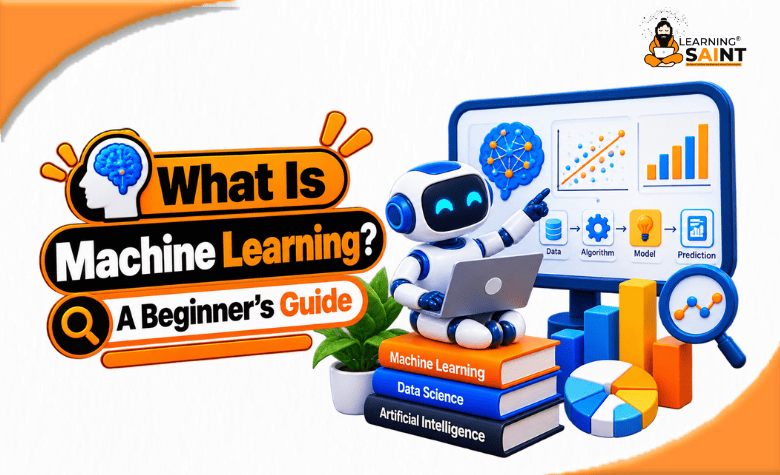
- Model: The job of an algorithm is done when it studies the data. Later, it produces a model that is basically the system’s understanding of what it has learned so far or how ready it is to make predictions.
- Evaluation: Once the training is done, the model is then tested against data that has never been fed to it. It helps in checking if the model is actually accurate and reliable.
When these factors are joined together, they make almost every machine learning model work.
What are the types of machine learning?
Machine learning is not a single product or technique. It is usually divided into 3 core and broad categories, in which each category suits various kinds of problems.
Supervised Learning: In supervised learning, the computer tends to learn from labelled examples. The data that the system analyses and understands already comes with answers attached.
For example, thousands of images of cats and dogs, each already labelled with their name under them, can definitely help the system to predict the new pictures of either a cat or a dog. This kind of machine learning is widely used because it gives trusted and verifiable results.
Unsupervised Learning: Unsupervised learning is the exact opposite of supervised learning. In this approach, the computer system studies and learns from the unlabelled data. The data here does not come with any predetermined answers. The system basically needs to find its own structure within the data given.
Reinforcement Learning: This learning is the most different one. In reinforcement learning, the system learns through a trial-and-error method. The system takes a certain action, and if the decision is right, the system receives a reward, but if the decision is wrong, it has to pay a penalty. This helps the computer to modify its decisions for the future.
What are some real and practical examples of machine learning?
The core idea behind understanding what is machine learning will become clearer to you after you understand its daily-life uses.
The following are examples of machine learning in daily life:
- Predictive text: Have you ever encountered the moment when you are typing something and your phone has already suggested words with multiple options to complete the sentence? Well, that is machine learning, where the phone learns from the patterns of huge amounts of previous text.
- Product recommendations: If you have ever gone online shopping, you must have noticed that all the e-commerce websites suggest certain products on the basis of your previous purchases. This is also machine learning.
- Photo tagging: The Photo tagging option is pretty common when you are taking pictures with your phone camera. You must have seen that the camera recognises faces or objects in the pictures because of the models that were trained on millions of labelled images.
- Traffic predictions: This example is seen usually in navigation applications. Those apps learn from the historical traffic data to predict the time that will be taken to reach the destination at a given time of the day.
- Credit card fraud alerts: You must have often received credit card fraud alerts from banks, right? Banks use trained models to identify transactions that seem unusual in comparison to a customer’s basic expenses.
- Music and video recommendations: Everyone uses online music and video platforms. These platforms start recommending songs or videos to you based on the kind of songs or videos that you listen to or watch on a regular basis.
- Medical scan analysis: The medical scans’ analysis performed in the hospitals is also a part of the machine learning example. Hospitals use trained models in order to identify any early signs of danger of any condition in X-ray reports.
You can also read about machine learning in business in detail here.
What are the limitations of Machine Learning?
Till now, you have seen and read all the important factors that make machine learning useful. But it is also important to understand the limitations that come along with machine learning concepts.
The following are the most common limitations of machine learning:
- The operations completely depend on the data fed: Machine learning as a concept says that computers have to learn from the data and examples given to them. This ultimately means that if there is any error in the examples, the computer will not remove it; instead, it will learn from the wrong example.
- It might get stuck with rare scenarios: If your computer system encounters a situation that it has never seen before in the training, it may end up handling the case poorly.
- There might be difficulties in explaining it: Some advanced machine learning models make accurate assumptions or predictions but do not explain why they chose them. This can become a problem in industries like healthcare or finance, as these industries require explanations for making a decision.
- Machine learning models need regular updates: The world and its concepts keep changing. Nothing remains the same. This is why a model that was trained on old data might become less accurate over time unless it is modified by feeding new information.
- It might inherit human bias: The systems learn from examples under the machine learning approach. If the examples or the data fed to it have some unfair or biased patterns from the past, the system will automatically learn the same bias.
These limitations do not mean that machine learning is unreliable or should not be used. These are simply some problems that need to be fixed or a caution given to users before they use it so that they use it with accountability and confidence.
Conclusion:
So what is machine learning? The answer should be starting to sound a lot less mysterious than it sounded initially. This is not some distant dream in R&D labs. It's an everyday, hands-on tool built on one simple habit: learn by example, not by rule. You see this behaviour in action every time you see a video you are recommended, a word you are suggested, or an email that is blocked as spam.
The interesting thing about this topic isn’t really the technical detail to understand. Data flows in. Patterns learned. Better decisions come out. Like a person would. Over and over again. Practicing and improving. And what is ML, anyway? Another way of putting it more briefly.
You don't need a science degree or coding experience to get this idea. And there’s just one sentence to remember: machines get smarter the same way people do, by looking at enough examples to start seeing what matters. No matter what the headlines say, that sentence and the rest of this field will always be a little more rational.


Reply To Elen Saspita