 United States
 India
India United Kingdom
 Australia
 Canada
 Nigeria
 Others


 Learning Saint
Do you know how a company turns business problems into action and turns raw data into predictions? The answer simply comes in two roles that can manage this: business analyst and data scientist. Both have their expertise in data, but have different approaches towards it. According to a report by Skillify Solutions, data scientists in India earn an average salary of ₹14 LPA, which shows the growing demand for data expertise in various industries. If you are also planning a career in data or simply trying to understand which role fits you, this comparison will clear all your doubts.
What Is a Business Analyst?
A business analyst helps organizations to solve problems and achieve their goals with the help of data. They focus on the data first, then evaluate the whole process, identify the gaps, and then recommend final practical solutions to improve the efficiency of the business and also help with customer satisfaction.
Think of it with an example like a retail company that is experiencing declines in online sales. A business analyst would investigate the data and customer behaviour, evaluate the purchasing journey, gather overall feedback, and finally recommend a solution for further improvement, which may include simplifying the checkout process or introducing personalized products. Their goal is not just to interpret the numbers but also to solve the problems related to the business with the help of backend data and insights.
This is why both the role of a data scientist and a business analyst are discussed together. Both works same data, but a business analyst focuses more on understanding the business objectives and ensuring that the data-driven goals align with the organizational goals.
Key Responsibilities of a Business Analyst
A business analyst performs several important functions, which include:
- Understanding the requirements of the business and collaborating with stakeholders.
- Identifying challenges and coming up with solutions and suggestions
- Analyzing the data and then making a decision
- Preparing reports and presentations to make the workflow smoother
- Recommending solutions and strategies to improve performance
- Working with the technical team and making sure that the solutions match as per the research.
Learn more about: What Is a Business Analyst? Roles & Responsibilities
What Is a Data Scientist?
A data scientist is a technical expert who works with both structured and unstructured data. With the help of statistics, programming, and machine learning techniques, they identify the problem and then solve it; they not only check the past details but also follow the future trends, which helps the organization to stay ahead of time.
For example: Think about a streaming platform like Netflix. When you search for or watch a movie later, when you scroll it down, you get recommendations based on your interests. These suggestions don’t appear suddenly, but there is a data scientist who developed a machine learning model that helps to analyze your history, search behaviour, and ratings, and then guess what you are likely to enjoy next. This will help with user engagement and business growth.
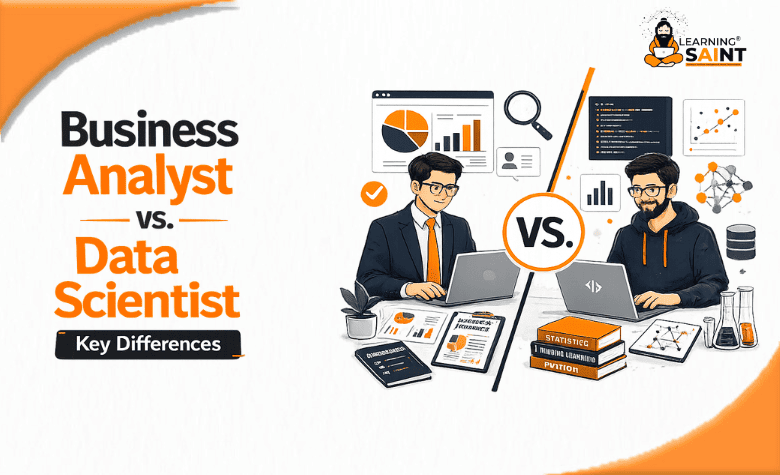
When the question comes, which one is better, business analyst vs. data scientist, the very, very first thing is that you should know the difference between both of them. A business analyst focuses more on understanding the challenges that businesses are facing these days and how can they resolve them on the other hand, a data scientist uses advanced analytics, programming, and modelling to solve complex data problems and determine what outcomes can be beneficial for the future.
Key Responsibilities of a Data Scientist
Here are some of the key responsibilities of a data scientist:
- Collecting large amounts of data and organizing them
- Making statistical analyses that help to identify patterns
- Building machine learning models
- Developing algorithms that will automatically update based on the user's choice
- Making complex data simple for the stakeholders
- Testing, validating, and improving the models from time to time
As organizations are generating more data, the demand for professionals is also increasing who can transform raw information into a strategic way. This growing demand has become a reason why many students compare the difference between a business analytics or data scientist career before they choose any one of them.
Want to become a Data Scientist? Read our complete guide on How to Become a Data Scientist.
Key Differences Between a Business Analyst and a Data Scientist
Now that you have understood both the roles individually, it’s easier to understand the comparison of business analyst vs. data scientist more deeply. The table below highlights the difference between both of them:
|
Feature |
Business Analyst |
Data Scientist |
|
Primary Focus |
Improving the business and decision-making |
Research and building models. |
|
Objective |
Solve challenges that businesses are facing |
Solve data-driven problems with the help of advanced analytics |
|
Skills Required |
Business analysis, communication, management |
Programming, statistics, machine learning |
|
Programming Requirement |
Basic to intermediate |
Advanced |
|
Data Usage |
Structured data |
Structured and unstructured data |
|
Tasks |
Gathering basic requirements, reporting, process improvement |
Data cleaning, modeling, experimentation, prediction of the models |
|
Stakeholder Interaction |
Very high |
Moderate to high |
|
Common Tools |
Excel, Power BI, Tableau, Jira |
Python, R, SQL, TensorFlow, Spark |
|
Results |
Business recommendations and process optimization |
Predictive models and actionable insights |
What’s the Difference Between a Business Analyst vs. Data Analyst vs. Data Scientist
It’s very common to get confused between the role of a business analyst, data analyst, and data scientist because all of them work with data and support decision-making. The table below will help you to understand the major differences between all of them:
|
Role |
Business Analytics |
Data Analytics |
Data Scientist |
|
Primary Role |
Improve business performance |
Analyze past data |
Build predictive and intelligent models |
|
Focus Area |
Business strategy and operations |
Reporting and analysis |
Analytics and AI |
|
Programming Skills |
Basic |
Intermediate |
Advanced |
|
Statistical Knowledge |
Basic |
Moderate |
Advanced |
|
Machine Learning |
Not much |
Occasionaly |
Advanced |
|
Business Communication |
Very high |
Moderate |
Moderate |
|
Output |
Business recommendations |
Dashboards and reports |
Models and automation |
Which Role Is More Suitable?
If you are choosing, the right choice always depends on your interests and career goals.
Choose a business analyst if you enjoy:
- Working with teams
- Solving challenges that the organization faces
- Presenting your data to stakeholders
- Maintaining business processes
Choose a data analyst if you enjoy:
- Working with spreadsheets and dashboards
- Researching past data and representing it
- Creating reports
- Supporting business decisions through analysis
Choose a data scientist if you enjoy:
- Programming and coding
- Mathematics and stats
- Machine learning
- Solving highly technical problems with data
Want to compare Business Analyst and Data Analyst roles? Read our detailed guide on the Difference Between Data Analyst and Business Analyst.
Essential Skills for Business Analysts and Data Scientists
Now, if you are comparing business analyst vs data scientist, understanding the required skills is also important.
Skills Required for a Business Analyst
Business analysts require the ability of analytical thinking and communication skills to solve business problems. Their ability to understand the goals of the organization and translate them into solutions that create value throughout the industry.
Some of the most important skills include:
- Business analysis and gathering all the requirements
- Problem-solving
- Good communication and management skills
- Data visualization and reporting
- SQL and Microsoft Excel
- Process mapping and documentation
- Project management fundamentals
Skills Required for a Data Scientist
A data scientist must have strong technical knowledge and should be able to work with large databases, develop programming models and should be able to understand all the concepts and stats.
Essential skills include:
- Python or R programming
- SQL and database management
- Statistics and probability
- Machine learning
- Data cleaning
- Big data technologies
- Data visualization
- Artificial Intelligence
- Model optimization
Tools and Technologies Used by Business Analysts and Data Scientists
There are different types of tools used by business analysts and data scientists; to know more, here are the following tools that one should know:
|
Business Analytics Tools |
Data Scientist Tools |
|
Microsoft Excel |
Python |
|
Power BI |
R |
|
Tableau |
Jupyter Notebook |
|
SQL |
TensorFlow |
|
Jira |
Scikit-learn |
|
Microsoft Visio |
Apache Spark |
|
Confluence |
Hadoop |
|
Google Sheet |
SQL |
Education, Certifications, and Career Path
If you are also planning a career in data or a student who is searching for a perfect degree for a future in data, one question often comes to mind: Do you need one particular degree to get started? The answer simply depends on what career path you choose based on your interests, educational background, technical skills, and opportunities that you have.
Becoming a Business Analyst
Most business analysts have backgrounds in:
- Business Administration
- Commerce
- Economics
- Information Technology
- Computer Science
- Engineering
Popular certifications include:
- ECBA (Entry Certificate in Business Analysis)
- CBAP (Certified Business Analysis Professional)
- PMI-PBA (Professional in Business Analysis)
A typical career path looks like this:
Business Analyst Intern → Junior Business Analyst → Business Analyst → Senior Business Analyst → Lead Business Analyst → Product Manager or Business Consultant
Becoming a Data Scientist
Data scientists generally come from more technical backgrounds, such as:
- Computer Science
- Data Science
- Statistics
- Mathematics
- Artificial Intelligence
- Engineering
Popular certifications include:
- Google Data Analytics Professional Certificate
- IBM Data Science Professional Certificate
- Microsoft Certified: Azure Data Scientist Associate
- AWS Certified Machine Learning – Specialty
A common career progression is:
Data Analyst → Junior Data Scientist → Data Scientist → Senior Data Scientist → Lead Data Scientist → AI or Machine Learning Specialist
Continuous learning is essential in both careers, as tools, technologies, and business needs evolve rapidly.
Business Analyst vs. Data Scientist Salary Comparison
While choosing a career path, salary is the most important thing for anyone. It can be based on experience, location, industry, and skills. Data scientists generally earn higher salaries than business analysts because of their technical skills.
Here's a general overview of the salary:
|
Role |
Average Salary in India |
|
Data Analyst |
Around ₹6 LPA |
|
Business Analyst |
Around ₹8–12 LPA |
|
Data Scientist |
Around ₹14 LPA |
These are the estimated figures and may vary depending on the company, experience, location, and the market value.
Business Intelligence Analyst vs. Data Scientist
Now you have a clear concept about a business analyst and data scientist; there is one more comparison that confuses people: business intelligence analyst vs. data scientist. This is also the same as we have read earlier: business intelligence also works with data.
A business intelligence analyst focuses on the past data of a business, creates dashboards, and generates reports that helps organization to monitor the performance. They ensure that they provide clear and accurate data timely.
Here's a quick comparison between a business intelligence analyst and data scientist that will clear all your doubts:
|
Business Intelligence Analyst |
Data Scientist |
|
Focuses on past data |
Focuses on predictive data |
|
Builds dashboards |
Builds machine learning models |
|
Uses BI tools |
Use AI tools |
|
Supports business decisions |
Predicts future business outcomes |
|
Limited machine learning |
Extensive use of machine learning |
Which Career Is Right for You? Business Analyst or Data Scientist
Choosing between a business analyst and a data scientist completely depends on your interests, strengths, and career goals. Understanding what each role involves can help you to make more informed decisions and choose the right career for you.
A Business Analyst role may be the better fit for you if you choose:
- Working closely with people
- Solving real-world challenges
- Improving business processes and working more smoothly
- Communicating ideas and presenting your recommendations
A Data Scientist role may suit you if you enjoy:
- Programming and coding
- Mathematics and statistics
- Machine learning and Artificial Intelligence(AI)
- Solving technical problems with the help of data
Both the career comes among the fastest-growing professions in today’s digital economy, and they also offer excellent opportunities in other industries too, such as finance, healthcare, e-commerce, technology, manufacturing, and consulting.
Instead of just focusing on salary and popularity, you should always consider the work that you actually like and enjoy. Building expertise in the right field will create strong and long-term career prospects.
Ready to start your career? Explore our Data & Business Analytics Course and gain the skills needed for today's data-driven industry.
Conclusion:
The comparison between the business analyst vs data scientist is not just about deciding which profession is more superior than the other, but it’s about understanding the basics of them and which career will lead you towards success. Business analysts transform challenges into opportunities, while data scientists use advanced research and machine learning for good outcomes.
As organizations have excessive data, both roles are increasing and getting valued across industries. If you enjoy business strategy, communication, and improvement in the process of data management, then the career of a business analyst suits you well; and if you are more into coding, statistics, AI, and data science, and have the ability to solve complex problems, you should choose a data scientist. Understanding these requirements and responsibilities will lead you towards your future goals.


Reply To Elen Saspita