 United States
 India
 United Kingdom
 Australia
 Canada
 Nigeria
 Others


 Learning Saint
In your ordinary day, you will bump into encryption more times than you would expect. Start from unlocking your phone in the morning to securing the news article you are reading over your coffee; encryption performs it all, but nothing is visible. Other tasks, like protecting the payment while you are grabbing a coffee or even securing the video call that you join for work, are also performed by encryption.
This article will help you walk through the complete concept of encryption. It will help you understand what is encryption using the everyday lens. It will break down the various types of encryption. You will read about the protocols that work behind the applications and websites that you are already using. By the end of this article, you will feel a lot more familiar with the concept of encryption. Everything is written in an easy and readable language so that it is easy for you to understand.
What do you understand by Encryption?
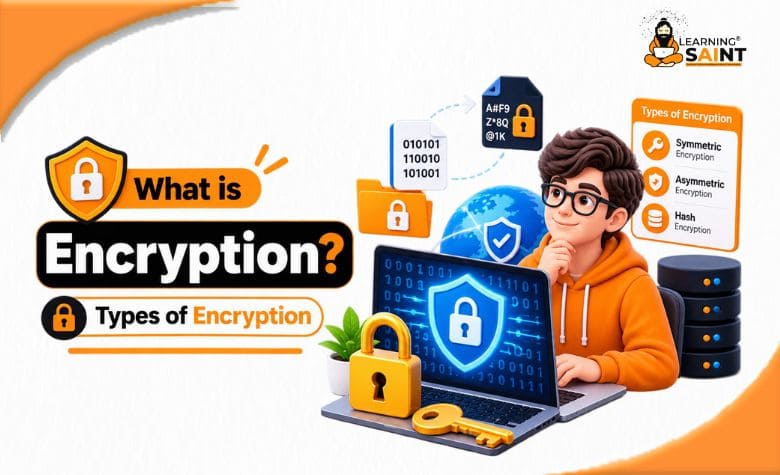
If you study what is encryption to its core, it narrows down to a simple job: converting readable information into something unreadable, unless you hold the right key to unlock it. The readable information is called plaintext, and once scrambled, it turns into ciphertext, which is a collection of meaningless characters to everyone.
To compare it with a real-life object, imagine it as an envelope sealed with a wax stamp. Anyone can see the envelope being sent from the sender to the receiver, but only someone who has the right seal can unlock it and see what is inside. Encryption plays a kind of the same role for digital or online information. The only difference is that, except for the wax seal, it is dependent on mathematics.
This complete process operates continuously across the internet and safeguards everything from a message to a complete medical record of a hospital.
What does a day in the life of encryption look like?
Right now, the entire concept must feel abstract and illogical, right? To make it make more sense, it is important that you trace a complete day and spot where encryption is doing its job behind the scenes.
The following is what a day in the life of encryption looks like:
In the morning, the first thing that a person does after waking up in the morning is to unlock their phone with a fingerprint or a passcode. Behind that unlock screen, your device’s storage is generally encrypted. It means that the data on the screen would look like a bunch of letters scrambled together for anyone who is trying to unlock your device without your credentials.
While the Commute: Imagine you are at a coffee shop, and you check your emails over public wi-fi. Do you wonder if anyone else with the same wi-fi can also read your messages? Encryption helps you forget this stress. It protects that connection so that someone else on the same network cannot read your messages or important information casually while they travel between your phone and the email server.
At Work: Everybody works over the internet today. When you log into your computer’s systems remotely, there is a secure connection that encrypts the link between your laptop and the workplace's internal network. It keeps your business data private even if you are not physically present in the office.
Encryption by purpose—communication, Storage, browsing, and identity verification—and the protocols that make them work give you a much clearer, more practical picture than just looking at the technical details. You don't have to be an expert to benefit from this technology. Recognising where it shows up and building a few simple habits around it is enough to meaningfully protect your everyday digital life.
At Lunch: You must have used your card to pay for your lunch? Ever wondered how your personal account details are still safe? It is because of encryption. That brief transaction is encrypted; that means your card details are protected during the transfer between the card, the terminal, and the bank.
In the Evening: Evening is the time when you return from work to your home. Imagine you have joined a video call with your family. It depends on the application that you are using whether that call may use end-to-end encryption. It simply means only you and the people on the call can see or hear everything going on in it, not even the company that is running the application.
What are the basic mechanics working behind encryption?
If you want to understand what is encryption a bit more deeply, you must understand the 2 most important parts working: the algorithm and the key. Getting to know these 2 ideas makes the remaining guide a lot easier to follow.
The algorithm is simply the fixed mathematical recipe that is used to scramble the data. The trustworthy algorithms are available to the public, and they are extensively tested by researchers worldwide, as security developed on the secrecy of the method itself tends to fail if the secret gets out.
On the other hand, the key is the variable ingredient in the recipe. It is a unique piece of data that decides how the algorithm transforms a particular message. If you change the key, you will see that the same algorithm will produce a completely different scrambled result.
What are the different types of encryption on the basis of usage?
Instead of starting with the technical terms or categories, you should group encryption on the basis of its purpose or how it works for you.
The following are the types of encryption grouped on the basis of their purposes:
1. Encryption for personal conversations
This sort of encryption is responsible for your messages, calls, and emails as they are transferred between people. The strongest or the most well-known version of this is end-to-end encryption. It ensures that apart from the sender and recipient, no one can read the messages, not even the app provider. Most common or popular messaging apps use this by default for their chats and calls.
2. Encryption for the data stored
This part of encryption secures your important information sitting on a device instead of moving anywhere. Full-Disc encryption on phones and laptops comes under this category, along with encrypted cloud storage, which ultimately scrambles your files before or while uploading them so that they remain protected, even if there is a server breach.
3. Encryption to perform web browsing
The encryption used while web browsing protects your connection between the browser and the website that you visit. Along with that, it is probably the most visible example of what encryption actually does on a daily basis. Does it still feel confusing? Well, do you remember the padlock icon and “https” at the start of a web address? It is a signal that the “Transport Layer Security (TLS) is constantly protecting that connection.
4. Encryption for the identity verification
This type of encryption is a bit different from what you have seen so far. This one does not hide your message’s content till a point that the sender is visible. Digital certificates and digital signatures are dependent on encryption to confirm that a website, an email, or a piece of software actually originates from who it claims to be and is not tampered with along the way.
What are the two basic key methods behind these purposes?
No matter the purpose that you are looking at, the encryption working behind it basically depends on one of the two core approaches. You will find these 2 approaches at the very middle of understanding what is encryption in practice, irrespective of the app or service that you are using.
The following are the 2 types of encryption behind the discussed purposes:
A. Symmetric encryption
Systemic encryption basically uses one shared key for both locking and unlocking the data. It has a faster operating speed, which makes it appropriate for encrypting big piles of data, such as a complete hard drive or a long video call. The Advanced Encryption Standard, also known as AES, is the most common and widely trusted method in this category currently.
B: Asymmetric encryption
Asymmetric encryption uses the same pair of keys. A public pair that is freely available to be shared and another one that is private and kept as a secret. Data that is locked with the public key can only be unlocked with the matching private key. RSA is the most common example of it. It is generally used to exchange the smaller, faster symmetric keys used for the rest of a conversation safely and securely.
In real and practical life, most systems use a combination of both. The asymmetric method is responsible for the tricky part, as it is a bit slow, whereas the symmetric method is responsible for the real bulk of the data.
What are the common protocols that allow encryption to perform?
You must have understood by now that the key methods are important, but the daily security depends upon the named protocols that turn this protection into something that the application can actually see. These protocols are the point where the real essence of “what is encryption” meets the real world.
The following are the most common protocols that put encryption to work.
- S/SSL – S/SSL stands for Secure Sockets Layer. It secures the connection between your browser and websites. It is the technology that works behind the padlock icon that is visible to you while browsing.
- VPN protocols – VPN stands for Virtual Private Network; it is a security tool that basically creates an encrypted digital tunnel to protect your data and keep your real IP address a secret online.
- PGP (Pretty Good Privacy) – PGP is quite commonly used to encrypt the content and attachments available over email. It gives users control over their keys instead of making them completely dependent on the email provider.
- S/MIME – S/MIME is another standard for encrypting and digitally signing emails. It stands for Secure/Multipurpose Internet Mail Extensions. It is mostly used within corporate email systems.
- SSH (Secure Shell) – SSH basically encrypts remote access sessions. It is most commonly used by developers and system administrators to handle the servers safely.
Conclusion:
Take a typical day and trace the path of encryption through it. You’ll find that it’s everywhere in our modern lives, though it rarely makes itself known. What is eWhenption? Remove the technical language, and it’s just a secure way of ensuring your information can only be read by the right people, whether that’s a private message, a stored file or a card payment. Keeping this simple definition in mind is often all you need, even as the specific tools and protocols around “what is encryption” continue to change over time.
Encryption by purpose—communication, Storage, browsing, and identity verification—and the protocols that make them work give you a much clearer, more practical picture than just looking at the technical details. You don't have to be an expert to benefit from this technology. Recognising where it shows up and building a few simple habits around it is enough to meaningfully protect your everyday digital life.


Reply To Elen Saspita