 United States
 India
 United Kingdom
 Australia
 Canada
 Nigeria
 Others


 Learning Saint
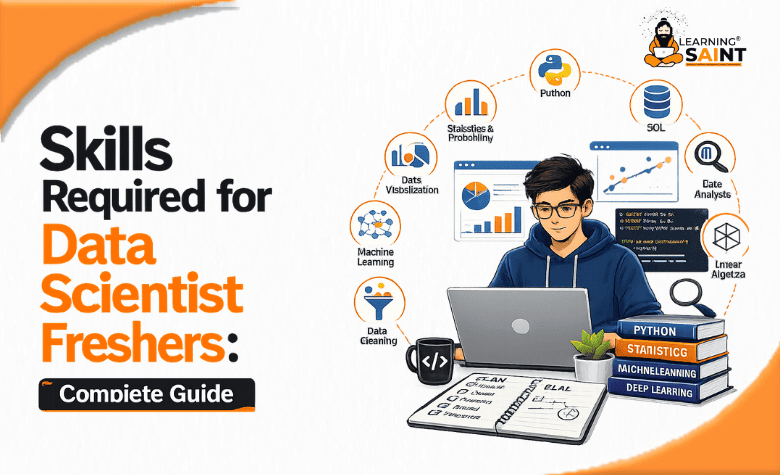
This is a time when everything operates on the data that they receive. This is known as data science. Every time you make a purchase online, watch a video on any streaming platform, share anything on social media, or use digital maps to reach a certain location, you contribute to creating information. Companies and brands all around need this information to make smart choices and grow. If you are a beginner in your career and you wish to try the field of a data scientist, the most important thing to know is the Skills Required for Data Scientists.
There is a misconception that is highly circulating among people, which says that you are supposed to be a genius at maths and computers to be a data scientist. This is not the real case. You need to understand and learn the appropriate tools, apply your skills practically, and keep yourself ready to learn. This article is a guide that outlines the technical and practical skills an individual needs to be a data scientist. It will use simple and readable language to make sure that you understand every step in detail and that you are ready to use it in real life.
What is the importance of data science for beginners?
Brands and companies have understood the importance of collecting information. Companies of the current time have more data, facts, and figures than previous companies. However, this complete information will be of no use if anybody cannot read and understand it. This is why brands search for and hire people with the skills to read and understand data and use it for real-life business purposes. If you go into the depth of the important skills for data scientist roles, you will see that there is a major blend of tech, mathematical thinking, and human communication.
Beginners have lots of creativity stuffed inside that only requires a platform to channel it. They have high energy and excitement towards work. Having the accurate skills needed for data science can make you very useful for companies to solve real-life problems. You do not have to come with the experience of over 10 years; instead, what matters is that your core skills are strong, practical, and ready to be implemented.
You can also read about how to become a data scientist in 2026 in detail here.
What are the technical skills required for a data scientist?
Technology is the basis of the job of a data scientist. They create a foundation for your professional life. The technical skills in data science include some specific tools and programming methods that assist you in talking straight away to computers and converting the unorganised numeric data into an organised dataset. The following are the most important skills needed for data scientist jobs:
1. Coding Languages
Using programming languages is the only way to tell a computer about the results that you want with the huge piles of online files. You are not supposed to know about every programming language existing, but learning, understanding, and knowing the practical use of the main ones that every business uses are important.
- Python: Python is the intelligent programming language chosen by data scientists from all around the globe. It is very beginner-friendly. It reads almost like simple and readable English, which is highly appreciated and used by beginners. Python includes a unique collection of pre-written code called libraries. Some of their examples are Pandas and NumPy. These tools are used for tasks like sorting the data, filtering the data, and performing mathematical calculations quickly and easily.
- SQL: SQL, known as "structured query language", is a programming language that deals with databases. Data is hardly supposed to be kept in ordinary text files. Instead, you will see them stored in huge online filing cabinets known as relational databases. SQL is a special language that you, as a data scientist, can use to talk to these databases. You can ask them to provide you with the specific files, rows, or columns that you need to perform your daily analysis.
- R programming: R is a language that is accurate for performing in-depth statistical math and building visually appealing educational charts. Python is used all over in normal business settings, but R remains extremely common and popular in the tech- and science-related fields.
2. Core Math and Statistics
As a data scientist, you do not require an advanced university maths degree to succeed in your field. You just need to have basic knowledge about numerical grouping. You must understand how numbers behave when they are grouped. Statistics provides you with assistance in ensuring that your business summaries are authentic, with no guesses.
The following are the most important math and statistics skills you need to be a data scientist:
- Descriptive Statistics: Being a beginner in data science, you must know how to find out the mean, median, variance, and standard deviation. The most basic statistics include finding out the average, the middle number in an organised list, and how spread out the numbers are.
- Probability: Probability is a mathematical concept that helps you measure how likely a certain event is going to happen in the future. It is the foundational basis of creating digitally smart business predictions on the basis of the historical facts.
- Hypothesis Testing: Hypothesis Testing is a step-by-step process that helps in logically testing if the pattern that you found in the data sets is actually meaningful or if it is just another random accident that will never take place again.
3. Data organisation and preparation
The actual and practical data are very unorganised and messy. It has missing pieces, human typing errors, wrong dates, and multiple duplicated rows that might confuse the programmes fed into the computer. Data cleaning, also called 'data wrangling', is an important process where you can fix these errors, which improves your final analysed result.
- Filling in missing numbers: As a data scientist, it is important to learn when to put average numeric values in the empty spots, when to predict the missing value based on the other hints, and when to delete the distorted row from your computer.
- Data modification: This part includes transforming the file format into something that your computer can easily read and understand, such as converting dates fed as characters into actual digital calendar days that can be organised chronologically.
- Outlier Detection: This step will teach you how to find strange, extreme numbers that have the potential to create problems in your final results or charts, like an individual's age being fed as 1000 years because of a typing mistake made by an employee.
4. Data visualisation and narration
Most people believe what they see. Their trust factor depends upon the things that are visible to them. Most of the business leaders, brand heads, store executives, and company directors are not interested in looking at the huge data sets combined numerical rows and columns. They prefer seeing a clear and easy picture that solely explains the real situation immediately.
- Chart selection: Chart selection means understanding where to use a bar graph, a line chart, and a scatter plot. They serve different purposes in data science. A bar graph is used to show a comparison between two things; a line chart shows various changes occurring over time, and a scatter plot shows the relationship between 2 different things.
- Visual Libraries: The visualisation libraries mean learning the usage of easy, powerful programming libraries such as Matplotlib and Seaborn in the created Python script in order to generate visually appealing, clean, and colourful diagrams easily.
- Business Intelligence Dashboard Software: As a data scientist, your profession expects you to get acquainted and comfortable with the basic and core drag-and-drop software like Tableau Public or Microsoft Power BI.
5. The basics of machine learning
Machine learning sounds very complicated. It sounds like a concept that came from a future science world. In reality, it just means teaching a computer system to learn from its past examples. It ensures that the computer is not being specially programmed for every situation that exists. As a beginner data scientist, you are only required to know the following basic methods:
- Regression Analysis: Regression analysis is a method that helps in predicting a specific and continuous number, such as predicting how much money a house will be sold for on the basis of its size, location, and number of bedrooms.
- Classification Models: Classification models are a method that includes grouping items into different baskets or categories, like choosing if an incoming email is normal or a junk email.
- Clustering Methods: Clustering methods involve spotting natural and secret groups within the data you have. It does all this without giving the computer any labels beforehand, like automatically categorising store consumers into some groups on the basis of their expenses.
What are the non-technical skills required for a data scientist?
Being a data scientist does not mean excelling in math and computers only. That is the half-side of the job. The other half is the non-tech skills required for a data scientist. If you want to be the best at data science, you must be good at working with humans too, along with working with data. These non-technical qualities are the core parts of the entire skill set required for a data scientist.
1. Sharp Critical Intellect
You should be critically intelligent to be a good data scientist. There should be natural curiosity in you for the things around you. Watching a chart on the screen with a sudden and strange drop in sales, the first question to come to your mind should be, "Why did the drop occur?” Having a critical intellect means finding out the root cause of any business problem rather than just addressing the surface-level symptoms.
2. Easy and effective communication
When you work as a data scientist for a company, you will be working in a corporate setting. There will be managers, experts, agents, and sales directors around you. Your job will include working and communicating with them. You must know how to translate the complicated tech discoveries into readable sentences. If you have the calibre or the skill to explain your findings to a 10-year-old effortlessly and clearly, you will easily be able to explain them to the managers and the brand head too.
3. Collaborative efforts
Data scientists or other data workers are not just limited to their computer screens in a dark room. As a data scientist, you will have to work with software engineers, product designers, customer service leads, and business heads. This job requires you to be friendly, be a good listener, and have great acceptance towards suggestions and feedback. It will help you complete your group projects much faster, with fewer mistakes or errors.
You can also read about how to become a data scientist after 12th in detail here.
Conclusion:
Starting a professional career as a fresher in data science is a very rewarding journey with growth, continuous learning and solving interesting problems. The entire list of tools, programming languages, and mathematical theories can be overwhelming at first sight, but the core Skills Required for Data Scientist success are limited to a few core areas: coding straightforwardly and cleanly, understanding how basic numbers behave, cleaning up messy information, and communicating with your team members openly.
Do not make the mistake of trying to learn every single concept in a single weekend. Instead, treat your studies like a marathon: Pick one simple tool, like Python basics or SQL queries, and practise using it for just twenty to thirty minutes every single day. By intentionally building your personal skills for data scientist roles step by step, you will naturally build the confidence, knowledge, and portfolio needed to land your very first professional role. Stay deeply curious, keep your code clean, explain your ideas clearly, and enjoy the wonderful process of turning messy everyday numbers into helpful stories that improve businesses!


Reply To Elen Saspita