 United States
 India
India United Kingdom
 Australia
 Canada
 Nigeria
 Others


 Learning Saint
Have you ever got stuck while making a decision? Have you ever felt the need for someone who would suggest to you or help you with decision-making? Now, have you wondered how big companies make decisions? They do not rely completely on guesswork or gut feeling. They utilise information collected based on what people like, how to save funds, and how to promote growth, among many other things. In this process, there are special helpers called analysts. Two of the most common jobs in the analysis fields are Data Analyst and Business Analyst.
Initially, they will sound similar to you. You might think they perform similar duties, inherit the same skills, have the same goals, and work for the same pay. In a way, both professionals work to help the brand succeed. But their daily workload, toolset, and goals are completely different. If your interests include solving numerical puzzles, talking to people, and planning new projects, you might like to be a Data Analyst or a Business Analyst.
This article will act as a step-by-step guide and will tell you the difference between Data analyst and Business analyst easily. You will learn their job roles, their workloads, their skill sets, and their pay expectations.
Before looking into the difference between Data analyst and Business analyst, it is important to understand the meaning of an "Analyst". “Analyse” refers to looking at something very closely and curating its significance.
Imagine there is a big puzzle in front of you. An analyst is an individual who picks up all the puzzle pieces, sorts out the basis, understands how they fit with each other, and explains to everyone what the end picture looks like.
Nowadays, every brand has a pool of information. They are drowning in all the information and require a person to sort that out for them. Whenever a customer purchases a product, clicks on a website to visit, or dials customer service, brands receive data from them. But the brands do not have time to look at data and go through all the rows and columns. They require analysts to understand those numbers and translate them into simple English. Without analysts, companies are like cars driving in the dark without headlights.
What Does a Data Analyst Do?
Before you jump into the difference between Data analyst and Business analyst, it is important to understand both fields separately. Firstly, you must learn who a data analyst is and what they do. Imagine there is a detective who loves to play with numbers. He collects the numerical clues to solve a certain crime. Then he cleans, curates, analyses, and concludes the given data. A data analyst is the same as that detective. Whenever you contribute to the data collection, the data analyst collects those numbers and brings out the useful information from them.
A data analyst is solely concerned about the truth inside the numbers. The truth that is not visible to normal people. They do not rely on guesses and gut feelings. They work based on the factual information visible in front of them. If the factual information shows that the black shirts are not in demand in July, the data analyst will bring their proof to their team.
Various blogs and videos on the internet will teach how to become a data analyst. These sources are completely free and yet informative.
Major Duties of a Data Analyst
- Gathering Information: The data analysts collect raw data from different places, such as websites, mobile applications, and customer feedback forms.
- Straining Data: When the data is collected raw, it is messy and unorganised. It has lots of mistakes, or probably areas for improvement. A data analyst fixes those errors and makes sure that the data is correct.
- Finding Patterns: Humans have the tendency to do certain things repeatedly. For example, every monsoon, the sales of black shirts rise, and people are purchasing them repeatedly. This creates a pattern in the data collected. A data analyst looks at those patterns and concludes the basis of the pattern occurring. This also helps them identify a trend.
- Making Charts: No brand will be able to make decisions if the information curated is presented in a boring way. A data analyst curates the information and presents it in a visually appealing way. They present their data in the form of charts and graphs. It is also easy to understand things in the form of charts.
- Building Reports: Data analysts are collecting information every day; they see all the changes happening in the data every day. So it becomes their responsibility to create daily reports on the basis of that.
What Does a Business Analyst Do?
Now you have understood all the important points about a data analyst. Next in the queue is a business analyst. Being a business analyst means acting like a bridge. They connect the software team (who build the software) and the brand heads (the leaders of the company). Their job is not concerned with the numbers, but they do have to figure out the way the raw data can be used to grow the company.
A business analyst will always look forward and think about the bigger picture. They are not limited to curating the information. They focus on better, faster, and cheaper ways to grow the particular brand. Their job also includes talking to the managers, listening to their problems, and giving them solutions to the same.
Where a data analyst spends all their time with their computer and the numbers, a business analyst spends their time in meetings with the managers, HR, and the brand heads. They are required to be good speakers but even better listeners. They need to listen to what a manager has to say and later turn it into a computer program.
Major Duties of a Business Analyst
- Holding Stakeholders: A business analyst has direct connections with the brand heads. They are directly answerable to the leaders. Their job is mainly related to attending meetings with the brand heads.
- Resolving Issues: Business analysts are the ones who are responsible for the brand growth plans and strategies. They are able to find the spots or parts of the business breaking the brand’s growth. They understand the problem, analyse it, and bring out the solution.
- Noting the Requirements: A business analyst is also required to make a step-by-step guide about all the updates, plans, and strategies required by the company.
- Comparing Results: After a business analyst has implemented a plan of action or a new strategy, it is equally important to see if the changes are seen as beneficial or not. A business analyst notes down the results seen after implementing the changes.
- Enhancing Operations: If the mistakes or the loopholes are coming due to employee behaviour, the business analyst understands how the issue can be solved and comes up with a solution to improve workflow.
The difference between Data analyst and Business analyst
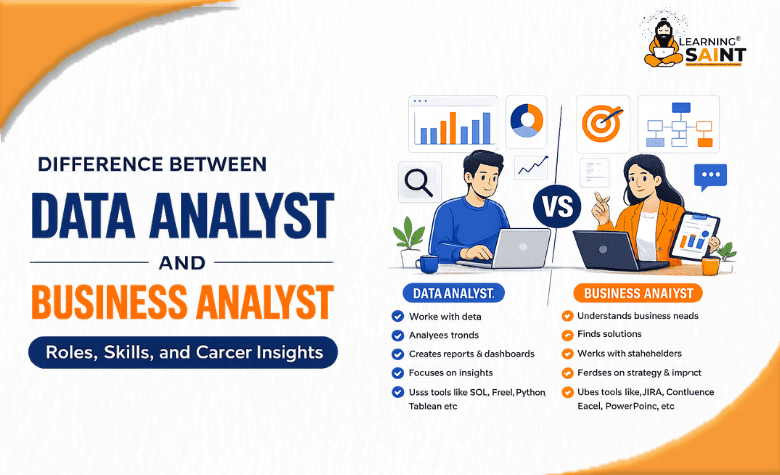
Now, it is time to address the biggest question, which is the difference between Data analyst and Business analyst. To understand this, imagine a school bus out on the road.
The data analyst is the conductor who has collected complete information about the destinations of all the students sitting inside. He knows about the locations that the bus needs to stop at.
The business analyst is the driver of the bus. He has the responsibility to drop the students at their respective locations. He will take the information from the conductor and decide the route that he will follow and drop off all the students.
Both of them are important to complete the journey successfully, but they both have different duties, they both require different skills, and they both have different workloads. The following is an easy and tabular difference between Data analyst and Business analyst:
|
Feature |
Data Analyst |
Business Analyst |
|
Primary Focus |
Numerical data, trends, and data systems |
Business expansion, procedures, and staff members |
|
Daily Goal |
To curate the data and find important facts hidden inside it. |
Connect the given data to the problems faced by the brand and bring solutions to the table. |
|
Skill Required |
Expert-level, such as Coding, databases, and maths |
Mid-level, such as Business logic and communication |
|
Primary Tools |
Must know about Excel, PowerPoint, Jira, and Flowcharts |
|
|
Work Environment |
They have independent work settings that include only their computers. |
They have to attend various meetings and talk to managers and brand heads. |
|
Final Output |
Their final result is visible through dashboards, clean datasets, and math models. |
Their final result is visible through Strategy documents, flowcharts, and project plans. |
Skills Needed for Each Job
Now you must have understood that there is a difference between Data analyst and Business analyst. Their professions are different, which is why they have different skills to know. The following is a breakdown of information about skills that you need for both paths.
Skills a Data Analyst needs
To become a data analyst, you are required to get your hands on technology and statistics. Here are some basic skills that a data analyst needs:
- SQL: It helps you understand databases. This language helps you search for a specific document from a giant company database.
- Programming Languages: A data analyst must know how to write code in programming languages like Python or R.
- Data Visualisation: A data analyst must understand the significance of creating charts and graphs.
- Math and Statistics: A data analyst must understand basic math and statistics, like averages, percentages, and many more.
- Data Cleaning: A data analyst must know how to erase duplicate or useless data from the databases.
You can also read a blog about the differences between data analytics and business analytics.
Skills for a Business Analyst
The following are skills that are required to become a business analyst:
- Communication: A business analyst must be able to communicate properly, along with being a great listener to the managers and brand heads.
- Problem-Solving: A business analyst must have the ability to go beyond the brief and think about the strategies that can solve the current problems.
- Process Modelling: A business analyst creates plans of action, so they must also know how to explain them through flowcharts.
- Project Management: A business analyst must keep track of all the deadlines and ensure that everyone is completing their task on time.
- Negotiation: A business analyst must be a good negotiator. In a company, different people might want different things. A business analyst must know how to negotiate between them and reach a conclusion.
Conclusion:
If you want to drive through the road of the difference between a data analyst and a business analyst, you must know that they are 2 different sides of the same coin.
Data analysts go deep into the data and find out what factual information is hidden behind the numbers. Whereas business analysts take that information and come up with a plan of action to use it for the growth of the brand. A brand needs both of them to be successful.
Think about what you enjoy doing most every day. Do you want to build data dashboards and write code? Or do you want to talk to teams and fix business workflows? Whichever path you choose, you will be entering a stable, exciting, and well-paying career field.
Frequently Asked Questions (FAQ)
1. Which is better, a data analyst or a business analyst?
Neither of the two is universally better. It depends on the skills you inherit and the strengths you have.
2. Which pays higher, a data analyst or a business analyst?
A business analyst is generally paid more than a data analyst with mid-level experience. But gradually, the data analyst’s salary increases when they learn pro-level programming languages.
3. Is coding important for a business analyst?
No, coding is not a required skill to be a business analyst.
4. Which degree is the best for a business analyst?
The best degree for a business analyst depends on their career focus, but the usual path is business analytics, business administration, computer science, or finance.
5. Can a data analyst earn around 40 LPA?
Yes, a data analyst can earn 40 LPA at a senior-level post. Initially, their salary is around Rs 4 LPA to Rs 7 LPA. But gradually, as the experience increases, 40 LPA is quite achievable.
6. Which role needs more coding skills?
A data analyst is the role that requires more coding skills. They must know programming languages like Python and R.


Reply To Elen Saspita