 United States
 India
 United Kingdom
 Australia
 Canada
 Nigeria
 Others


 Learning Saint
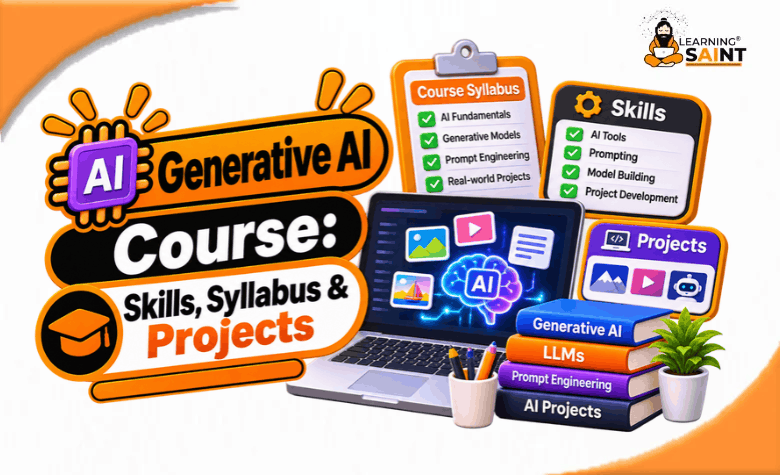
A Generative AI Course teaches you how to create a tool that can easily write, draw, code, and even talk. You might have used a chatbot or image creator already. A worthy Generative AI Course will show you how those tools work and how you can create one of your own. This guide is simple and easy to follow. It will explain the skills that you will develop, the syllabus that you will study, and the projects that you can expect along the way.
What do you understand by Generative AI?
Generative AI is a form of Artificial Intelligence that focuses on creating new things. It is capable of creating text, music, video, and also computer code. It learns from the huge amounts of data sets fed to the system as examples. Then it uses those learnings to create something new whenever you give a prompt.
To remember it easily, think of it as a student who reads a thousand assignments and later writes a new one in a similar style. Generative AI operates in a similar way, but it uses math and computers to work.
The following are the core facts to know about Generative AI:
- Large language models (LLMs): LLMs are responsible for the texts. Various chatbots use them to work with text.
- Diffusion models: The next part is images. The diffusion model creates images.
- Generative adversarial networks (GANs): GANs were introduced by Ian Goodfellow and his team in 2014. They are a class of machine learning frameworks used in unsupervised and semi-supervised learning to make realistic synthetic data.
- Transformers: Transformers were introduced in a research paper named “Attention Is All You Need” in 2017. It is a type of artificial neural network architecture that creates the core foundation of modern Generative AI.
Every Generative AI Course begins with these core ideas and facts. Once you understand them, it is much easier to follow the rest of the information.
To better understand how generative AI differs from conventional artificial intelligence, explore our guide on Generative AI vs Traditional AI, which explains their key differences, working methods, and practical applications.
Why should you take a Generative AI Course?
You can learn a lot of things from online videos and blogs. So, what is the point of joining a Generative AI Course? The core reason for choosing a Generative AI Course is the correct order. You do not have to waste time shifting from one topic to another.
A Generative AI Course also helps you practise writing code, testing ideas, and fixing errors. This is exactly how you grow your skills in real life.
The following are the top advantages of applying a Generative AI Course:
- It helps you learn in a clear order, starting from easy to difficult
- It lets you get your hands on the real tools.
- In the process, you will create projects that you can use in your portfolio to show others.
- When you are following a course, you have the opportunity to ask your doubts to a teacher or a mentor instead of searching for them on the internet.
- It helps you learn safe and fair ways to use AI.
However, you will see many people joining a Generative AI Course to switch jobs or grow in their existing careers. These tools are used all over by writers, designers, marketers, teachers, and developers.
If you are new to this field and want to understand where to begin, check out our guide on How to Learn Generative AI From Scratch. It covers the basic concepts and learning steps to help beginners get started with generative AI.
What are the skills that you will learn in a Generative AI Course?
The most important part of any course is the skill set that it helps you learn. A worthy course will teach you both technical and psychological skills.
The following are all the skills that you will learn in a Generative AI Course:
Technical skills that you will learn:
- Python programming: Python is considered to be the most common and beginner-friendly programming language. It is most widely used for AI work. You can learn how to write simple code and use its libraries.
- Machine learning basics: Machine learning is the study of how computers learn various patterns from the data fed to them as examples.
- Deep learning and neural networks: Neural networks act as the basis of most AI models. It teaches you how layers, weights, and training operate.
- Working with transformers: Transformers act as the basis of modern Generative AI. In this, you will learn how a transformer model reads and writes text.
- Prompt engineering: With prompt engineering, you learn how you can write clear instructions so that AI can provide you with accurate outcomes.
- Fine-tuning: Fine-tuning refers to learning how to train an existing model on your own data so that it can accurately fit your task.
- Retrieval-augmented generation: RAG, or Retrieval-augmented generation, teaches you how to connect a model to your own documents so that it uses real information for answers.
- Working with APIs: 'APIs' refers to the set of rules or protocols that allow different software to communicate and share data with each other. It teaches you how to connect AI models to applications and websites.
- Data handling: Data handling refers to the basic knowledge of cleaning, storing, and preparing data.
Thinking skills that you will learn:
- Problem-solving: The Generative AI Course helps you learn how to divide big tasks into small steps.
- Verifying facts: AI learns from the data that is provided to it, which is why it can make mistakes. These mistakes are usually called hallucinations. A Generative AI Course prepares you to verify the AI responses before trusting them.
- Responsible AI: One of the most important things to know before using any AI is to learn about using it responsibly. You must learn about bias, privacy, and copyright along with learning why humans should review AI work.
- Clear communication: Communicating your thoughts and discoveries clearly is an important part of every job. The Generative AI Course teaches you to communicate what your AI does and what its challenges are.
Before exploring advanced AI concepts, it is important to understand how machine learning and generative AI are connected. Read our guide on Generative AI vs Machine Learning to understand their relationship, differences, and applications.
What is the standard syllabus for the Generative AI Course?
The syllabus is the core plan of the entire Generative AI Course. It includes the basic information about each topic and the order in which you will learn it. However, each course is different. They can have different factors inside.
The following is the standard syllabus that is followed by almost every Generative AI Course:
Module 1: Introduction to Generative AI
The initial step of the Generative AI Course is about learning what generative AI is and where it is used. You will understand the difference between AI, machine learning, and deep learning. You will also go through a short, yet important history, from GANs in 2014 to transformers in 2017 and the public chatbots that followed later on. Most people noticed Generative AI when OpenAI was launched.
Module 2: Python and Data Basics
The next phase of the course is about understanding variables, loops, functions, and some basic tools in Python. There will also be classes about using notebooks, like Jupyter or Google Colab. This module prepares you with the base for the rest of the Generative AI Course.
Module 3: Machine Learning Foundations
Machine learning is the process of teaching computers to learn from data. While learning machine learning foundations, you will learn about training data, testing data, and measuring a model. You will also understand overfitting, which refers to a situation when a model remembers the example instead of the pattern.
Module 4: Deep Learning and Neural Networks
In this module, you are exposed to the world of neural networks. You learn what the meaning of neural networks is and how they train with the help of loss and gradients.
Module 5: Transformers and Large Models
Transformers are the core of a modern Generative AI Course. It teaches you to break a text into tokens and how attention helps a model focus on the right words. You also get to know how to train LLMs.
Module 6: Prompt Engineering
Prompts are the most important part of working with AI. The complete idea of artificial intelligence works over prompts. In prompt engineering, you practise writing prompts for various tasks, like summaries, emails, and code help. Also, you will learn how to test prompts and compare results.
Module 7: Image and multimedia generation
This module is all about images and their generation. It will teach you how diffusion models create images and edit them. However, some courses even teach you about audio and video generation.
Module 8: Fine-Tuning and RAG
Fine-tuning means training a pre-trained model on a precise and small specialised dataset. In this, you will learn when to fine-tune a model and when to use RAG instead.
Module 9: Developing Applications using AI
AI is a useful source only when you know how to use it. In this module, you will learn to call a model through an API. You will be creating an easy chatbot or tool with a framework such as LangChain or with plain Python. You will learn how to launch your application online.
Module 10: Ethics, Safety, and Responsible Usage
This module prepares you with all the knowledge about bias, data privacy, copyright, and safe use. You learn about bias, data privacy, copyright, and safe use.
Module 11: Capstone Project
In the final module, you are supposed to finish the Generative AI Course by creating one larger project from beginning to end.
What are some project ideas for the Generative AI Course?
Projects are the final destination of the Generative AI Course. It is where your entire learning comes to life.
The following are some of the project ideas that can be done using Generative AI:
Beginner’s Projects
- Smart email writer: This project is helpful specifically for the individuals who have most of their work done in the mail. You just need to give AI some facts, and it will generate polite and official mail.
- Text summariser: A text summariser helps you break a long document into short points. You just need to paste a long article, and you will get a short summary out of it.
- Story maker: Story makers mostly help out kids. It just needs a few words, and the tool will automatically create a story for kids from those words.
- Prompt Library: The Prompt Library consists of tested prompts for common tasks.
Mid-level/Intermediate projects
- Document question-and-answer tool: This tool is created to take a PDF and questions from it. This tool operates using RAG.
- Customer support chatbot: You must be aware of what the customer care tools are. This chatbot basically answers the common questions from a help page.
- Image generator application: As the name suggests, this tool takes in a sentence and provides a picture with the help of a diffusion model.
- Code helper: Code helper focuses on helping out with errors. You just need to paste an error message, and you will get a clear explanation.
Advanced Projects
- Fine-tuned model: A fine-tuned model basically means training a small model on your own dataset examples, like small product descriptions.
- Study buddy: 'Study buddy' refers to a tool that can be an all-time partner for students. Create a tool that can analyse class notes and prepare questions for a quiz from them.
- Multi-step assistant: Create an assistant that can search, read, and draft a short report with resources.
Ready to Build Your Career in Generative AI?
Take your AI knowledge to the next level with Learning Saint's Post Graduate Program in Generative AI. Learn Python, LLMs, prompt engineering, RAG, and AI agents through live mentor-led sessions and hands-on projects.
Conclusion:
Taking a Generative AI Course is a sure way to get into one of the most useful areas of technology today. You learn Python, machine learning, neural networks, transformers, prompt engineering, fine-tuning, and RAG. You will also learn how to use AI responsibly and fairly. Above all, you develop projects that show off your ability.
So, remember the 3 steps: learn the basics, build real projects, and always check your work. Pick a Generative AI Course that suits your level, has a clear syllabus, and provides hands-on training. Start small, stay steady, and keep building


Reply To Elen Saspita