 United States
 India
 United Kingdom
 Australia
 Canada
 Nigeria
 Others


 Learning Saint
This world depends on or operates on data today. Every click you make, every purchase you make, and every message that you send add up to a huge pile of information. Companies or brands use this information to make better and smarter decisions. This is why people keep enquiring about the promising future of data science. It is not just some trend that might fade away in some time. It is potentially turning into the backbone of how a business thinks and grows.
In this article, you will look at the path that data science is heading to, how AI (artificial intelligence) contributes to this scenario, and what its significance is in the future roles of data engineering and business analysts. This article will keep all the information simple and readable so that you can easily understand it completely, even if you are new to the topic.
Not only for tech workers, but understanding the future of data science is useful for anyone who needs to figure out the future situation of jobs, tools, and ideas in the coming few years.
You can also read about what data science is in detail here.
What and how is data contributing to this field?
To understand this, imagine data like fuel for a car. If there is no fuel, the car will not move. Similarly, if there is no data fed to the AI systems, even the smartest ones will not work. Today, almost every brand collects data from social media, online stores, sensors, applications, and even more ways.
This huge demand and supply of data has created an urgent requirement for individuals who can understand it accurately and turn it into important, insightful information. This is the point where data science enters. It basically combines statistics, programming, and business sense to solve real-world problems.
Data will never stop growing. With each year, the number of devices to connect to the internet increases, which adds up to new streams of information. This growth is one of the reasons why you will see various experts talking about the future of data science as one of the most important paths of this decade.
What do you understand by Data Science?
Data science is simply the study of data. It uses math, computer science, and subject knowledge to look for and spot patterns. These patterns help companies predict what might happen next in their market niche. For example, a commercial store can use data science to predict the products that will sell more during the coming winter season.
AI and machine learning are the tools that data scientists generally use to make these forecasts better and faster. Instead of an individual checking every single data point, a machine learning model is capable of scanning millions of records in a few seconds.
This is the reason that data is usually called a combination of lots of subjects. This is why data science is often called a mix of many subjects. A good scientist is required to understand numbers, write code, and demonstrate the results in simple language so that the employees coming from a non-tech background can act on them too.
You can also read about the top 10 benefits of data science in detail here.
What are the future key trends to watch in data science?
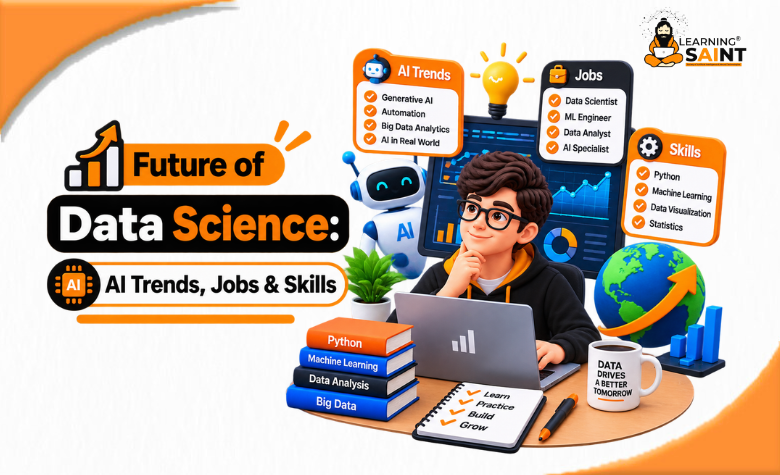
The future of data science is prominently bright, but it is also changing significantly. The following are some of the core future trends in data science:
- Better and more automation: The repetitive jobs, such as cleaning messy data, will be handled by AI tools in the future. This will help data scientists to focus on solving bigger problems by freeing up a lot of their time.
- Rising Generative AI: Even if you look around you, you will see the increasing popularity of tools that can write text, create images, or generate code. Data scientists will be required to understand how to create and handle these tools responsibly.
- Increasing focus on ethics and fairness: In the coming time, AI will be responsible for most of the decisions. People want to know if these decisions are fair or not. Brands are supposed to hire more experts to check models for any prominent signs of bias.
- Real-time data processing: Businesses no longer want to wait for days to get their reports. They ask for immediate answers. This ultimately pushes the need for faster data systems.
- Smaller yet specialised models: The original idea was to create a single giant AI model that performs everything, but in the near future, you will see that companies will create smaller models trained for every specific task. These operate at a cheaper rate and at a faster speed.
- Rapid growth in edge computing: In the near future, you will see that the data is being processed a lot closer to its original creation, such as a phone or a factory sensor, rather than sending all the data stuff to a distant server.
These trends depict that the future of data science does not focus on replacing people. Instead, it is focused on giving people better tools to perform their jobs faster and more accurately.
This will also help you remember that trends are supposed to change quickly in this field. This is the reason that professionals who are working with or are responsible for the future of data science are required to continue learning throughout their careers.
In what aspects is AI changing this data-driven world?
AI and data science are no longer two separate entities. They are both deeply connected to each other. AI models operate on what they learn from the data fed to them, and that data is prepared by the data scientists. If the data is not clean and well-organised, even the best AI model will end up giving poor results. This process is generally shortened to an easy rule: bad data in, bad results out.
The following are the industries that use AI for daily life and work:
- Medical or healthcare: Healthcare is a field that is rapidly using AI in its daily activities. AI helps doctors in spotting diseases at an early stage by simply studying scans and patient records.
- Finance or Banks: It might seem unlikely, but even the finance sector uses AI. AI helps in catching fraudulent activities or individuals by spotting strange expenses or spending patterns.
- Retail: While visiting E-commerce stores, you must have noticed that they suggest you products based on your needs and the ones that you have searched for or bought earlier.
- Transport: You must be wondering, what does AI have to do with transportation, right? Well, self-driving cars and traffic systems use AI to make roadways safer.
- Farming or agriculture: The weirdest of all the sectors using AI is the agriculture sector using AI. The farmers use AI and sensors in order to check the soil health and forecast rainfall.
The above explanation simply shows that AI is used in almost every part of life. This is the reason why understanding the future of data science is required in so many industries, and not only in tech-based companies.
Even if you look at a small-scale business, you will see that they are using AI-powered tools for simple and easy tasks, like organising emails or answering repeated or common customer questions. This will make you realise that the future of data science is not limited to companies with huge corporate scale and big budgets.
What is the future of data engineering?
You know that data needs to be organised before being used for the final procedure. But the data does not organise itself. Someone is required to build the pipes and systems that move data from one place to another, clean it, and store it securely. This job is called data engineering, and thinking about the future of data engineering is the reason why it is as important as data science itself.
The following are some of the core areas that the future of data engineering will focus on:
- Cloud-first system: With the passing of time, more and more companies are moving their data storage and processing to the cloud instead of maintaining physical servers.
- Improved data pipelines: Engineers are working hard and will be able to build systems that move data smoothly and quickly, even if it is coming from various sources.
- Data quality checks: Most companies are currently dependent on AI, which is why they need reassurance about their data. Engineers are planning and will be building various systems that will create automatic checks to catch errors early.
- Streaming on the data: This basically means that instead of updating data once a day, many systems will keep updating it second by second.
If there is weak or no data engineering, data science will not be able to make a successful impact. A data scientist might have powerful ideas, but if the underlying data is messed up or slow to access, those ideas will not have the possibility of turning into real results. This is the reason why you will hear many experts say that the future of data engineering is the silent hero that works quietly behind every good AI model.
Imagine data engineers as the people who build roads before the vehicles finally drive on them. If the roads are not well-built, even the fastest cars would fail to drive smoothly. Similarly, without solid data pipelines, even the smartest AI models will have nothing useful to learn from. Since more companies depend on AI, the demand for skilled data engineers is supposed to increase alongside data scientists.
What is the future of the data analyst role?
Anyone who is working in this field is not supposed to build AI models. Many people also perform the job of a data analyst, and their role is also significantly shifting. A data analyst looks at the data and explains what it means in simple and understandable language. It generally uses charts and reports.
The following is the possible future of data analyst work:
- More storytelling using data: Analysts are not solely responsible for showing numbers. They are also required to explain the story behind the chosen numbers, or driven numbers, so that even the non-technical teams are able to understand it.
- AI-assisted tools: Various analysts will also use AI tools to draft queries or create charts faster, which will ultimately cut the time spent on manual work.
- Closer work with business teams: Analysts will be spending more time discussing with the marketing, sales, and other teams in order to understand what questions require answers.
- Basic programming or coding skills: Where there is no requirement for deep coding, understanding simple scripting will help analysts work faster with huge datasets.
This signifies that the future of data analyst roles is changing from just reporting with numbers to becoming a bridge between data and decision-making.
You can also read about top data science tools in detail here.
Conclusion
How people and businesses use data every day will determine the future of data science. AI is not a replacement for human thought. It helps people work faster and smarter. The future of data engineering will also be about enabling data to flow freely and securely, and the future of data analyst roles will be more about simple communication and storytelling.
Together, these three disciplines form the backbone of the data-driven world. The companies that invest in strong data systems, talented people, and responsible AI usage are the ones that will grow steadily over the coming years. It’s a good time for people to learn more about data, as the field is set for continued growth. “The answer is not to test every new tool but to have a deep understanding of data, to use AI wisely and to always put people at the heart of all decisions.


Reply To Elen Saspita