 United States
 India
India United Kingdom
 Australia
 Canada
 Nigeria
 Others


 Learning Saint
In the current scenario, every business uses computers, phones, and the internet. This makes operations easier, but it also makes it easier for hackers and digital criminals. This is the reason that every company, be it small or big, requires a cybersecurity strategy. This article will help you understand what a cybersecurity strategy is, why it is important, and how you can develop a strategy step by step.
By the end of this article, you will understand how a cybersecurity strategy works and how a strategist is capable of helping you build something that actually secures your business.
You can also read about what is cybersecurity in detail here.
What do you understand by a cybersecurity strategy?
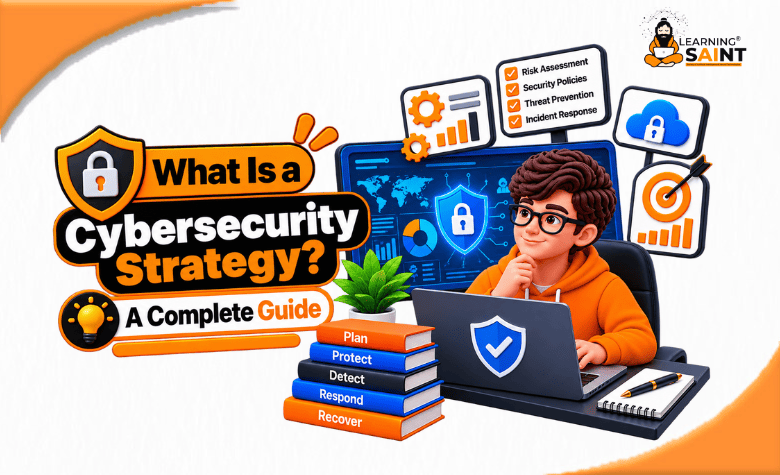
A cybersecurity strategy is basically a plan or a blueprint that helps a brand or business to secure its computers, networks, and data from attacks. It is not just a tool or a single rule. Instead, it is a complete plan that covers people, tools, and steps to keep information safe.
To understand it better, imagine a cybersecurity strategy similar to a plan for a house. While leaving your house, you lock the door, set an alarm, and make sure to inform your family about the possible consequences along with safety measures. This plan makes sure that your house is safe even when you are not physically present there. A cybersecurity strategy does the same thing, but for the brand’s digital world.
A good cybersecurity strategy basically focuses on the following things:
- What needs protection from attacks, such as data, systems, and devices?
- What are the threats most common in the current situation, such as hackers, viruses, and scams?
- What should be your plan of action before, during, and after a certain attack?
If a business were to operate without a clear cybersecurity strategy, it would be like a house without any locks. Anyone can simply walk in and steal what they want.
However, cybersecurity is not similar to cybersecurity policies. They do work together, but they are not similar. Cybersecurity policies are the rules and regulations drafted inside the plan, whereas the broader strategy is the bigger picture that ultimately ties up the rules, tools, and people together into a single working system.
Why does every business require a cybersecurity strategy?
Cyberattacks tend to occur on a daily basis. They happen all over the world. Cyberattacks happen every day, all over the world. Businesses operating on a small scale are usually the easiest and the biggest targets for attackers. This is because they have comparatively weaker security or protection than businesses operating on a large scale. A strong cybersecurity strategy makes sure that the business remains protected and secure.
The following are the main factors that are protected by a well-thought-out and curated cybersecurity strategy:
- Money: A cyberattack mostly occurs because of money. Attackers are mostly after money in return for the stolen data, which is why a cyberattack can cost a business a lot of money.
- Trust: Every business is collecting data from its consumers, and even the consumers know that. They want to be sure that their data is safe and not prone to cyberattacks. If the company ends up losing its consumers’ data, they ultimately lose people’s trust in them. Customers want to know their data is safe. If a company loses customer data, people stop trusting it.
- Brand Longevity: Cybersecurity strategies do not guarantee 100% prevention of a cyberattack, but they definitely make sure that your business gets back on track fast instead of losing its worth forever.
Many countries and their Governments also ask businesses to follow certain rules and regulations in order to protect their data, and having a cybersecurity strategy helps a company to follow these rules and regulations while avoiding fines.
What are the benefits of having a cybersecurity strategy?
A well-curated cybersecurity strategy offers you a lot more than just security from hackers. It also gives peace of mind to the business. It allows the heads and employees to focus on their work instead of being concerned about the consequences.
The following are some of the most prominent benefits of having a strong cybersecurity strategy:
- It reduces the chances of a company losing money in cyber fraud or theft.
- It develops trust between customers and partners.
- It supports the business in following the important legal and industry rules.
- It lowers downtime in case anything goes wrong, ultimately wrong.
- It provides employees with clear steps to follow in case of consequences.
To make a cybersecurity strategy effective, it is important that you take small steps at an early stage. It will help you take precautions instead of making things right after the attack has been done.
What are the core parts of a cybersecurity strategy?
A complete cybersecurity strategy is built with a combination of various parts operating together.
The following are the main parts when creating a cybersecurity strategy:
1. Risk Assessment
The very first step in any cybersecurity strategy is assessing the risk. It refers to identifying the consequences of being attacked by cybercriminals. While assessing the potential risks, a business must ask: What data do we currently have? Where is all that data stored? Who has access to all that data? What would happen if it were stolen or lost?
2. Cybersecurity policies
A cybersecurity strategy needs clear rules to operate smoothly. These rules are known as cybersecurity policies. These policies inform employees about what they can and cannot do with the company’s data and devices.
For example, the following are some of the most common grounds for cybersecurity policies:
- Employees must put strong passcodes on their respective systems.
- Employees are not allowed to share their work files on personal email IDs.
- Employees must leave their respective desks only after locking their computers.
- Employees can only use applications approved by the organisation on the office devices.
3. Controlling accessibility
In a company, not every employee or staff member is required to access every piece of data of the company. A well-curated cybersecurity strategy makes sure that employees know their accessibility limits based on their job role. For example, an employee working in the marketing team is not required to access data about financial payrolls.
This helps reduce the impact of an attack, in case it occurs. If one account is hacked, the damage still stays small.
4. Training employees
Human capital is one of the easiest and most popular targets for attackers. They are usually the weakest link in security. Whatever plan you may introduce in your business, your employees must be aware of it. They should get regular training about it.
5. Backing up and recovering data
As mentioned before, cybersecurity strategies do not guarantee 100% prevention from cyberattacks. This is why backup is important. Standard backup means that if you have lost the data or it is locked by ransomware, the business can still restore it without having to pay the attacker in return for the data. But backups must be stored somewhere away from the main network so that a single cyberattack cannot reach and damage the backup too.
6. Attack response plan
Now, imagine the attack just happened, and you only informed your staff about the prevention and not about how to respond if the attack happens anyway. Your staff will mess it up, right? This is why you must inform your staff of the answers to questions like: Who do they contact first? How can they stop the attack from causing further damage? How should they inform the customers if their data has been affected?
How can you create a strong cybersecurity strategy?
The most important thing about building a cybersecurity strategy is that it does not have to be confusing.
The following are the simple steps that you can take while creating a cybersecurity strategy for your business:
- Make a list of all assets you need: First of all, list all the required assets, such as every device, system, and type of data your business uses.
- Identify your risks: In the next step, you must know what you are creating a strategy for. This means you should know the weak spots of your company that hackers can easily target.
- Maintain clear goals: Imagine you are creating a strategy to protect your company, and you are confused about the end intent of your business. There is no point in creating a strategy, right? This is why you should have a picture of a safe business in your mind with no confusion around it.
- Draft your cybersecurity policies: While writing down the cybersecurity policies for your company, make sure to put simple rules that your staff can easily follow.
- Pick the appropriate tools: The right tools include firewalls, antivirus software, and password managers that can help your cybersecurity strategy perform effectively.
- Provide appropriate training to the team: Creating a cybersecurity strategy is not enough. You must train your staff about how to use it and avoid common attacks.
- Perform proper testing of your cybersecurity strategy: Whatever you create or plan on paper or on your computer screen must come alive and be tested in real situations. You must run drills to check how your cyber team reacts and responds to a fake attack.
- Review and improve your performance: Most companies make their cybersecurity strategy once and forget about it. This is not right. A business must update its cybersecurity strategy often, as there are new attacks being introduced every year.
If a business follows these steps, it basically turns an ambiguous idea into a real and practical cybersecurity strategy that is capable of protecting your complete business. Also, you must draft your cybersecurity strategies in one place so that it becomes easy to share them with the rest of the staff, partners, or auditors who need to understand how the business stays safe.
What is the role of a cybersecurity strategist?
By now, you must have understood everything about a cybersecurity strategy. But another important thing is: what is the role of a cybersecurity strategist? Many companies hire a cybersecurity strategist to help them create, organise, and handle their plans. They are trained experts who have appropriate knowledge of both technology and cybersecurity.
A cybersecurity strategist does a lot more than just install software. This person studies the business to its core, identifies the possible risks in it, and curates a well-thought-out plan that does not exceed the budget and the size of the business. They are also responsible for keeping up with new attacks in the market to stay one step ahead of the attackers.
Businesses hire these kinds of experts so that they do not have to learn about every kind of cyberattack themselves, instead investing time in business policies and partnerships. A skilled and talented professional uses their years of knowledge and experience to identify the threats that other individuals often miss before they actually harm the business.
A cybersecurity strategist generally begins their journey by asking a simple question: What is the most important thing that the business is dependent on? What would be the worst situation if it were lost or stolen? The answers to these questions help them build a cybersecurity strategy along with testing it with real-life situations.
You can also read about types of cybersecurity attacks in detail here.
Build Your Cybersecurity Skills with Learning Saint
Understanding cybersecurity strategies is an important step toward protecting digital assets and managing security risks. Take your knowledge further with Learning Saint's PGP in Cyber Security, designed to help learners develop practical cybersecurity skills through expert-led training, real-world projects, and industry-relevant concepts.
Explore the program and take the next step toward developing your cybersecurity expertise.
Explore the PGP in Cyber Security Program
Conclusion:
A cybersecurity strategy is not just a technical paper. It is an all-encompassing plan to protect the money, data, and reputation of a business. That includes risk assessment, clear cybersecurity policies, staff training, backups, monitoring, and a plan for when things go wrong. Building it yourself or hiring a cybersecurity strategist, having a strong cybersecurity strategy is one of the smartest choices any business can make today. The digital world will continue to change, but a clear, well-tested cybersecurity strategy will keep a business prepared for whatever comes next.


Reply To Elen Saspita