 United States
 India
 United Kingdom
 Australia
 Canada
 Nigeria
 Others


 Learning Saint
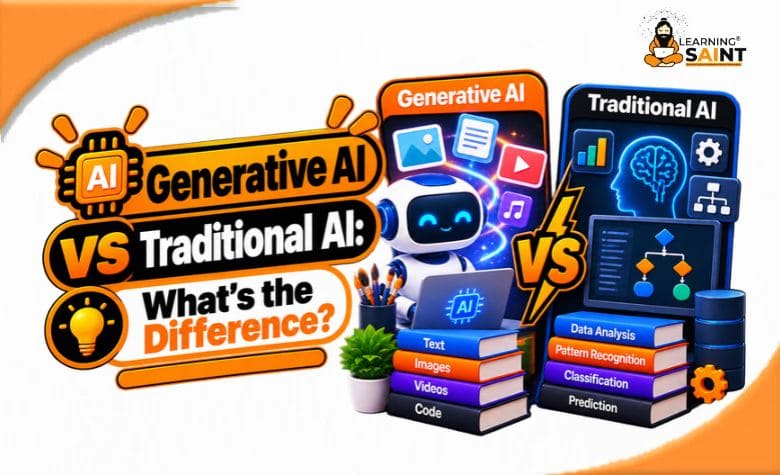
Artificial Intelligence has become a part of everyone’s daily life today. It helps people to shop online, converse with the chatbots, and even draft important emails. However, all sorts of AI do not work similarly. You must have come across the 2 terms: Generative AI and Traditional AI. If you are someone who does not know what they mean, you are in the right place. This article will break down the complete discussion of Generative AI vs Traditional AI in easy and understandable language.
By the time you reach the end of this article, you will understand how each type of AI works, the core differences between them, and their basic pros and cons.
What do you understand by Traditional AI?
Traditional AI is the older and more popular form of Artificial Intelligence. It is created to perform a single job very well. The responsibility of a traditional AI can include organising emails, detecting fraud, suggesting a movie, or even predicting the weather.
Traditional AI operates by following the rules or identifying patterns in data. It looks at past information and makes a decision or a prediction on the basis of that. For example, a traditional AI system in a bank can easily read, study, and analyse years of transaction records. In the next step, it identifies the transactions that look unusual and flags them. This procedure is known as predictive AI, as it basically predicts the results based on the patterns that it has already seen and learnt from.
Traditional AI does not provide you with anything newly created by itself. It will not write a brand new story or draw a new image. Instead, it can identify, organise, estimate, and suggest. Consider traditional AI as a smart assistant that can follow instructions and learns from the examples fed to it. Traditional AI always stays within a fixed task.
The following are some of the most common characteristics of Traditional AI:
- Traditional AI is created in a way that it can only perform a single, narrow task.
- The results or predictions in traditional AI are dependent on the labelled data and clear rules.
- The most common outputs in Traditional AI are scores, labels, or predictions
- There is no feature in traditional AI to create new content.
- Traditional AI is dependent on human experts to feed it the rules or features that it should learn from.
Traditional AI has been there in use for decades. Some examples of Traditional AI are spam filters, credit score systems, and voice-activated assistants that follow certain fixed commands. Most machine learning models being used today, such as the ones that forecast sales or identify faulty products, are also considered traditional AI only.
What do you understand by Generative AI?
Generative AI is a newer and different kind of artificial intelligence. It performs a lot more than just estimating or organising. It can easily create brand-new content. It can create text, images, music, computer code, or even videos.
Generative AI learns from huge amounts of data, like books, articles, and pictures. During its training, it identifies the patterns in the language, colour, sound, or structure. Once the training is completed, it is completely capable of producing something new that was not even present in its training in the form it is required to be created.
For example, A Generative AI tool can easily write a poem for you about any object, person, or feeling in just a second.
Tools like ChatGPT, Google Gemini, and image generators such as Midjourney are some of the most popular tools that come under Generative AI. These tools use a technology known as “Deep Learning”, which is developed on structures called neural networks. A transformer (a huge and powerful type of neural network) helps these systems to understand context and produce text that resembles human writing. The following are the main characteristics of Generative AI:
- Generative AI can easily create new content in just a few seconds, instead of only analysing existing content.
- It uses huge and diverse datasets to train itself.
- It is created with the capability of handling various tasks at a moment's notice, instead of focusing on a single one.
- It usually responds to easy and clear instructions known as prompts.
- It might sound or seem creative to you since it is a mixture of different patterns in new ways.
What is the core of Traditional AI vs Generative AI?
By now, you must have understood what 'traditional AI' and 'generative AI' mean individually. It is now time to understand the differences between them.
The following are the differences between Traditional AI and Generative AI:
|
Factors |
Traditional AI |
Generative AI |
|
Objective |
Traditional AI is created to solve a single problem at a time. For example, a fraud detection system only detects fraud, and a movie recommendation system only recommends movies. |
Generative AI, however, is created to generate new content across various sorts of tasks, from drafting essays to generating and designing logos. |
|
Type of output |
Traditional AI generally gives you a numeric value, a label, or a choice. For example, “This email is spam” or ”This customer might cancel their subscription." |
Generative AI, on the other hand, generates new content, such as a complete paragraph, an image, or a piece of software code. |
|
Data training procedure |
Traditional AI is usually trained on smaller and well-sorted datasets that are created for a specific task. |
Whereas generative AI requires a huge amount of different datasets that are generally pulled from millions of documents, images, or audio files so that it can learn wide patterns in human language and creativity. |
|
Flexibility |
Traditional AI is a narrow technology. It stays inside the fixed job given to it by an individual. It needs to be trained from scratch to step out of its designed job. |
Generative AI is way more flexible. It can easily write an email along with summarising reports and even drafting answers. It can perform it all without creating a new command for it. |
|
Behaving like a human |
Traditional AI has a mechanical feel in its operation. It will give you results on the basis of rules and numbers. |
Generative AI has a more human-like feel, as it focuses on reciprocating the style, tone, and structure of the data that was used for its training. It can easily hold a conversation and also write in a certain voice. |
|
Creative Authority |
Traditional AI does not create new content. It does not have a creative aspect. It only estimates, organises, and calculates. |
Generative AI creates new ideas. It uses high creative authority to generate ideas, sentences, or designs that did not exist before in the same form. |
What are the pros and cons of Traditional AI?
|
Pros |
Cons |
|
Traditional AI is based on a simple technique, which is why it is easy to understand and explain. |
It works on the rules given to it and cannot handle tasks that are outside its training. |
|
It can be trained on a very small amount of data and computing power. |
It requires to be redeveloped or retrained for tasks outside its training. |
|
It performs generally quite accurately on its specific task. |
It is not capable of generating new content. |
|
It does not require huge development and operating investment. It can be created and run on a cheaper budget. |
It can face complications with unorganised and unlabelled data. |
What are the pros and cons of Generative AI?
|
Pros |
Cons |
|
Generative AI can easily handle various types of tasks with a single model. |
Needs large amounts of data and computing power. |
|
It can produce content like drafts, designs, or code in very little time. |
It might end up producing inaccurate or made-up information. |
|
It is created with a feature that adapts the tone and style of the required task to match it. |
It is quite difficult to explain to the other person why it gives a certain answer. |
|
It is quite useful and important in various industries, starting from marketing to software development. |
It can create questions about original ownership and copyright. |
Conclusion:
The debate between generative AI and traditional AI is not about which one is better. It’s about which one gets the job done. Traditional AI is a blunt instrument. It is trained to analyse a set of patterns and to make accurate predictions in one specific domain. Generative AI is a creative tool that can produce new content, like text, images, and code, based on patterns it learns from large datasets.
Both types of AI are useful, and both are changing the way we work, communicate, and problem-solve. When people look for Generative AI vs traditional AI, they want a quick answer. Use the right tool for the job, not the coolest-sounding tool. This information can help you select the right tool, act responsibly when using AI, and set realistic expectations about the tech you interact with daily. With AI continuing to evolve, many of the tools will probably take a hybrid approach, using traditional AI for accuracy and generative AI for creation.


Reply To Elen Saspita