 United States
 India
India United Kingdom
 Australia
 Canada
 Nigeria
 Others


 Learning Saint
Have you ever explored your career options in technology? Going through all the possible career options, you must have heard about the term “full stack” several times. It comes up when you are listing possible job opportunities, when you are scrolling through coding bootcamp ads, and even in online courses. But have you ever wondered what Full Stack Development means?
This article will be your guide in this journey of understanding Full Stack Development completely. It will cover all the factors that Full Stack Development involves, the skills it requires, and the steps for you if you want to become a full stack developer yourself. This article will cover all these topics in simple and readable language.
Many people enter tech fields for the first time, and they end up feeling unsure if they need to specialise narrowly or learn broadly across various areas. When you are trying to understand this career option completely, you must go through its benefits and the real challenges that it offers. It helps you in deciding if the choice you are making actually suits you or not.
What do you mean by Full Stack Development?
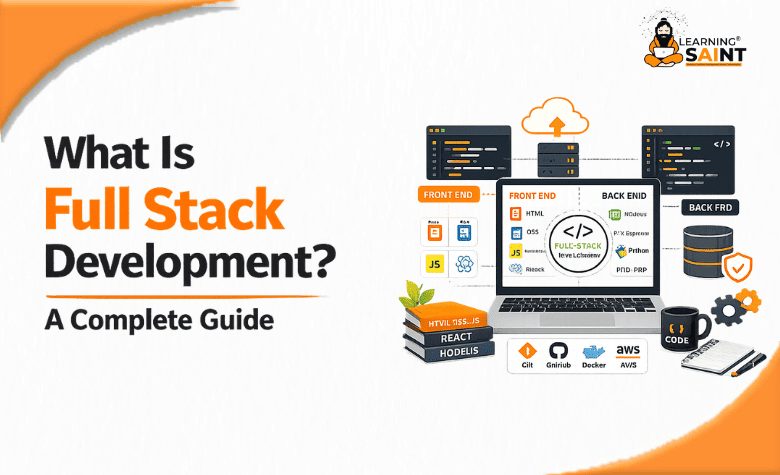
Full Stack Development refers to building both the parts of a website or an application that the users will see and interact with and the parts that will be performing behind the scenes to make everything possible. To simplify, Full Stack Development covers the complete “stack”, or layered set of technologies, required to build an entire, working product.
To make it even easier for you, imagine there is a restaurant. The dining area represents the front end where the customers can see and interact with each other directly. It includes the menu, the tables, and the overall atmosphere. Whereas the kitchen acts like the backend, where the real work happens. Whatever the customers eat in the restaurant is cooked in the kitchen. In the same way, what users see or interact with on the front end is made, functions or performed in the backend. A full stack developer has the calibre to work in both spaces instead of specialising in just one.
This idea of a full stack developer working with both modes does not mean that they are equally expert in each technology available. This means that they have enough understanding and knowledge about each layer of the system to create an entire working application all by themselves and to make effective communication with specialists when a certain project demands a bigger team.
What do you understand by Front-End and Back-End?
If you really want to know about Full Stack Development, you must break down the concept of backend and frontend development. The following is an elaborated brief about Front-End and Back-End development:
Front-End Development
The front-end, also known as the client-side, is all the stuff that the user directly sees and interacts with in their browser. This stuff involves layout, buttons, colours, and how smoothly the page operates in response to queries, like a click or scrolling.
The following are some of the most popular frontend technologies:
- HTML – A website needs structure within all the factors it has to present. HTML organises the content. It provides structure to the content visible on a webpage.
- CSS – Imagine you enter a website and all the text is mixed up. There is no spacing, no layout and no colour pattern. It will look messed up, right? CSS ensures that your website is mess-free. It controls how your content looks. It includes controlling colours, spacing, and layout.
- JavaScript – A big page of text looks boring. A viewer will never stick to your page if all you can offer is text on your webpage. JavaScript helps you out here. It adds interactivity, like animations, form validation, and dynamic content updates.
- Frameworks like React, Vue, or Angular – Technology changes daily. New updates are coming up faster than you believe. These frameworks were created to help developers to build complicated and interactive interfaces more efficiently.
Back-End Development
The back end, or server-side, is responsible for controlling the logic, data, and processes that take place behind your eyes. Handling logic and data means managing databases, processing user queries, and making sure that the information moves securely between the server and the user’s browser.
The following are the most common backend technologies:
- Node.js – The most basic thing behind a webpage is the code used to create it. Node.js is an open-source software that allows developers to create servers, web apps, command-line tools, and scripts.
- Python (Django or Flask) – The entire idea behind the backend is handling the logic and data processing. Python is a programming language that is widely used for back-end logic and data processing.
- Databases such as MySQL, PostgreSQL, or MongoDB – Imagine you provided the whole code to the backend, but it stored nothing in them. How will you make it work? This is why these databases were created to store and organise the application data.
- APIs – Imagine 2 teams are working together on a project. They are working on their individual duties, but they are not communicating with each other. You know the ending, right? The project will be a mess. In the same way, if the backend and frontend keep working on their individual responsibilities and do not communicate with each other, the webpage will end up being a mess. This is why APIs allow the front-end and back-end to communicate with each other effectively.
A skilled and talented full-stack developer has an understanding of how these 2 sides connect with each other. Knowing about this helps the developer to create complete applications instead of just a single isolated piece of the puzzle.
What are the advantages of Full Stack Development?
Every day, millions of people are searching about Full Stack Development; there must be a reason that so many people are choosing it. There are several reasons that every company or industry, even the smaller ones and startups, is seeking talented and skilled full stack developers.
- Efficient cost performance – Developing an app means a whole bunch of teams working together to make it perform better than anyone in the market. Companies prefer hiring 1 skilled generalist instead of hiring different frontend and backend specialists.
- Quicker development – There is no requirement of having a specific team of developers to create an application. A skilled developer who has appropriate knowledge about the entire system is fully capable of moving between tasks without waiting on a separate team.
- Flexibility – Flexibility is one of the most popular reasons for everyone choosing Full Stack Development. Full stack developers can easily adapt to various project requirements since they do not have limitations to being stuck to one particular layer of application.
- Firm career demand – There are thousands of companies or industries looking for full stack developers. Their search for a skilled full stack developer remains consistently high, which shows the interest of various employers in the field.
What are the core skills required in Full Stack Development?
Full Stack Development is a technical job which ultimately requires knowing individual languages. Beyond that, even more skills are needed to call yourself a skilled full stack developer. The following are some core skills needed in Full Stack Development:
- Version control (Git and GitHub) – A full stack developer must know how to reach out to other developers. Git and GitHub track changes in code and help other developers.
- Standard database designs – An individual must know how to organise data accurately. To be a skilled full stack developer, you must be able to structure and query data efficiently.
- API development and integration – When you build an application, you aim to make it available to the outside world. API development and integration help you connect various parts of your application to external services.
- Responsive design principles – Everyone in this world has different devices. Not all of them come in the same size. A full stack developer must ensure that the website is responsive. This means that the website works the same across different devices and screen sizes.
- Standard deployment knowledge – After you have created the application and you are done with every important factor. How will it be made live for the audience to use it? A full-stack developer must understand how to deploy an application and make it accessible to the users. It is usually performed using platforms like AWS, Google Cloud, or Azure.
You will require time to ace these fields. Mastering them will take you longer than you expect, but they are the practical reasons behind almost every successful project in this area. Apart from all the technical requirements, the core soft skills are equally important for beginners to grab a good career opportunity. Skills like clear communication, the critical ability to break things down, managing steps, and comfort in asking for assistance when you are stuck on a certain task, especially when you are working with a larger team, are very essential to being known as a skilled full stack developer.
You can also read about top Full Stack Development courses in detail here.
How do you become a full stack developer?
By now you have read about all the important factors in the journey of learning Full Stack Development, but that is not enough. The main idea behind this is to become a full stack developer. The following are the steps to become a full stack developer:
- Initiate with the standard topics – Everything starts with the basics. When you are starting your journey in Full Stack Development, you must start with the basics like HTML, CSS, and JavaScript thoroughly before you move forward.
- Choose one front-end framework – Full Stack Development is a combination of front-end and back-end frameworks. You must choose at least one front-end framework. React is currently the most widely used option, but you can also go for Vue and Angular.
- Understand and practise a back-end language – Along with front-end stuff, back-end languages are equally important. Node.js is the most natural next step for developers working with JavaScript, whereas Python can also work as another popular and beginner-friendly option.
- Learn about databases – Databases are the most basic factor in the Full Stack Development. To enhance your skills and polish yourself as a full stack developer, you must practise both relational databases like PostgreSQL and non-relational options like MongoDB.
- Work on real-life projects – Real and practical projects will give you more authentic experience in the field. To gain real experience, you must build small and complete applications that have an accurate blend of frontend and backend work instead of some individual tutorials.
- Work on standard deployment – Creating an application is not the only job of a full stack developer. They must know how to make it live for the audience. Learning about deploying code is really important for a full stack developer. You must practise putting a project online with the help of a cloud platform so that you understand the complete process from beginning to end.
Conclusion
Full Stack Development is a super versatile and useful career for anyone who wants to create fully functional web applications from scratch. You’ll have the entire skill set that employers are looking for nowadays by learning both front-end and back-end technologies and by consistently practising with real, hands-on projects.
If you want to work in a growing startup, go freelance, or eventually specialise further within a bigger company, taking the time to learn full stack development well gives you a solid, flexible foundation for a long-term career in technology.
There is no 'right way' to get into this field. Some learners do a structured bootcamp, some learn on their own with free resources, and many do some of each over time. The main thing is to do something practical every day, to be really curious about how everything works and connects together, and to keep making real stuff even when it all feels like it's taking forever. That consistent effort can make a rewarding, flexible career in full-stack development a reachable goal for committed learners.
You can also read about how to become a full stack developer in 2026 in detail here.


Reply To Elen Saspita