 United States
 India
India United Kingdom
 Australia
 Canada
 Nigeria
 Others


 Learning Saint
Introduction to the MERN Stack Ecosystem
Have you ever noticed the art of handling millions of users smoothly on popular websites? Did you ever think about how these websites do this without crashing? Creating a modern website needs lots of moving parts that must know how to speak to each other in perfect synchrony. Previously, the computer developers were required to learn four or five types of computer languages only to build one web application. This is why learning how to write software became very slow and complicated for new users. But fortunately, things have become better now. Today, you can create high-quality websites structured well by using just one language.
The most common and popular way used to create web applications using only JavaScript is by using the MERN stack. The MERN stack is a collection of four effective software technologies that coordinate perfectly with each other. When you start learning these tools, you also open the door to an amazing career path. All the tech brands, creative organisations, and e-commerce businesses require employees who have the ability to manage these systems. The employees with knowledge about the MERN stack are highly in demand. This is why you must follow a clear MERN stack Developer Roadmap to secure your career with the best choice.
What is the MERN Stack?
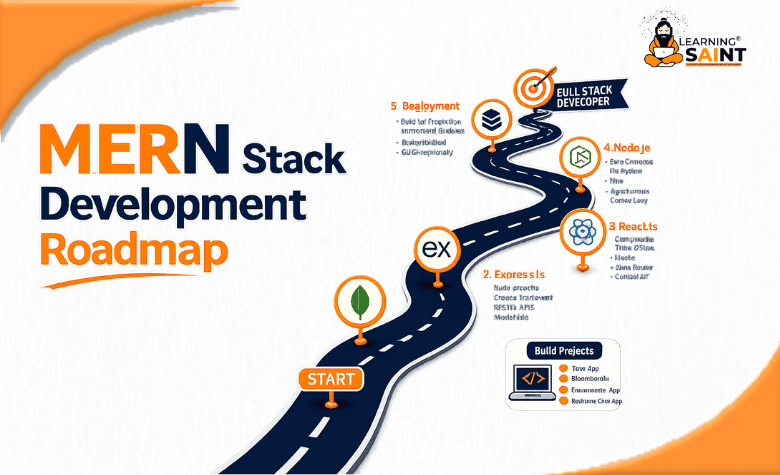
Before we lean into cramming the steps of the MERN Stack Developer Roadmap, it is important to understand what MERN is. The name, MERN, is an expression that is made using the first letters of the four core technologies that create the stack. Every piece consists of a particular job to complete. Such as taking care of either the database, the server logic, or the visual interface that you see on screens. Combined, they consist of everything a modern web application needs to operate properly.
The following are the four parts of the stack and how they work in real life:
- MongoDB: MongoDB is the memory and database of your application
- Express.js: Express.js is a lightweight and minimalist framework situated on top of Node.js.
- React.js: React.js is the visual handler of the stack. It is created and maintained by meta.
- Node.js: Node.js is the foundational engine that helps full-stack JavaScript become possible and operate successfully.
Also Read: Full Stack Developer Roadmap
Step 1: Acing Web Foundations and JavaScript
If you want a great building, you will need a strong foundation. An outstanding foundation will help your building withstand the storms. The same rule applies to full-stack web development. Before learning any big frameworks or complicated databases, you must learn how to master the basic building blocks of the web. If you skip these basics, it will lead you to confusion and frustration in the future of your journey. These are steps in the MERN Stack Developer Roadmap that you must follow.
HTML5 and CSS3 Essentials
The first thing that you must do is learn to put your web page into structure and style. Consider HTML5 as the wooden skeleton of the house. It guides the browser where to place the text, heading, images, and buttons. Whereas CSS3 acts like the paint, the wallpaper, and the furniture. Colours, fonts, outlines, and layout are a precious part of creating a website, and CSS3 helps add them to your website. Your website must be responsive on laptops, desktops, smartphones, and tablets.
The following are the key layout concepts that you must focus on if you want your styling to work faster:
- Flexbox: It is a one-dimensional system that allows you to align items in a straight row or column easily.
- CSS Grid: It is a two-dimensional grid system that helps you create a strategic web layout with the combined work of rows and columns.
- Media Queries: They are special rules that change the style of your website automatically on the basis of the user’s screen size.
- Tailwind CSS: It is an extremely common and popular utility-first CSS framework that helps you style your web page quickly by writing simple classes directly into your HTML code.
Also Read: How to Become a Python Developer
Understand more about JavaScript (ES6+)
Now, you have created the style for your webpage. You must learn to make them come alive. JavaScript is the muscle that adds movement and logic to your webpage. Becoming a full-stack developer comes with another responsibility of understanding JavaScript to its core. All the tools in the MERN stack depend on JavaScript, which is why it is even more important to understand.
You must practise the following JavaScript topics every day:
- Variables and Functions: It will help you understand how to store information using “let” or “const” and how to create reusable code blocks with arrow functions.
- Array Methods: It will help you master tools like .map(), .filter(), and .reduce() to decode and arrange lists of data easily.
- Asynchronous Programming: It will help you learn the practical use of async/await and promises. It helps your website load data in the background without freezing the screen.
- Fetch API: It will help you find out how to request information from an external web link and show it safely on your page.
Also Read: Java Full Stack Developer Roadmap
Step 2: Acing the Frontend with React.js
Now, you must have completely and strongly understood JavaScript. It is time for you to move on to the third layer of the stack. React.js is currently the ultimate standard for creating modern user experiences. It changes the way you consider web design by allowing us to break a large webpage into small and manageable pieces called components.
Becoming an expert frontend engineer has various factors. The MERN Stack Developer Roadmap proposes you learn how to handle data as it passes the UI components.
When you are studying React.js, you must invest yourself in mastering the following important features:
- Components and Props: This refers to learning to write independent blocks of code and to safely provide information from a parent component to a child component.
- State Management: It refers to using the useState hook to remember user actions, track products in a shopping cart, or capture any text typed into a form.
- Side Effects: It refers to mastering the useEffect hook to perform actions like fetching clean data from the server as soon as the page opens.
- Context API: It refers to finding out how to share global information, such as a user’s login details or a dark mode theme, among all components without passing the props manually.
- Next.js Framework: Next.js is the modern framework created on top of React. If you learn this framework, it will add built-in server-side rendering and search engine optimisation that will make your web page load instantly.
Step 3: Creating the Backend using Node.js and Express.js
The frontend of your webpage is sorted in the journey of learning the MERN Stack Developer Roadmap. You have learnt every important thing. Now, it is time to move on to the behind-the-scenes in the server room. The backend is referred to as the brain of your web application. It looks after the heavy computing tasks, protecting sensitive user data, and ensuring the correct files are sent securely to the browser.
The significance of Node.js
Node.js helps you use your existing JavaScript skills outside of your web browser. It has an event-driven architecture that makes it super fast and efficient at handling thousands of user connections at the same time. This is why it is the appropriate choice for creating live chat rooms, streaming services, or busy e-commerce stores. You have to use a tool called Node.
Setting up APIs with Express.js
Express.js is a tool that resides on top of Node.js and improves your ability to build server routes. A route is nothing but a web address that your frontend can have a conversation with. You have to use Express.js to create RESTful APIs that will be the clear digital bridges between your user interface and your storage.
You must ensure that when you study backend studies, you include the following fundamental topics:
- Routing
- Middleware
- JSON Web Tokens
- Bcrypt Hashing
Step 4: Database Mastery with MongoDB
Imagine you have created an application that forgets all the information fed to it the moment you close the browser. Do you think the users will grow on that application? No, right? This is why you must learn data modelling and database management on your MERN Stack Developer Roadmap. MongoDB is a tool that gives the appropriate storage solution because it takes care of the information naturally, using a format that is already loved by JavaScript developers.
When you are on the journey of mastering database engineering, you must not avoid the following essential skills:
- CRUD Operations
- Data Modelling
- Aggregation Pipelines
- Atlas Search
Step 5: The Modern Standard of Type Safety with TypeScript
In the current web world, writing simple, primitive JavaScript for large projects is known as an outdated approach in the MERN Stack Developer Roadmap. Modern engineering teams are now looking for hires to write their applications using TypeScript. TypeScript is a highly typed superset of JavaScript. This means that it adds strict rules to your code to prevent silly mistakes before you run.
Imagine you are writing a function that expects to receive a user’s age as a number, but someone mistakenly sends it as text. In standard JavaScript, your website might crash or start behaving strangely for the user. In this case, TypeScript acts like an automatic spell-checker that catches mistakes instantly inside your code editor and draws a red line under them so that you can fix them instantly.
You must ensure that you integrate TypeScript across every layer of the stack, which will make you stand out to the recruiters:
- Type Definitions
- Interfaces
- Generics
- Strict Configurations
Step 6: Cloud Deployment, DevOps, and Portfolio Projects
If you know how to write code on your personal laptop, it is great, but your applications are not real-world ready until they are out for use on the public internet. The final part of your MERN Stack Developer Roadmap is about learning deployment workflows, basic server management, and showcasing your talents to potential employers.
Git and Version Control
You must use Git to track your changes and save different versions of your code before you put any creation of yours online. GitHub is like a public resume for software engineers. You must upload all your code on GitHub regularly, writing clear documentation files that discuss how your projects operate and how to test them.
Linking to Cloud Infrastructure
The current deployment tools have made operating web applications easier than the previous times. You should use cloud hosting platforms in order to start or present various pieces of your applications safely.
- Vercel and Netlify are wonderful platforms if you want to host your React or Next.js frontend UIS.
- Render or Railway are excellent services for practising your backend Node and Express.
- MongoDB Atlas acts like the cloud home for your database, which backs up your application data.
Also Read: How To Become a Full Stack Developer
Conclusion:
If you want to become a full-stack engineer, you must know that you are on a very rewarding journey. It will change your interaction with the internet completely. You must ensure that you have skills that match perfectly with the tech market needs. You should divide your learning into structured modules, starting with the basics of HTML and CSS, diving more into expert JavaScript logic, mastering React UI architecture, and lastly connecting everything safely using Node.js, express, and MongoDB. This way you will complete your MERN Stack Developer Roadmap.
Frequently Asked Questions (FAQ)
1. Will AI replace MERN?
No, AI will not replace MERN developers who will evolve.
2. Can I learn MERN in 3 months?
Yes, you can learn MERN in 3 months. The roadmap that you must follow starts with core web technologies, creates some real-world projects, and learns one full-stack technology.
3. Is the MERN stack highly paid?
Yes, MERN stack developers are highly paid. However, their salaries are highly dependent on the location, experience, and brand.
4. Is the MERN stack in demand in 2026?
Yes, the MERN stack (MongoDB, Express.js, React, Node.js) is highly in demand.
5. Which country is number one in coding?
China is known as the best country in worldwide coding competitions.


Reply To Elen Saspita