 United States
 India
India United Kingdom
 Australia
 Canada
 Nigeria
 Others


 Learning Saint
Have you ever imagined how your phone gets unlocked with your face? How does the grocery app know exactly what to suggest to you? The smart computer systems make it possible for everyone. You must have heard people talking about terms like “Artificial Intelligence”, “Machine Learning”, and “Deep Learning”. They are all a part of this effect of smart computers.
What do these factors refer to? When you look closely at Machine Learning vs Deep Learning, you will realise that they are two very different things. One of them is a group of various tools, and the other one is a special tool in that group.
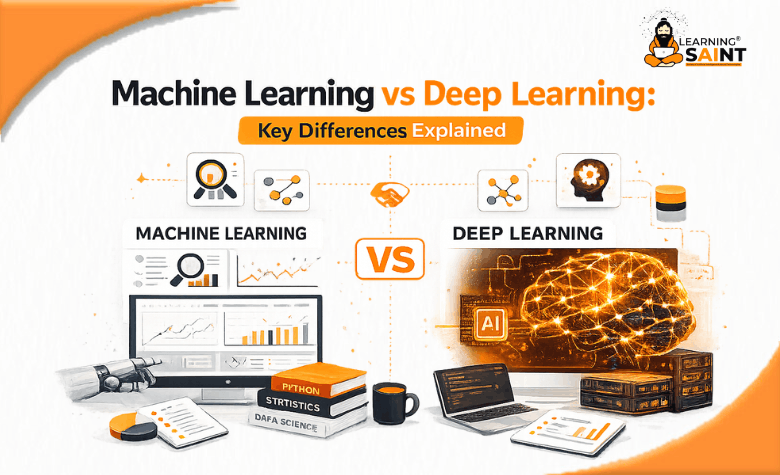
This article will be your guide to understanding and analysing Machine Learning vs Deep Learning very deeply. It will break down every important thing that you are supposed to know in simple and readable language.
How do they fit in together in the real world?
Before you address Machine Learning vs Deep Learning, you must know and understand the entire bloodline of smart machines. Have you seen the russian dolls? Remember how they would fit inside one another? This smart machine family is the same as theirs. These factors also fit into one another. The following is their brief detailing:
- Artificial Intelligence: AI is the main leader here. It is the biggest doll of all. The complete idea of making smart computers think and act as humans comes from here.
- Machine Learning: ML is the first subfactor. It is the middle doll in the hierarchy. It comes under AI. This is the middle doll. It is a part of AI. The power that allows computers to learn from facts and data comes from machine learning. It makes sure that humans are not required to write code every single time.
- Deep Learning: DL is the last factor of the family. It is the last and the smallest doll. It has some extra parts of machine learning. It uses a technology called an 'artificial neural network' so that it can understand and copy the way a human brain thinks.
When we discuss Machine Learning vs Deep Learning, we basically look at the comparison between the middle doll and the smallest doll. It is important to see and understand them individually. Before you see the comparison, understand what you are comparing.
What do you mean by Machine Learning?
Do you remember how your school teachers used examples to solve math sums in school? Machine learning also refers to the way of teaching computers using data. Rather than writing firm terms and conditions for a computer to follow, you prefer giving it examples. The computer will study these examples and find hidden patterns. When it spots the pattern, it makes guesses about new things.
How does machine learning work?
Imagine you are planning to look for a house. You have a huge sheet with lots of data about the house, such as its area, the size of the yards, its prices, and internal information.
If you ask a human expert, they will take more time and effort than a machine. Rather than that, you can use your computer for the same. You must ask your computer to look at the sheet filled with the size of the yard and the area. A computer expert must tell it all the important facts so that it can give you the correct answer. This step is known as feature engineering.
The computer will use math to find the connection between the data. It will create a formula. Afterwards, when you feed it with a new house with 2 rooms, it will guess the price itself.
You can also read about machine learning in business in detail here.
What are the most common machine learning examples?
- Filtering email spam: You must have received up to hundreds of emails that say, “buy this newly launched product on our website” or “free money straight into your account." Your computer looks for words like “free money" and “buy this” so that it can separate them in the junk folder.
- Product advice: When you buy something from a website, you do not leave the site after checkout. Websites look closely at what you have bought so that they can suggest products of the same kind to you.
- Automatic Service: Have you wondered how the big factories are able to manage to maintain their machines at the same time? They do not have the time to check each machine individually. They use machine learning so that the system will alert them about any breakdown that might happen. It helps them to fix it at an early stage.
How many types of Machine Learning Methods?
Machine Learning is not a single factor. It has different types under it.
Supervised Learning
This way is the same as a teacher teaching a student. You will provide questions to the computer along with the answers. For example, you are showing 2000 pictures of a mango to the computer and labelling each one "mango". The computer will learn what makes a mango look like a mango.
Unsupervised Learning
This kind of learning is like exploring a new destination alone. You will provide the computer with data, but no answers or labels will be given. The computer will group the data by spotting things that look the same as each other. For example, the system looks at a store’s customers and classifies them into “people who buy boots” and “people who buy slippers”.
Reinforcement Learning
The last learning is like training your computer, like training your pet with a treat. The computer, here, learns by the trial-and-error method. If it does something good, it will get a digital point. If it commits a mistake, it will have to pay a penalty.
What do you mean by Deep Learning?
Deep Learning is a more powerful and developed version of Machine Learning. It does not require a human to spot the important points of the data fed to it. It has the ability to figure out those essential parts by itself.
This ability is possible with the help of an artificial neural network. This is a network made up of little digital minds put on top of each other in layers. It looks like the stuffed cells inside a human brain. As it has so many layers over each other, it has “Deep” in its name.
How does Deep Learning work?
Have you seen your computer systems identifying a particular creature in a photo of lots of creatures? For example, there is a photo full of wild animals, and you want your computer to identify a tiger. You will see that your computer will recognise it correctly.
In standard Machine Learning, you were supposed to tell the computer to look for “sharp teeth, golden brown colour with black strips, and black eyes".
With Deep Learning, you are not required to do that at all. You just have to throw thousands of pictures of a tiger and feed them to your system. The first layer of the network only looks at simple edges and lines. The next layer below it puts those lines together to see the existence of any shapes in them. The deeper layers identify eyes, noses, and ears. Lastly, the final layer screams, “That is a tiger!” It tends to learn everything by itself.
What are the most common deep learning examples?
- Face recognition unlock: Does it cross your mind how your phone unlocks with face recognition? Deep Learning makes it possible. It helps the system to scan the deep shapes of your face.
- Automated driving cars: There are cars that drive themselves. Do you wonder how that is possible? Those cars use cameras and deep networks to identify stop signs, roadside pedestrians, and other vehicles in real-time.
- Voice commands: You must have used or heard about tools like Siri and Alexa. These tools use deep learning to understand the words that you speak, even if you have a certain accent.
What is the difference between Machine Learning and Deep Learning?
The following are the main factors or areas where Machine Learning vs Deep Learning can be seen at its best:
1. Human assistance and Feature Engineering
This is the major and biggest point in the discussion about Machine Learning vs Deep Learning.
- The operation of Machine Learning requires human help. There must be a person to decide essential features from the raw data. If the person picks wrong or useless features, the computer will make wrong guesses.
- At the same time, Deep Learning is able to operate on itself. It does not require human help for this. It will take the raw data, such as a whole video, a complete video, or a raw audio file, and it will extract its features through its deep neural layers. Deep Learning does not need human help for this.
2. The Data size
These systems work on data. The more data you feed them, the better they will work. It is like food for them. But, as every human has different dietary needs, these systems also need different sizes of food.
- Machine learning requires only a small amount of data. If you give it a few hundred rows on an Excel spreadsheet, it will perform a great job. But if you increase the data size or give it too much data to analyse at once, it might slow down or get confused.
- Deep Learning, on the other hand, starves for data. It will not be satisfied with thousands; it requires millions of datasets to work. If you give it small data points, it will create poor results, as it will not have enough examples to look at. It needs a huge pile of data to train all its brain-like layers well.
3. System power and hardware
You need physical machine power to operate these systems. There is a certain minimum power required to run these systems properly.
- If you compare, Machine Learning is lightweight. It can operate smoothly on a traditional computer chip, also called the Central Processing Unit. It does not require too much cost to be spent on its operation or electricity to run.
- Whereas Deep Learning is a heavy lifter. It performs billions of math steps at once. For this performance, it needs special chips that are known as “Graphics Processing Units” (GPUs) or “Tensor Processing Units” (TPUs). Their speciality is that they are graphics-intensive and use a lot of power.
4. Training Period
Have you wondered how long it takes for any computer to complete its homework and memorise the task?
- Machine Learning works faster. It has the ability to learn from its data in just a few seconds, or sometimes a few hours.
- Whereas Deep Learning will take a long time to train itself. It has complicated networks and huge datasets, which is why it takes days, weeks, or sometimes even months to finish training a single model.
5. Transparency and the “Black Box” Problem
Till now, you have understood that the computer makes choices after you have provided it with the data. Are you wondering why the computer has made its choice?
- The Machine Learning systems are the easiest to interpret. For example, you must have heard people say, “The computer rejected my loan application because my annual income is low.” This shows that the machine learning is highly interpretable.
- On the other hand, Deep Learning is usually a black box. The data will go through millions of small and confused connections. It might give you the appropriate answer, but it is not possible for a human to figure out “how it happened”. This makes it difficult to debug when a problem arises.
Conclusion:
Understanding Machine Learning vs Deep Learning – It Doesn’t Have to Be Confusing. Remember, Machine Learning is the broader approach of teaching computers from data with human guidance. Deep Learning is a further step that uses Artificial Neural Networks stacked like human brains to learn directly from raw information without help from humans.
Numbers and charts are your quick, easy and cheap friend. Machine learning is. Deep Learning is your data-hungry expert for images, sounds and complex tasks. They both change our world every day. Knowing the difference helps you understand the smart future we are building.
You can also read the detailed article about machine learning vs generative AI here.
Frequently Asked Questions (FAQ)
1. What is the main difference between Machine learning and Deep learning?
Machine learning is a broad branch of Artificial Intelligence, whereas Deep Learning is an advanced and upgraded version of Machine Learning.
2. What are the 4 types of AI?
The 4 types of AI are reactive, limited, theory-of-mind, and self-aware.
3. Can I learn DL without ML?
Yes, technically, you can learn Deep Learning without studying traditional Machine Learning.
4. Can I join AI after 12th?
Yes, you can definitely join AI after completing your 12th.
5. Who is the father of AI?
American computer scientist John McCarthy is known as the “Father of Artificial Intelligence”.


Reply To Elen Saspita