 United States
 India
 United Kingdom
 Australia
 Canada
 Nigeria
 Others


 Learning Saint
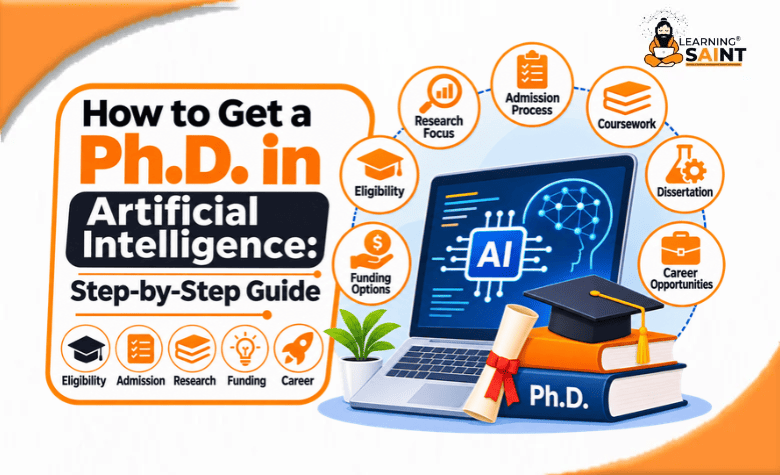
Are you willing to create smart machines, rather than simply using them? A PhD can be your way to create new ideas in the field. This article will act as your guide and explain how to get a PhD in Artificial Intelligence in easy and understandable language. You will read about the degree, how long it takes to complete one, and what the steps are to get it.
What do you understand by a PhD in Artificial Intelligence?
A PhD in Artificial Intelligence is the highest degree you can earn in this field. It is a research degree, so you do not just take classes. You ask a new question, run experiments, and share what you find with the world.
Most students study one area, such as:
- Machine learning: teaching computers to learn from data.
- Natural language processing: helping computers work with human language.
- Computer vision: helping computers understand images and video.
- Reinforcement learning: teaching a computer to learn by trial and error.
- Robotics: building machines that sense and move.
At the end, you write a long paper called a dissertation, or thesis, and defend it in front of experts. Knowing how to get a PhD in Artificial Intelligence starts with knowing that research is the heart of the degree.
How to Get a PhD in Artificial Intelligence?
Step 1: Get Your Bachelor’s Degree
The very first step in the process of understanding how to get a PhD in artificial intelligence is a bachelor’s degree. Most learners choose computer science, maths, data science, or engineering.
Some countries and universities allow you to apply for a PhD immediately after a bachelor’s degree. Whereas others require a master’s degree first. So, you must read the rules of each university carefully.
Step 2: Get your hands on maths and coding
No matter what the way that you use to get a PhD in AI, you will require to have strong basics.
The following are the topics that you need to know:
- Linear algebra: The 2 most important topics under linear algebra are vectors and matrices.
- Calculus: Calculus refers to studying how things change.
- Probability and statistics: Probability and statistics are all about understanding how to work with chance and data.
- Algorithms and data structures: Algorithms and data structures tell you how you can draft fast and clear code.
- Python: Python is the most common and beginner-friendly language in AI research.
- You can learn these skills through your regular college classes or unpaid online courses. After that, you can practise your learned skills on tools such as PyTorch and TensorFlow.
Step 3: Study Machine Learning
The next step is to study machine learning and deep learning, since they play an important role in the journey of knowing how to get a PhD in Artificial Intelligence. You will learn how models are trained, tested, and modified.
Step 4: Gain Research Experience
This step can make the entire difference. It is the biggest step in how to get a PhD in artificial intelligence. Almost every university seeks evidence that you are capable of performing research.
The following are ways that can help you gain some good research experience:
- Work as a student helper at a professor’s lab
- Look for a research internship
- Complete a final-year project or a master’s thesis
- After completing your graduation, start working as a research assistant.
Another brownie point is for those whose work has been shared at a workshop or on arXiv. arXiv is an unpaid website where researchers can post their white papers.
Step 5: Think about getting a Master’s degree
There are some places where students can move straight to a PhD from a bachelor’s degree. Whereas in other places, a master’s degree is the standard process. A master’s degree can, however, help you strengthen your grades if your research record is not strong enough.
Step 6: Choose Your Research Niche
AI is a huge field, and it is not practically possible to study all of it. Choose one area that interests you, because understanding how to get a PhD in artificial intelligence is easier when you have a defined focus. Read recent papers and look at what topics you enjoy.
The following are the places that can help you choose your niche:
- Google Scholar and Semantic Scholar to find any kind of recent papers.
- arXiv to look for new work
- Best conferences, like NeurIPS, ICML, ICLR, CVPR, and ACL.
Step 7: Find a Good Advisor
The advisor, also referred to as a supervisor, is more important than the university’s name. An advisor is responsible for guiding you and your research for years. In many programmes, you can even work with one main advisor.
The following are the things that you must check in your advisor:
- Check if the professor has any published papers in the niche you have chosen.
- Make sure that if it's a yes, then the papers are recent.
- Look out for whether their students get a good job after finishing their PhD.
- Carefully note if the professor is open to accepting new students
Step 8: Keep your application ready
Most programmes require a repetitive set of documents.
The following is the list of all the standard documents required:
- Statement of Purpose: An SOP is a short essay that briefs about your goals and research interests.
- Letters of recommendation: Letters of recommendation, usually counted as 3 as a standard number, are a paper backing your work and research skills signed by people who know your work.
- CV or resume: A CV or a resume contains the basic information about your education, projects, and papers.
- Transcripts: Transcripts refer to your marks from your previous institution.
- English test marks: This is important in cases where English is not an individual’s first language.
- GRE scores: GRE scores are not a mandatory requirement. You need them only if the particular programme asks for it.
Step 9: Organise your Funding plans
Many PhD programmes in AI are funded, specifically in the United States and in many European countries. The term “Funded” basically means that the university waives tuition and even pays you a stipend amount, which covers your monthly living costs. In return, you will be required to work as a research or teaching assistant. However, the final details can be different based on the school and country, which is why you must always confirm details in the offer letter.
The following are some other ways to fund your PhD:
- Fellowships from the university
- Government grants, like the NSF Graduate Research Fellowship Programme in the United States, which is open to U.S. citizens, nationals, and permanent residents.
- Fellowships that are backed by the company.
- Funding from your professor’s research project.
Step 10: Complete the programme
Once you are accepted into the programme, the real work begins there.
The following is what your standard path will look like:
- Courses: Completing your classes in the 1st or 2nd year.
- Qualifying exam: It is a test to validate that you are ready for research. However, not every institution uses one.
- Research proposal: A research proposal is basically a plan that summarises your main project.
- Papers: 'Papers' refers to the published results of the experiment that you perform.
- Dissertation: A Dissertation is the process of drafting your thesis.
- Defence: It is the final time when you present and defend your thesis to the committee.
Conclusion:
So, now you know how to get a PhD in Artificial Intelligence from the beginning to the end. Step one: Get your maths and your code. Then get research experience and pick an area you love. Get a good advisor, write a clear application and plan your funding. But be consistent throughout the long middle of the programme. The road is long, but each step is small and clear. Consider this your roadmap. Get started on step one today by following this guide on How to Get a PhD in Artificial Intelligence.


Reply To Elen Saspita