 United States
 India
India United Kingdom
 Australia
 Canada
 Nigeria
 Others


 Learning Saint
Does your phone also unlock when it sees your face? Or maybe your video app suggests what you would watch next? If yes, then you must know that behind all these actions or innovations is a technology known as deep learning. If you have wondered what is deep learning, then you have landed in the right place.
This article will help you understand the basics of deep learning, including how it operates and what its types are, in easy and understandable language.
What do you understand by Deep Learning?
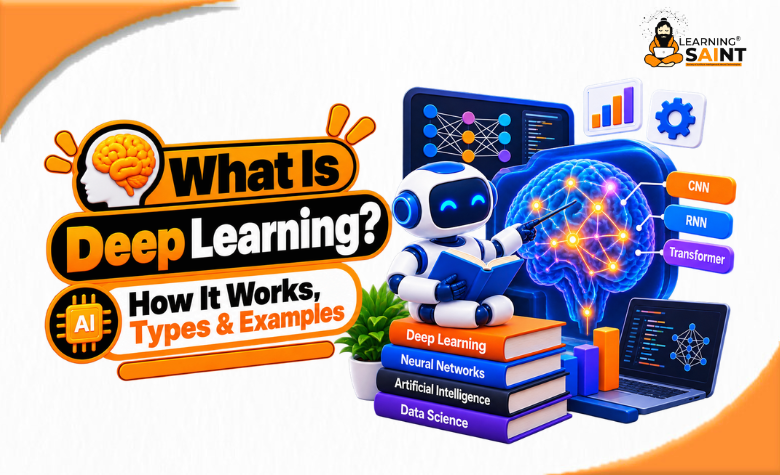
Deep learning is a process of teaching computer systems to learn from huge datasets using a system called a neural network. A neural network is a computer program that is somewhat inspired by the way brain cells pass signals to each other. The word "deep" refers to the number of layers inside that network. A network with many layers is called a deep network.
In standard programming, an individual is supposed to write the rules for the computer system to follow. However, in deep learning, the computer looks out and figures out the rules itself. You are just required to show millions of examples to your computer system, and it slowly analyses the important patterns.
What is the difference between Deep Learning vs Machine Learning vs Artificial Intelligence?
The 3 terms that are usually confused with each other are Deep learning, machine learning, and artificial intelligence; however, they fit inside each other like nesting dolls.
The following is the basic difference between these 3 terms:
|
Deep Learning |
Machine Learning |
Artificial Intelligence |
|
Deep learning is a technology that comes under machine learning. It uses neural networks with various layers. |
Machine Learning is one of the many ways to develop AI. It helps the computer to learn from examples instead of fixed rules. |
Artificial Intelligence is the biggest idea behind all of it. It refers to the idea of creating machines that can perform tasks like normal humans. |
To understand these concepts in more detail, explore our guides on the difference between Machine Learning and Artificial Intelligence and Machine Learning vs Deep Learning: Key Differences .
How does Deep Learning operate?
You must have understood the basics of what deep learning is by now. But it is important that you understand more of it and analyse how it operates.
What are the core blocks of deep learning?
- Neurones: Neurones are the small math units. Every neurone takes in a number, performs a little bit of math, and transfers the result forward.
- Layers: All the neurones are grouped into layers. The initial layer accepts the raw data, and the final layer provides the answer. Also, the layers between these 2 are known as hidden layers.
- Weights: It is important to know that the connection between these neurones has a separate number known as a weight. A weight is used to decide how strong the influence of one neurone is on the other one. Learning basically refers to adjusting these weights.
What are the operating steps in deep learning?
- Feed in data: Imagine you want a network to identify handwritten numbers. What will you do? You will provide millions of examples in the form of images, with each of them labelled with the right number. This way, you feed the data into the system.
- Make a prediction: The data that you provided initially flows through the layers, and the network gives back an answer. Initially, most predictions are inaccurate, as the weights start out randomly.
- Analyse the error: In the next step, the computer compares its predictions with the accurate answer and analyses what it missed and how much it needs to cover up to be accurate.
- Adjust the weights: There is a method known as backpropagation that allows the network to work backward through its layers and adjusts the weight to make the error seem smaller. Backpropagation was made popular in a famous paper by David Rumelhart, Geoffrey Hinton, and Ronald Williams in 1986.
- Repeat: This process loop runs again and again, usually a million times in a row. With each passing round, the guesses improve and become better.
- Test it: As the final step, the network is tested on the new data that the system has never encountered before. If the system performs well in that, then the network is ready to use.
How many types of deep learning are there?
Once you understand all the important information about deep learning and the core of it, it will be easy for you to follow up with the types of deep learning.
The following are the most common types of deep learning networks:
1. Convolutional Neural Network (CNNs)
CNNs are networks that are created for images specifically. They use small filters that basically slide across an image to spot simplified features, such as edges and corners. Later, the layers mix up those features into bigger and better shapes, such as eyes, wheels, or faces.
2. Recurrent Neural Network (RNNs)
RNNs are a bit different. They are created for data that comes in a certain order, such as speech, text, or stock prices over time. They include loops that allow them to remember what came earlier in the sequence. A famous modified version of this is known as LSTM, or Long Short-Term Memory, which is certainly better at remembering things over longer stretches.
3. Transformers
Transformers came into existence in 2017 in a Google research paper that was titled “Attention Is All You Need”. They use a method known as 'attention' that allows the model to look at all the words in a single sentence in one go and decide which ones are the most important. Transformers are currently the base of most of the large language models. It is the kind of system that is behind the working of chatbots.
4. Autoencoders
An autoencoder is simple. It is responsible for squeezing the data down into a smaller form and later tries to recreate the original one. This helps the system to learn the most important part about the data.
5. Generative Adversarial Networks (GANs)
GANs were given to all by IAN Goodfellow and their colleagues in the year 2014. They take 2 networks that compete. 1 network creates fake examples, like fake pictures. The other network, however, tries to separate real from fake. When they compete, the first network becomes better at creating realistic results.
6. Deep Reinforcement Learning
Lastly, there is deep reinforcement learning. Under this category, a network basically learns by trial and error. The network takes certain actions, gets rewards if the answer is correct, or pays a penalty if the answer is incorrect.
What are the main advantages of deep learning?
- It helps you handle unorganised data: Deep learning helps you manage images, audio, and raw text, as they are a bit difficult for older methods to handle.
- It is capable of finding features on its own: While working in deep learning, you do not have to list all the information or details by hand.
- It modifies or improves itself with more and more data: In most tasks, the result of deep learning networks keeps getting improved as more and more better samples are added.
What are the challenges faced in deep learning?
Understanding what deep learning is, along with its basics, also includes understanding the challenges it brings.
The following are the challenges faced in deep learning:
- It requires a lot of data: The core of deep learning is that it learns from the data. This simply means that it requires millions of accurate examples to learn well.
- It requires strong computers: Deep learning is a heavy technology that requires strong computers to be tested. It can take a huge amount of time, electricity, and money.
- It can make you face difficulties while explaining: A lot of times, it can become difficult to explain to the other person or to give direct answers. This is sometimes known as the “black box” problem.
Conclusion:
What is Deep Learning? This is a method that allows computers to learn from large data sets using neural networks with multiple layers. The network learns the patterns itself rather than being given rules. It learns everything from simple edges in a photo to the meaning of a full sentence.
You saw how it worked, feeding data in, tweaking the weights over and over. You saw the big ones: CNNs for images and transformers for language. You also saw its limits, like the massive amount of data it requires and the difficulty in explaining its answers. And knowing both sides helps you use it wisely.


Reply To Elen Saspita