 United States
 India
India United Kingdom
 Australia
 Canada
 Nigeria
 Others


 Learning Saint
Machine learning is an important factor in changing our lives. It affects the way you work, live, or even shop. From the songs that your music app suggests to the way your face unlocks your phone, machine learning is everywhere. However, there is a different kind of machine learning working behind each of these things. If you are willing to understand this field in depth, you must understand the kinds of machine learning. This article will be acting like your guide that will explain the kinds in an easy and understandable language.
In this article, you will be covering what machine learning is, what its importance is, and the main kinds of machine learning. By the time you reach the end of this article, you will know the different kinds of learning along with understanding how each of them operates.
What do you understand by machine learning?
Machine learning is a part of computer science. It is concerned with teaching a computer to learn from the data fed to it instead of a bunch of fixed rules. A standard computer program follows the exact set of rules given by the individual. Whereas a machine learning model has a different way of operating. It looks at the data, identifies the possible patterns, and makes its own predictions.
To understand it better, imagine a child learning to identify a tree. You do not provide the child with a set of rules; instead, you show him multiple trees of various types, and he slowly realises what a tree looks like. Machine learning operates in a similar way. This is the point where understanding the types of machine learning steps in.
The learning process differs with every type of machine learning, which is why discussing them becomes important while understanding machine learning. Each type of machine learning uses a different method to learn from the data, and each of them is appropriate for different tasks.
What is the difference between Machine Learning and Traditional Programming?
|
Machine Learning |
Traditional Programming |
|
Machine learning has a very specific approach. Instead of learning from a rule book, it learns from the millions of examples fed to the computer. |
Traditional Programming follows a general and standard approach. It makes the computer follow what it is asked to do by the individual at every step. |
What are the main types of Machine Learning?
Now, it is time to acknowledge the biggest question in everyone’s mind.
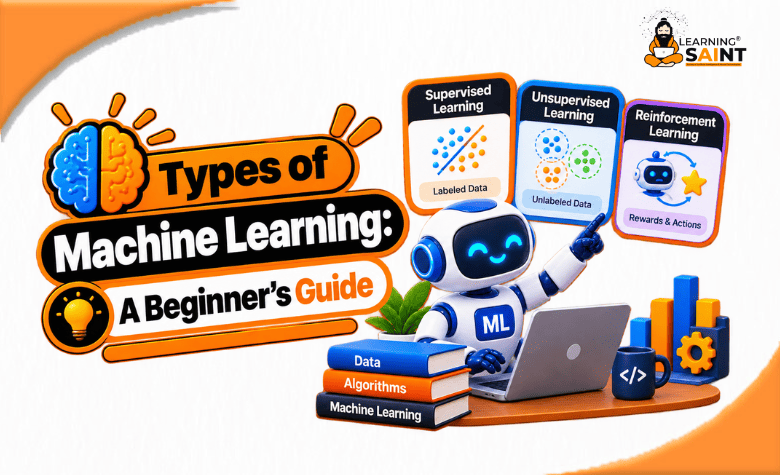
The following are the 4 major types of machine learning:
- Supervised Learning
- Unsupervised Learning
- Semi-supervised Learning
- Reinforcement Learning
The names are important to be addressed first, but they are not enough.
The following is a detailed discussion on all the types of machine learning:
1. Supervised Learning
Supervised learning is the most popular and common type of machine learning among the rest. In this type of machine learning, the computer is provided with a huge dataset that is already labelled. The computer looks at the millions of labelled examples and understands what that looks like in a completely unknown situation. Labelled data refers to data that already comes with its answers attached to each example.
For example, imagine you are willing to create a tool that spots the difference between trees and skies. You will have to show the computer millions of pictures of trees and skies separately, but each picture would be labelled as a tree or a sky. The computer will study those labelled pictures and analyse what a tree and a sky look like.
2. Unsupervised Learning
The next type of machine learning is unsupervised machine learning. In this type of machine learning, the process remains the same as supervised learning, but the examples are not labelled. The computer receives a huge data set, but the picture does not come with the answers attached. Instead, it must find patterns and groups on its own.
For example, imagine a person is handed a box full of different accessories mixed with each other, and they are asked to sort each of them out. They have no guide or no help available No one tells them how to sort the buttons. They might start with grouping them on the basis of colours, sizes, or even shapes, based on how much they can notice. Unsupervised learning works in a similar way. The computer has to figure out and differentiate between the data itself.
3. Semi-Supervised Learning
Semi-supervised learning lies somewhere between supervised and unsupervised learning. In this type of machine learning, the computer uses a small amount of labelled data along with a huge amount of unlabelled data. Basically, the labelled data acts as helper data for the unlabelled data here. This type of machine learning is considered the most practical type of machine learning. This is because every piece of data given to this one is usually very expensive or slow.
For example, imagine there is a school student who has 10 essays labelled as good and 100 unlabelled essays. The student will read those 10 labelled essays to understand what a good essay looks like and then understand the rest of the essays. This is exactly how semi-supervised machine learning works.
4. Reinforcement Learning
Reinforcement learning is the most different type of machine learning. It operates like a game. In this type of machine learning, the computer makes guesses; if the guess is right, it receives a reward, and if the guess is wrong, the system has to pay a penalty.
For example, imagine yourself training a dog. When the dog follows your command, you give him a treat, which ultimately tells him that following this command is good, and if he does not listen, you do not offer any treat, which tells him that doing this is wrong. Doing this again and again makes the dog understand the things that he should do and perform well. Reinforcement learning works the same way. With every reward for the right guess, the computer system understands what it must do for maximum efficiency.
What are the real-world examples of each type of machine learning?
By now you must have understood the types of machine learning theoretically, but knowing and looking at their real-life examples is equally important.
The following are the real-life uses of each type of machine learning:
- Supervised learning: You must use voice assistants that would turn your speech into text. It uses supervised learning to accomplish that.
- Unsupervised learning: Unsupervised learning is most used in streaming platforms that basically create a personalised group of a section of songs or movies on the basis of your previous choices.
- Semi-supervised learning: This type of machine learning is usually used in applications that categorise pictures on the basis of faces.
- Reinforcement learning helps robots learn to walk or pick up objects through repeated practice.
Conclusion:
Machine learning is a powerful tool, but it is not one single method. It is a family of different approaches, each suited to different problems. In this guide, we covered the four main types of machine learning: supervised learning, unsupervised learning, semi-supervised learning, and reinforcement learning. Each type has its own way of using data to learn and improve.
Supervised learning works with labelled data to predict outcomes. Unsupervised learning finds hidden patterns in data without labels. Semi-supervised learning blends both approaches to save time and cost. Reinforcement learning learns through trial, error, and rewards. Together, these types of machine learning form the base of most modern artificial intelligence systems.
If you are just starting out, do not worry about mastering everything at once. Take time to understand each of the types of learning in machine learning, try small projects, and build your knowledge step by step. With practice, these ideas will become easy to remember, and you will be ready for more advanced topics.


Reply To Elen Saspita