 United States
 India
India United Kingdom
 Australia
 Canada
 Nigeria
 Others


 Learning Saint
Generative AI has rapidly shifted its position from a niche research topic to something that is used by millions of people every day. It has expanded its production range from writing help to image creation. This technology has successfully changed the way people work, learn, and even create. But have you wondered what makes it so useful? This article will help you understand the facts by simply breaking down the benefits of Generative AI in easy and readable language so that you understand what this technology actually offers you without any confusion from jargon or exaggerated claims.
If you are a student, a brand head, or just curious about the technology, this guide will help you walk through the real and practical benefits of generative AI, the limitations of using it, and a comparison between Gen AI and traditional automation.
What do you understand by Generative AI?
Before you jump onto the benefits of using Generative AI, it is important that you are aware of what Generative AI is. Generative AI refers to artificial intelligence systems that are capable of creating new content, like text, images, audio, or code, based on patterns that it learns from a huge amount of existing data.
The difference between traditional automation software and generative AI models is that the generative AI models learn from examples and then generate new content that ultimately follows similar patterns. This is the reason that generative AI writes a paragraph, creates an image, or even suggests a piece of code. It even performs requests that it has never seen before.
What are the core benefits of generative AI?
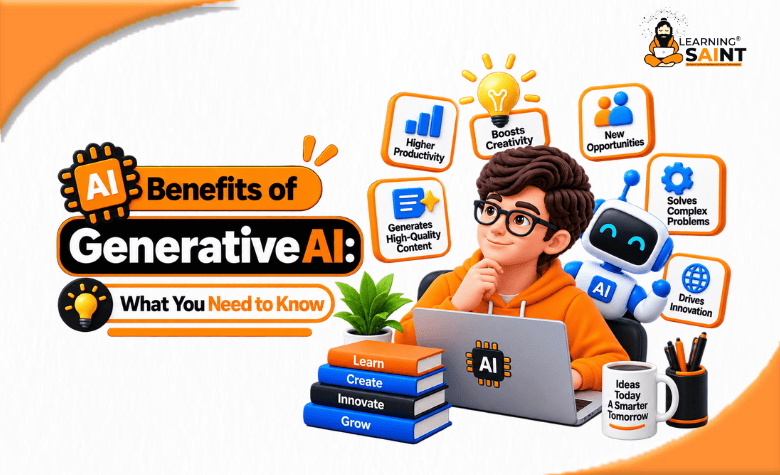
The following are key benefits of Generative AI that are reasons for such a wide usage of Generative AI:
1. It saves your time on recurring tasks
One benefit that is the clearest advantage of using Generative AI is how much time can be saved on repetitive, time-consuming tasks. Tasks like writing routine emails, drafting reports, concluding long documents, or generating basic code snippets can be performed in seconds. Instead of consuming a large amount of time, it can happen in a few seconds.
The fact that the output is created in seconds does not always mean that the output will always be accurate or ready to use instantly. However, it usually provides a strong starting point that cuts down the time that is needed to go from a blank page to a final draft.
2. It supports creativity and Idea generation
Generative AI is capable of helping people get past creative blocks by rapidly producing multiple ideas, drafts, or variations. The writers, designers, and marketers generally use it to brainstorm available options that they might not have considered on their own, which they can refine and shape further with their own judgement and expertise.
Instead of replacing human creativity, generative AI is a technology that generally works best as a starting point or a creative partner. It helps speed up the initial stage of a project.
3. It modifies the accessibility of advanced skills
Another practical advantage of generative AI is that it helps in lowering the hurdle to tasks that once required specialised skills. With the help of generative AI, people without strong writing skills can easily get help in drafting a clear message, someone without real design experience can easily create an easy visual concept. Someone without design experience can create a visual concept, and even someone without deep coding experience can easily understand or write a basic script.
This easy accessibility does not intend to replace the value of deep expertise; instead, it helps more people participate in tasks that used to require years of specific training.
4. It modifies efficiency in business operations
Businesses across various industries tend to use generative AI to speed up their tasks, such as writing marketing copy, summarising customer feedback, generating product descriptions, or even supporting customer service using chatbots. This process can free up employees to focus on better-value work that basically requires human judgement, relationship-building, or strategic thinking.
Increases in efficiency like these can be specifically valuable for smaller businesses or teams with limited staff, as the generative AI tools can help in performing the tasks that might otherwise need additional support.
5. It personalises the content and communication
Generative AI can help in adapting content to particular audiences more rapidly than human methods alone. This process generally includes customised marketing messages, personalised learning materials, or even some product recommendations that are shaped around a certain user’s preferences and past behaviour.
This sort of customisation can improve engagement and relevance. Due to this, the content can feel more directly suited to the individual receiving it instead of a generic or one-size-fits-all message.
6. It promotes academic learning and education
Students or learners who want to learn for the entire life are seen to be excessively using generative AI to get quick demonstrations of difficult topics, practice questions, or understandable summaries of complicated material. This has the capability to encourage self-paced learning, specifically for students who require extra help outside of normal classroom times.
One of the most important things to notice is that generative AI works best as a complement to the standard form of learning, which helps in reinforcing understanding, instead of a complete replacement for structured instructions and human help from teachers.
7. It enhances the speed of software development
You will see developers using generative AI to help them write, explain, or debug code easily and quickly. This can make their development time shorter for specific tasks and help programmers with less experience understand unfamiliar code better.
Where the generated code still requires careful review and testing, there are many developers who have reported that it significantly increases the speed of the early drafts and recurring coding tasks, which frees up time for better and more complicated problem-solving work.
8. It modifies content prototyping
Generative AI can easily and quickly generate images, layouts, or design concepts for visual and creative projects that would take a lot longer if a human were to do them manually. This allows the teams to explore various creative directions on an early basis, before investing significant time and resources in a single approach.
9. It guides you with the data conclusion
No one likes to go through a huge pile of text, such as research papers, legal documents, or even long reports. Today, they can easily be summarised or concluded with the help of generative AI. This allows people to get a basic and general understanding of long reading materials faster before choosing which part of the document deserves a closer and more careful read.
10. It promotes multilingual communication
Generative AI is a fully capable technology that can easily translate or adapt content across various languages, supporting easier and better communication for businesses and individuals who are working across multiple regions. However, it is not a complete replacement for professional or skilled translation in sensitive or extremely technical contexts; it can still be an important tool for daily informal communication requirements.
What are the possible limitations of using Generative AI?
You have seen and read all the top advantages of generative AI, but that is not enough. You must also understand the limitations of using this technology.
The following are the most common challenges of using generative AI:
- Might not always give accurate results: Generative AI is technical software. It is true that it provides fast results, but the accuracy is not guaranteed. It can sometimes generate incorrect or misleading information, usually termed “hallucinations”. So, you must carefully review the output, specifically for important or factual content.
- It has less value of true understanding: Generative AI gives results on the basis of what the software has learned from the data or the examples fed to it. These systems generate content based on the patterns they have learned. They are not supposed to provide a genuine comprehension, which basically means that they can sometimes miss context or nuance that a human would easily identify.
- It can be biased in its outputs: As these systems take lessons from the existing data, they might show biases present in that data. It requires careful review, specifically in sensitive applications.
- It can witness over-reliance risk: If you end up being completely dependent on generative AI and apply no human judgement, it can lead to low-quality or less-original work over time.
- It might raise copyright and originality concerns: There have been numerous questions roaming around the ownership and originality of AI-generated content, still evolving in many countries. This is why it is important to stay informed about the relevant guidelines in your specific field or niche.
Being known and informed of these limitations allows people to use this technology with better responsibility and effectiveness, instead of feeling it is a flawless solution.
What is the difference between Generative AI and traditional automation software?
It is completely worth briefly comparing generative AI to older, traditional forms of automation, as both of them are usually seen as confusing with each other. Traditional automation tools follow firm and pre-programmed rules. It performs the same exact action every time, irrespective of the context. This work is good for predictable and repetitive jobs with clear and the same steps, such as automatically organising emails into folders based on particular keywords.
Generative AI, however, works differently. It does not follow a strong or fixed script; instead, it generates new and context-specific content based on patterns that they learn from the data. This flexible learning is one of the core benefits of generative AI in comparison with traditional automation methods, as it is capable of handling a much broader range of requests without requiring a separate and hand-written rule for every possible situation.
What is the cost consideration for businesses?
For individuals, there are many generative AI tools that offer free or low-cost access. But the businesses are adopting this technology at a scale that often requires thinking about the cost carefully. Pricing models vary widely, from free basic tiers to subscription plans to usage-based pricing tied to how much content is generated.
Small-scale businesses prefer initiating with a free or low-cost tier, which becomes a practical way to explore the advantages of Generative AI before finally committing to a bigger investment. However, companies or organisations usually need to calculate the cost of these tools against the time and labour savings that they provide, along with some additional costs related to training staff or integrating these tools into strategised workflows. If you discuss any business decision, start with a small investment, calculate real results, and scale up gradually on the basis of what is proven worthy in practice.
Conclusion:
What are the benefits? The benefits of Generative AI are already changing how people work, learn and create — from reducing time spent on repetitive tasks to helping creativity, accessibility and business efficiency. This type of technology has real, practical value in many areas of our daily lives, whether it’s helping a student understand a difficult topic, supporting a small business with limited staff, or speeding up early drafts of creative or technical work.
Just as recognising its strengths is important, acknowledging its limitations, such as accuracy and the risk of over-reliance, is equally important. When used wisely, with careful review and a clear understanding of both its benefits and its limits, generative artificial intelligence can be a genuinely useful tool for individuals and businesses alike, supporting human effort rather than replacing it entirely.
Start small, stay curious, and know where this technology really saves you time and where your own judgement still counts most. Over time, that balance will come into focus, helping you extract real, lasting value from generative AI in whatever work or learning you’re focused on.
You can also read about how to learn generative AI from scratch in detail here.


Reply To Elen Saspita