 United States
 India
India United Kingdom
 Australia
 Canada
 Nigeria
 Others


 Learning Saint
Have you wondered how you learned about this world and how it works? When you enter the room, your eyes do not move straight away to the text on the wall. You look around and observe the colours, shapes, and everything about the room. The sound of people talking or the music playing in the room – everything comes to your attention. You will even notice the temperature and the fragrances. Humans are built in a way that they use all of their senses to understand the environment around them. They are capable of using all their senses together.
Initially, when computers were invented, they could not do this. They had limited capabilities to perform. A computer program was designed to read words, but it could not look at a picture. Later, it could scan a picture but could not listen to a sound file.
But everything changed a few years later. The scientists created a new technology known as multimodal AI.
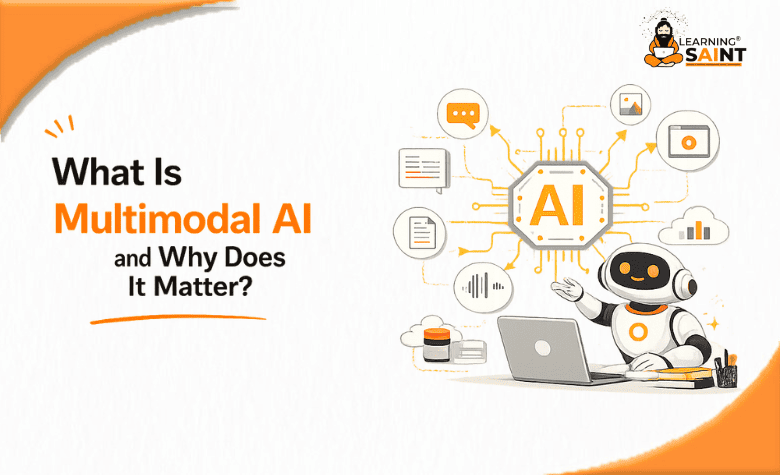
This article will act like a guide for you in understanding What Is Multimodal AI. You will learn how it operates, what its significance is, and how it is changing the aspects of the surroundings.
What Is Multimodal AI? What are its basics?
To understand any technology or any tool, you must understand its basics. You must know where it came from. “Multimodal” is a combination of 2 words that are broken down as follows:
- Multi: ‘Multi’ refers to anything that is more than one.
- Modal: ‘Modal’ refers to the kind of information or a procedure of how something happens. In the world of computer science, a modal is a unique kind of data. For example, data including text, photos, recorded sounds, and video clips.
So, whenever your brain asks, ‘What Is Multimodal AI?’, just remember that it is a kind of artificial intelligence that can scan, listen, read, see, and have conversations. It performs all these functions at the same time. It generally takes various kinds of information and blends them together to know all about a certain situation. It performs exactly like a human brain does.
The difference between old modal and new modal
Multimodal AI is a big deal today. Everyone is talking about it. But have you wondered what about the previous versions of the modal? To understand why everyone is talking about it, you should be aware of the previous versions of it and how it worked. The old method is known as “unimodal AI”.
- Unimodal AI (The old version): The term “Unimodal” consists of the word "uni", which stands for “one”. If you gave a text-based computer a picture of a tree, it would not be able to read it. It would show an error saying that it cannot read or scan images. It will not be able to listen to it and will get confused about what to do with the voice message. Every tool would reside in its personal box. They were not capable of talking to each other.
- Multimodal AI (The updated version): The modern system does not ask tools to stay in a single box. It is capable of looking at a picture of an anniversary cake, reading the note written in human writing and put on top of the cake, listening to people singing carols, and figuring out that a party is happening. It takes care of all the inputs at once. It can operate with all the instructions at the same time.
Whenever you are in the discussion of What Is Multimodal AI, you must know that it is a technology that is capable of looking at multiple things at the same time. It does not predict on the basis of one clue. Instead, it uses all the clues.
How does Multimodal AI operate?
After understanding the initial core of What Is Multimodal AI, you must be wondering how it is possible for a computer to look at photos and listen to a voice message at the same time. It sounds impossible or fictional, but it is performed in an advanced 3-step process that is mentioned as follows:
1. The Input Module
Every technology or process starts with an initial step. The first step in Multimodal AI is to collect the data. There must be something as an input to feed into the technology. Imagine this step like the computer is using its eyes and ears. The system consists of tiny and specialised parts known as encoders.
- The first encoder converts words to numbers.
- Another encoder converts images into numbers
- The third encoder is responsible for converting sounds and voices into numbers
2. The Fusion Module
This is the core operational area. After the entire dataset is converted into numbers, the system sends that to a major mixing bowl. The tech specialists and computer scientists call this “data fusion”.
3. The Output Module
When blending the information is completed, the system has to figure out what to do. It forms an answer. The unique part is that the answer can be any sort of media. You can also ask the question by speaking it into the mic, and the AI is allowed to answer by drawing an image or drafting a paragraph.
You can also read about how AI can change the future of work in detail here.
What is the importance of Multimodal AI?
Now, you must have understood all about What Is Multimodal AI. It is time to also learn about the side information about it. It is important to talk about why Multimodal AI matters for everyone in their school, family and worldwide business.
Before the deployment of this technology, making conversations with the computer used to feel stiff and firm. Users were supposed to type exact words in the search box to get accurate results. If you made any typing error, the computer would get lost. Multimodal AI helps computers be friends rather than machines. The following are the core reasons for the growing significance of Multimodal AI:
Improved context and understanding
You must have sent a text message to any of your friends, but have they ever misunderstood your tone or the message you are trying to give? It usually happens because words are not enough in themselves to show emotions too.
Multimodal tools help your computer to go beyond reading just the words. It makes the computer capable of listening to the sound of your voice too. The computer can scan if you are happy or stressed through a camera. This means that the computer is able to understand the true meaning of your words. It understands the difference between cheerful feedback and a sarcastic comment.
Fewer errors and more accuracy
Imagine your AI is only looking at one kind of data; it will end up making lots of mistakes. The computer Scientists call these mistakes “hallucinations”.
According to the top tech reports, when an AI system is blending the visual data with text data, the quantity of its accurate answers increases by 40% in comparison to when the system is only text-based.
The AI checks the image against the text to ensure that it has its facts and information accurate and straight.
Real Conversations
The modern tools allow a computer to converse with you just like you do with a human. You can open the AI camera, point it towards the broken tap, scan it, and ask how to fix it. The AI will look at the tap, listen to your voice, and tell you the complete procedure of how to fix it. It saves your time from writing out a long explanation.
You can also read how to use AI for content creation in detail here.
Multimodal AI: Examples in the Real World
This isn’t just an idea sitting on a shelf in a science lab. It’s working in the real world right now. There are some amazing ways people use it every single day.
1. Intelligent Vehicles and Autonomous Vehicles
Self-driving cars are a perfect example of why knowing What Is Multimodal AI so important. A safe car can’t rely on a single sense.
- It uses computer vision cameras to identify stop signs and lane lines.
- It uses radar and sensors to sense other cars around it.
- Audio tools listen for sirens from ambulances or fire trucks.
The car mixes all these inputs in real time to decide when to brake, turn or speed up. If it were just cameras, a heavy snowstorm would blind it. It is safe with all its modes.
2. Modern Healthcare and Doctors
- Healthcare and the Doctors of Today: To help sick people. They look at X-ray photos, read lab blood tests, and listen to the patient talk about their pain.
Multimodal tools can look at all these pieces of health data at the same time. The system can scan an MRI image, cross-check it against a patient's medical history and flag a health problem that a human doctor might miss. This helps people receive the right medicine much faster.
3. Improved Customer Service
We've all felt the annoyance of trying to have a conversation with automated phone bots. That’s a thing of the past thanks to new customer service bots that leverage multimodal features. They can read what you are typing in the chat. They can see a screenshot of the error you see on your computer. They can hear your voice tone to see how upset you are. If the bot senses you are very angry, it can automatically route the call to a human manager.
4. Learning and Education in the Classroom
Each student learns differently. Some kids like to read books. Some like to look at charts; some like to listen to a teacher talk.
A hard science lesson can become a custom experience for any student thanks to multimodal tools. It can read a page from a textbook, show an animated video of a plant growing, and quiz a student with voice commands. It makes learning fun and easy for us all.
What is the importance of Multimodal AI?
There have been many benefits recorded that came with the change from Unimodal AI to Multimodal AI. The following is a table listing all the advantages that came into the picture after the transformation of unimodal AI to multimodal AI:
|
Characterstics |
Unimodal AI |
Multimodal AI |
|
Inputs permitted |
It was only capable of accepting a single type of input, either text or image. |
It can take multiple types of inputs at the same time, be it text, voice, image, or video. |
|
Real emotions |
It used to miss the enhancement of real and raw emotions in the tone and the body language. |
It understands the emotions behind the tone, voice, and expressions perfectly. |
|
Precision ratio |
The accuracy rate in this was very low. It can get distracted by even the slightest voices. |
It has a high accuracy rate, as it double-checks the data across models. |
|
Procedure |
Its operation or working procedure requires writing long paragraphs. |
It can work by simply talking, pointing cameras, and texting manually. |
What are challenges faced by Multimodal AI?
Knowing What Is Multimodal AI and using it in practical life is brilliant and easygoing, but there is nothing perfect in this world. Everything brings benefits and challenges along with its deployment. Creating these systems is extremely hard work for the tech scientists. Making these systems is very hard work for computer scientists.
The following are a few reasons why it can be a bit challenging:
It requires a huge amount of computer power
When the system has to process videos, sounds, and text at the same time. It will have to require some special computer chips and a huge amount of electricity. This will make it very expensive for the brands or companies to run the large multimodal models.
The issue with the ruined data
AI learns from real-life examples. If you want to teach an AI how to connect images and words, you will need millions of the best examples to feed into it. If the ruined or bad data is fed to it, the AI model will end up learning inaccurate things. Finding clear, clean, and high-quality data that fits perfectly in the image along with the sound and text is quite a slow process.
Privacy and security worries
These systems are created with an inbuilt camera and microphones, which would help them work best. But this makes users worry about their privacy. It is a compulsion for the tech companies to ensure that they secure the private data of their users and do not listen to or watch them without their consent.
Conclusion:
What Is Multimodal AI? That’s the future of AI. It's a clever system that breaks down the barriers between text, pictures, sound and video. Why is this important? It lets computers understand the human world in real context. It creates Fewer mistakes, helps with creating safer self-driving cars, provides faster medical updates, and performs simpler discussions. By integrating all of our data streams into one smart brain, multimodal tools are making technology more helpful, more accurate and more human than ever before.


Reply To Elen Saspita