 United States
 India
India United Kingdom
 Australia
 Canada
 Nigeria
 Others


 Learning Saint
Introduction to Management
Management is one of the most important concepts in business, education, government organizations, and daily life. Every successful organization depends on proper management to achieve its goals efficiently and effectively. Whether it is a multinational company, a small business, a hospital, or a school, management helps organize people, resources, and activities in the best possible way.
In simple words, management is the process of planning, organizing, directing, and controlling resources to achieve specific objectives. It ensures that work is completed on time while maintaining quality and productivity. Without management, organizations may face confusion, poor coordination, and low performance.
Today, management is not limited to business operations only. It also plays a vital role in personal development, project execution, leadership, and team coordination. Modern businesses use management techniques to improve productivity, employee satisfaction, customer service, and profitability.
As competition increases globally, effective management becomes even more important. Companies need skilled managers who can make smart decisions, solve problems, motivate employees, and adapt to changing market conditions. Understanding management helps students, entrepreneurs, and professionals build strong leadership and organizational skills.
What Is Management?
Management is the process of coordinating and controlling people, resources, and activities to achieve organizational goals efficiently. It involves making decisions, setting objectives, organizing work, and ensuring tasks are completed properly. Management acts as the backbone of every organization because it guides all operations toward success.
The concept of management focuses on achieving maximum output with minimum resources. Managers are responsible for ensuring employees work together effectively while maintaining productivity and quality standards. Good management improves teamwork, communication, and overall organizational performance.
Management is both an art and a science. It is considered an art because managers use creativity, leadership, and experience to solve problems. At the same time, it is a science because it follows systematic principles, theories, and methods.
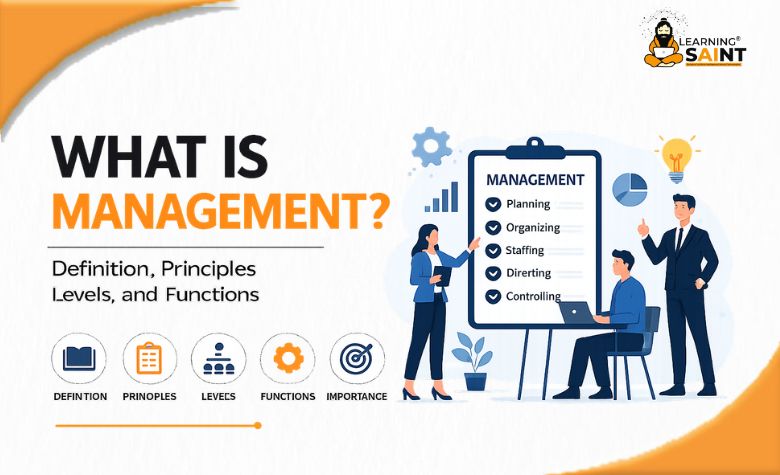
The process of management includes several important functions such as planning, organizing, staffing, directing, and controlling. These functions help organizations operate smoothly and achieve long-term success.
In modern organizations, management also includes innovation, technology adaptation, employee motivation, and strategic decision-making. Businesses that apply effective management practices can handle competition, increase profits, and maintain customer satisfaction more efficiently.
Definition of Management by Experts
Many management experts and scholars have explained management in different ways. These definitions help us understand the meaning, scope, and importance of management in organizations.
According to Henri Fayol, management means “to forecast and plan, to organize, to command, to coordinate, and to control.” Fayol emphasized that management is a process involving several important functions required to achieve organizational goals.
Peter Drucker, known as the father of modern management, defined management as “getting things done through people.” This definition highlights the importance of teamwork, leadership, and coordination in achieving business objectives.
Mary Parker Follett defined management as “the art of getting things done through people.” She focused on human relationships and cooperation within organizations.
F.W. Taylor, who introduced scientific management, believed management is “knowing exactly what you want men to do and seeing that they do it in the best and cheapest way.” His definition focused on efficiency and productivity.
These expert definitions show that management is not just about giving orders. It is about planning work, utilizing resources wisely, motivating employees, and achieving goals systematically. Modern management combines leadership, communication, strategic thinking, and decision-making to improve organizational performance.
Importance of Management in Business
Management plays a crucial role in the success and growth of every business organization. Without proper management, businesses may struggle with poor coordination, low productivity, employee conflicts, and financial losses.
One major importance of management is achieving organizational goals efficiently. Managers create plans, assign tasks, and monitor progress to ensure objectives are completed successfully. Effective management helps businesses use resources such as money, time, technology, and manpower wisely.
Management also improves employee performance. Skilled managers motivate workers, provide guidance, and create a positive work environment. This increases employee satisfaction, productivity, and teamwork.
Another important role of management is decision-making. Managers analyze situations, solve problems, and make strategic decisions that support business growth. Good decisions help organizations adapt to market changes and competition.
Management also helps maintain discipline and coordination among departments. It ensures all employees work toward common goals without confusion or conflict. Proper communication and leadership improve organizational efficiency.
In today’s competitive business world, management is essential for innovation and growth. Businesses that use effective management strategies can improve customer satisfaction, expand operations, increase profits, and achieve long-term success.
Objectives of Management
The main objective of management is to achieve organizational goals effectively and efficiently. Every organization uses management practices to improve performance, productivity, and profitability while maintaining quality standards.
One important objective of management is optimum utilization of resources. Managers ensure that resources such as manpower, finance, machinery, and materials are used efficiently to reduce waste and maximize output.
Another objective is improving employee productivity. Management motivates employees, provides training, and creates a supportive work environment that encourages better performance and teamwork.
Management also aims to achieve organizational growth and stability. Businesses use strategic planning and proper coordination to expand operations, increase market share, and maintain financial stability.
Customer satisfaction is another major objective of management. Companies focus on delivering quality products and services to build trust and maintain long-term customer relationships.
Management also works toward innovation and adaptability. Organizations must adopt new technologies, improve processes, and respond to changing market trends to remain competitive.
Social responsibility is also an important objective. Modern businesses are expected to contribute positively to society by following ethical practices, protecting the environment, and supporting community development.
Overall, management helps organizations balance productivity, employee welfare, customer satisfaction, and business growth effectively.
Key Characteristics of Management
Management has several unique characteristics that make it an essential part of every organization. These characteristics help explain the nature and importance of management in achieving organizational success.
One key characteristic of management is goal-oriented. Management always focuses on achieving specific organizational objectives through planned activities and coordinated efforts.
Management is also universal. It is required in all types of organizations, including businesses, schools, hospitals, government offices, and non-profit organizations. Every organization needs proper management for smooth functioning.
Another characteristic is continuous process. Management is not a one-time activity. It involves continuous planning, organizing, directing, and controlling operations to achieve long-term goals.
Management is dynamic in nature because it changes according to business environments, technology, and market conditions. Managers must adapt strategies and decisions based on changing situations.
Management is both an art and a science. It requires practical skills, creativity, leadership, and experience while also following systematic principles and theories.
Decision-making is another important characteristic of management. Managers regularly make decisions related to planning, staffing, budgeting, and problem-solving.
Management also involves coordination. It brings together employees, departments, and resources to ensure teamwork and smooth organizational operations.
These characteristics show that management is essential for maintaining efficiency, discipline, and productivity in every organization.
Nature of Management
The nature of management explains its basic features, functions, and role within organizations. Understanding the nature of management helps businesses and students understand how organizations operate effectively.
Management is considered a purposeful activity because it focuses on achieving predefined organizational goals. Every managerial action is directed toward improving performance and productivity.
Management is also a social process because it involves working with people. Managers communicate, guide, motivate, and coordinate employees to achieve common objectives. Human interaction is a major part of management.
Another important nature of management is that it is intangible. Management itself cannot be seen physically, but its results can be observed through organizational success, employee performance, and productivity improvements.
Management is multidisciplinary because it uses concepts from economics, psychology, sociology, statistics, and behavioral science. Modern management combines knowledge from different fields to solve organizational problems.
The nature of management is also flexible and adaptive. Managers must adjust plans and strategies according to changes in technology, competition, customer demands, and market trends.
Management is a group activity as organizational goals are achieved through teamwork and cooperation rather than individual efforts alone.
In today’s business world, management is becoming more technology-driven and innovation-focused. Organizations use modern tools, software, and leadership techniques to improve efficiency and decision-making processes.
Scope of Management
The scope of management is very broad because it covers all activities required to run an organization successfully. It includes planning, organizing, staffing, directing, controlling, and coordinating different business functions.
One major area within the scope of management is production management. This focuses on manufacturing processes, quality control, inventory management, and efficient use of machinery and resources.
Financial management is another important area. It involves budgeting, investment planning, cost control, financial analysis, and managing company funds effectively.
Human resource management deals with recruitment, training, employee welfare, performance evaluation, and maintaining healthy workplace relationships.
Marketing management focuses on product promotion, customer satisfaction, branding, advertising, and market research. It helps businesses attract and retain customers.
Operations management ensures smooth day-to-day business activities, while strategic management focuses on long-term planning and organizational growth.
The scope of management also includes project management, risk management, information management, and international business management. Modern organizations require specialized management practices to handle complex business operations.
As businesses continue to grow globally, the scope of management is expanding rapidly. Managers today need technical knowledge, leadership abilities, communication skills, and strategic thinking to manage organizations successfully.
Principles of Management
Principles of management are general guidelines that help managers make effective decisions and improve organizational performance. These principles provide a foundation for planning, organizing, and controlling business activities efficiently.
Management principles are flexible and can be applied to different types of organizations. They help maintain discipline, improve coordination, and increase productivity within the workplace.
One important principle is division of work, which means tasks should be divided among employees according to their skills and expertise. This increases efficiency and specialization.
Authority and responsibility are also essential principles. Managers must have the authority to make decisions while also being responsible for organizational outcomes.
Discipline is another important principle because organizations need rules and regulations for smooth functioning. Employees and managers should follow company policies and maintain professional behavior.
Unity of command means employees should receive instructions from only one superior to avoid confusion and conflicts.
Coordination and teamwork are important management principles that help departments work together toward common organizational goals.
Modern management principles also emphasize employee motivation, innovation, flexibility, ethical behavior, and customer satisfaction. Organizations that follow strong management principles can improve efficiency, maintain stability, and achieve long-term success more effectively.
Henri Fayol’s 14 Principles of Management
Henri Fayol introduced 14 important principles of management that are still widely used in modern organizations. These principles help managers improve organizational efficiency and maintain proper coordination.
The first principle is division of work, which increases productivity through specialization. Authority and responsibility should go together so managers can perform their duties effectively.
Discipline is necessary for maintaining order and respect within organizations. Unity of command means employees should receive instructions from one manager only.
Unity of direction ensures all organizational activities move toward the same objective. Subordination of individual interest means organizational goals should be prioritized over personal interests.
Fair remuneration motivates employees and improves job satisfaction. Centralization refers to balancing authority between top management and employees.
Scalar chain means organizations should maintain a clear chain of command for communication and reporting. Order ensures everything and everyone is placed properly within the organization.
Equity promotes fairness and kindness in employee treatment. Stability of tenure helps organizations retain experienced employees and reduce turnover.
Initiative encourages employees to contribute ideas and participate in decision-making. Esprit de corps promotes teamwork, unity, and positive workplace relationships.
Fayol’s principles continue to influence modern business management because they provide a strong framework for organizational success and efficient administration.
Levels of Management
Organizations are divided into different levels of management to ensure proper coordination, supervision, and decision-making. These levels define managerial authority, responsibilities, and communication flow within the organization.
Generally, management is divided into three main levels: top-level management, middle-level management, and lower-level management. Each level performs different functions but works together to achieve organizational goals.
Top-level management focuses on strategic planning and major business decisions. They set organizational objectives, policies, and long-term goals.
Middle-level management acts as a link between top management and lower management. They implement company plans, coordinate departments, and supervise managers.
Lower-level management directly supervises employees and daily operations. They ensure tasks are completed efficiently and according to organizational standards.
These levels create a structured management system that improves communication, accountability, and workflow efficiency. Clear management hierarchy helps organizations avoid confusion and maintain discipline.
Modern organizations may also use flat management structures, but managerial levels remain important for controlling operations and achieving business success. Each management level plays a unique role in improving organizational productivity and performance.
Top-Level Management Explained
Top-level management is the highest level of management within an organization. It includes executives such as the Chief Executive Officer (CEO), Managing Director, President, and Board of Directors. These managers are responsible for making major business decisions and setting organizational goals.
The primary role of top-level management is strategic planning. They create long-term business plans, policies, and organizational objectives that guide the entire company.
Top managers also make decisions related to business expansion, investments, mergers, product development, and market strategies. Their decisions directly affect the future success of the organization.
Another important responsibility of top-level management is leadership and vision. They inspire employees, establish company culture, and maintain organizational direction.
Top managers also coordinate with external stakeholders such as investors, government authorities, business partners, and customers. They represent the organization publicly and maintain corporate reputation.
In modern businesses, top-level management must adapt to technological changes, global competition, and market trends. Strong leadership, communication skills, and decision-making abilities are essential for successful top management.
Effective top-level management helps organizations achieve growth, profitability, innovation, and long-term sustainability in competitive business environments.
Middle-Level Management Explained
Middle-level management acts as a bridge between top-level management and lower-level management. This level includes department managers, branch managers, plant managers, and regional managers. Their main responsibility is to implement the plans and policies created by top management.
Middle managers coordinate the activities of different departments such as marketing, finance, human resources, and production. They ensure that organizational goals are properly communicated to employees and that work is completed according to company standards.
One important role of middle-level management is supervision and coordination. They monitor employee performance, solve departmental problems, and maintain smooth communication between upper and lower management levels.
Middle managers also participate in decision-making by providing feedback, reports, and suggestions to top executives. They help improve productivity by managing resources efficiently and motivating employees.
Training and employee development are also important responsibilities of middle-level management. They guide team leaders and ensure workers receive proper support and instructions.
In modern organizations, middle-level managers play a critical role in handling operational challenges, implementing business strategies, and improving teamwork. Their ability to coordinate departments and maintain organizational efficiency directly affects business success.
Lower-Level Management Explained
Lower-level management is the first or supervisory level of management in an organization. It includes supervisors, foremen, team leaders, and section officers who directly interact with employees and workers.
The main responsibility of lower-level management is supervising day-to-day operations. They ensure employees complete tasks properly, maintain productivity, and follow organizational rules and procedures.
Lower managers act as a communication link between workers and higher management. They pass instructions from upper management to employees and report employee feedback, problems, and performance updates to senior managers.
One important role of lower-level management is maintaining discipline and teamwork in the workplace. They monitor attendance, work quality, safety measures, and employee behavior.
Lower managers also help train new employees and provide guidance during daily operations. They motivate workers and solve small operational issues quickly to avoid delays.
Because they work closely with employees, lower-level managers have a strong impact on productivity and workplace relationships. Their leadership skills influence employee morale and organizational efficiency.
In modern businesses, lower-level management is essential for smooth workflow, quality control, and operational success. Effective supervision helps organizations achieve targets while maintaining employee satisfaction and discipline.
Functions of Management
Functions of management refer to the major activities managers perform to achieve organizational goals efficiently. These functions provide a systematic approach for planning, organizing, and controlling business operations.
The five major functions of management are planning, organizing, staffing, directing, and controlling. These functions work together to ensure smooth organizational performance and effective resource utilization.
Planning involves setting goals and deciding future actions. Managers create strategies and plans to achieve organizational objectives successfully.
Organizing focuses on arranging resources, assigning tasks, and establishing authority relationships within the organization. It helps maintain proper coordination among departments and employees.
Staffing involves recruitment, training, employee selection, and workforce management. Organizations need skilled employees to improve productivity and performance.
Directing is related to leadership, communication, motivation, and supervision. Managers guide employees and encourage them to work toward common goals.
Controlling involves monitoring performance, comparing results with standards, and taking corrective actions if necessary. This function ensures organizational activities remain aligned with business objectives.
These management functions are interconnected and essential for organizational success. Effective managers perform all these functions properly to improve productivity, employee satisfaction, and business growth.
Planning Function of Management
Planning is the first and most important function of management. It involves deciding organizational goals and determining the best course of action to achieve them. Planning helps businesses prepare for future challenges and opportunities.
Managers create short-term and long-term plans based on organizational objectives, market conditions, and available resources. Proper planning reduces uncertainty and improves decision-making.
One major advantage of planning is better resource utilization. Organizations can allocate manpower, money, technology, and materials efficiently to avoid waste and improve productivity.
Planning also helps organizations manage risks and solve potential problems before they occur. Businesses that plan effectively can adapt to changing market trends and competition more successfully.
There are different types of planning, including strategic planning, operational planning, tactical planning, and contingency planning. Each type serves a different purpose within the organization.
Effective planning improves coordination among departments because everyone understands their responsibilities and organizational goals clearly. It also helps managers monitor progress and evaluate performance more accurately.
In today’s competitive business environment, planning is essential for business growth, innovation, and long-term sustainability. Organizations without proper planning often face confusion, delays, and poor performance.
Organizing Function of Management
Organizing is the management function that focuses on arranging resources and activities to achieve organizational objectives efficiently. After planning, managers organize tasks, employees, and resources to ensure smooth operations.
The organizing function includes assigning duties, defining authority, creating departments, and establishing reporting relationships. It ensures every employee knows their role and responsibilities clearly.
One important aspect of organizing is division of work. Tasks are divided among employees based on their skills, expertise, and qualifications. This improves specialization and productivity.
Organizing also helps maintain coordination between different departments such as marketing, finance, production, and human resources. Proper coordination reduces conflicts and improves workflow efficiency.
A strong organizational structure improves communication and decision-making within the company. Employees can understand who reports to whom and how information flows within the organization.
Organizing also involves resource allocation. Managers ensure materials, technology, finances, and manpower are available where needed for efficient task completion.
In modern businesses, organizing plays a major role in improving flexibility, teamwork, and operational efficiency. Companies with effective organizational structures can respond quickly to market changes and business challenges.
Staffing Function of Management
Staffing is the management function related to recruiting, selecting, training, and maintaining employees within an organization. It ensures the right people are placed in the right positions to achieve organizational goals effectively.
The staffing process begins with manpower planning, where managers identify the number and type of employees needed. After that, recruitment and selection processes are conducted to hire qualified candidates.
Training and development are important parts of staffing. Organizations provide employees with knowledge, technical skills, and professional development opportunities to improve performance and productivity.
Staffing also includes performance appraisal, promotions, transfers, and employee compensation. Proper staffing practices help maintain employee satisfaction and reduce turnover.
One major benefit of staffing is improved organizational efficiency. Skilled employees can complete tasks more effectively and contribute to business growth.
Modern staffing also focuses on employee motivation, diversity, workplace culture, and talent management. Companies now use advanced recruitment technologies and human resource management systems to improve hiring processes.
In today’s competitive business environment, staffing is essential for building a strong workforce and maintaining organizational success. Businesses with talented and motivated employees gain a significant competitive advantage.
Directing Function of Management
Directing is the management function that involves guiding, supervising, motivating, and communicating with employees to achieve organizational objectives. It ensures employees work efficiently and remain focused on company goals.
The directing function includes leadership, communication, motivation, and supervision. Managers provide instructions and support to employees so they can perform their tasks effectively.
Leadership is one of the most important aspects of directing. Good leaders inspire employees, build confidence, and encourage teamwork within the organization.
Communication also plays a major role in directing. Managers must clearly explain goals, responsibilities, and expectations to employees to avoid misunderstandings and confusion.
Motivation is another key element of directing. Managers use rewards, recognition, incentives, and encouragement to improve employee morale and productivity.
Supervision helps managers monitor employee performance and provide guidance whenever needed. Effective supervision improves work quality and discipline.
In modern organizations, directing is essential for maintaining positive workplace relationships and improving employee engagement. Strong directing skills help businesses increase productivity, reduce conflicts, and achieve organizational success more efficiently.
Controlling Function of Management
Controlling is the management function that ensures organizational activities are performed according to plans and standards. It helps managers measure performance, identify problems, and take corrective actions when necessary.
The controlling process begins with setting performance standards. Managers compare actual performance with expected results to evaluate organizational efficiency.
If there are differences between planned and actual performance, managers take corrective measures to improve operations. This helps organizations avoid losses and achieve objectives more effectively.
Controlling also improves accountability within the organization. Employees become more responsible because their performance is regularly monitored and evaluated.
Financial control is an important part of controlling. Managers monitor budgets, expenses, profits, and investments to maintain financial stability.
Quality control ensures products and services meet customer expectations and organizational standards. Businesses use inspections, testing, and feedback systems to maintain quality.
Modern organizations use advanced technologies and management information systems for better control and performance monitoring. Data analysis and real-time reporting help managers make faster and more accurate decisions.
Effective controlling helps organizations maintain discipline, improve productivity, reduce waste, and achieve long-term business success.
Coordination in Management
Coordination is the process of integrating organizational activities and resources to achieve common goals efficiently. It ensures all departments, employees, and business functions work together smoothly.
Coordination is essential because organizations consist of different departments such as finance, marketing, production, and human resources. Without coordination, departments may work independently and create confusion or conflicts.
One major benefit of coordination is improved teamwork. Employees understand their roles and cooperate effectively to complete tasks successfully.
Coordination also improves communication within organizations. Managers share information, instructions, and updates among departments to maintain smooth operations.
Effective coordination helps avoid duplication of work, resource wastage, and operational delays. It improves productivity and organizational efficiency.
Managers achieve coordination through proper planning, leadership, communication, meetings, and supervision. Technology and management systems also support coordination in modern businesses.
Coordination becomes even more important in large organizations and multinational companies where multiple teams work across different locations and time zones.
In today’s competitive business environment, strong coordination helps organizations improve performance, customer satisfaction, and overall business success.
Role of Managers in an Organization
Managers play a crucial role in organizational success because they guide employees, make decisions, and ensure business operations run smoothly. They are responsible for achieving organizational goals efficiently and effectively.
One major role of managers is planning organizational activities. They set objectives, create strategies, and allocate resources to achieve business targets successfully.
Managers also organize work by assigning tasks, creating departments, and maintaining proper coordination between teams and employees.
Leadership is another important managerial role. Managers motivate employees, solve conflicts, and create a positive work environment that improves productivity and teamwork.
Decision-making is a key responsibility of managers. They analyze situations, identify problems, and make decisions related to finance, operations, staffing, and business growth.
Managers also monitor employee performance and ensure organizational standards are maintained. They provide training, guidance, and feedback to improve employee skills and efficiency.
In modern organizations, managers also focus on innovation, technology adaptation, customer satisfaction, and strategic planning. Strong managerial skills help businesses handle competition and achieve long-term growth.
Overall, managers act as the backbone of organizations by balancing resources, employees, and business goals effectively
Skills Required for Effective Management
Effective management requires a combination of technical, communication, leadership, and problem-solving skills. Managers need these skills to handle organizational challenges and achieve business goals successfully.
One important management skill is leadership. Managers should inspire employees, build teamwork, and create a positive work environment.
Communication skills are also essential because managers interact with employees, customers, suppliers, and stakeholders regularly. Clear communication improves coordination and reduces misunderstandings.
Decision-making skills help managers analyze situations and choose the best solutions for organizational problems. Good decisions improve productivity and business growth.
Technical skills are important for understanding business operations, technologies, and industry-specific processes. Managers with technical knowledge can guide employees more effectively.
Time management and organizational skills help managers handle multiple tasks efficiently and meet deadlines successfully.
Problem-solving and critical thinking skills are also important because managers face operational challenges, employee conflicts, and market competition regularly.
Modern management additionally requires adaptability, emotional intelligence, digital knowledge, and strategic thinking. Businesses today prefer managers who can handle technological changes and lead organizations in competitive environments.
Developing these management skills helps professionals become effective leaders and contribute to organizational success.
Types of Management
Management can be divided into different types based on organizational functions and areas of operation. Each type focuses on specific business activities and objectives.
Production management deals with manufacturing processes, quality control, inventory management, and efficient use of machinery and resources.
Human resource management focuses on recruitment, training, employee welfare, performance management, and workplace relationships.
Financial management involves budgeting, investment planning, cost control, accounting, and financial decision-making.
Marketing management focuses on advertising, branding, customer satisfaction, market research, and product promotion.
Operations management ensures smooth day-to-day business operations and process efficiency.
Project management focuses on planning, executing, monitoring, and completing projects within deadlines and budgets.
Strategic management involves long-term business planning, competitive analysis, and organizational growth strategies.
Information technology management handles digital systems, cybersecurity, data management, and technological infrastructure.
Modern organizations often combine different management types to improve efficiency and achieve business objectives effectively. Understanding these types helps businesses assign specialized managers and improve operational performance.
Difference Between Management and Administration
Management and administration are closely related concepts, but they have different roles and responsibilities within organizations. Understanding their differences helps clarify organizational structures and functions.
Administration mainly focuses on setting organizational objectives, policies, and strategies. Administrators are involved in high-level decision-making and long-term planning.
Management focuses on implementing policies and achieving organizational goals through planning, organizing, directing, and controlling activities.
Administration is generally associated with top-level authority, while management operates at middle and lower organizational levels.
Another difference is that administration determines “what should be done,” whereas management determines “how it should be done.”
Administration is more concerned with policy formulation and governance, while management focuses on execution and operational efficiency.
Managers directly supervise employees and daily operations, whereas administrators concentrate on strategic direction and organizational control.
In modern organizations, the distinction between management and administration is becoming less strict because many professionals perform both strategic and operational roles.
Both administration and management are essential for organizational success. Administration provides direction and policies, while management ensures effective implementation and operational performance.
Importance of Management in Modern Organizations
Management plays a vital role in modern organizations because businesses today operate in highly competitive and rapidly changing environments. Effective management helps organizations achieve goals, improve productivity, and maintain long-term stability.
One major importance of management is efficient resource utilization. Managers ensure that human resources, finances, technology, and materials are used properly to maximize productivity and reduce waste.
Management also improves coordination among departments and employees. Proper communication and teamwork help organizations complete projects successfully and maintain smooth operations.
In modern organizations, management supports innovation and adaptability. Businesses must respond quickly to market changes, customer demands, and technological advancements. Skilled managers help organizations implement new strategies and maintain competitiveness.
Employee motivation is another important aspect of management. Managers create positive work environments, encourage teamwork, and improve employee satisfaction, which increases overall productivity.
Management also plays a key role in decision-making and problem-solving. Organizations rely on managers to handle risks, solve operational challenges, and make strategic business decisions.
In today’s digital business environment, management helps companies maintain customer satisfaction, improve operational efficiency, and achieve sustainable growth. Organizations with strong management systems are more likely to succeed in competitive global markets.
Challenges Faced by Managers Today
Modern managers face several challenges due to changing business environments, technological advancements, and increasing global competition. Managing organizations today requires flexibility, leadership, and strong decision-making skills.
One major challenge is technological change. Businesses continuously adopt new software, automation tools, and digital systems. Managers must ensure employees adapt to these technologies efficiently.
Another challenge is employee management. Modern workplaces include diverse teams with different skills, cultures, and expectations. Managers must maintain teamwork, motivation, and workplace harmony.
Global competition is also a significant challenge. Organizations compete with businesses worldwide, requiring managers to improve quality, innovation, and customer service constantly.
Time management and multitasking can also be difficult because managers handle multiple responsibilities such as planning, supervision, communication, and problem-solving simultaneously.
Economic uncertainty and market fluctuations create additional pressure for managers. They must make smart financial and operational decisions during changing business conditions.
Remote work and hybrid work models have introduced new management challenges related to communication, productivity tracking, and employee engagement.
Modern managers must also focus on cybersecurity, customer satisfaction, sustainability, and organizational innovation. Successfully handling these challenges helps organizations remain competitive and achieve long-term success.
Advantages of Good Management
Good management provides many advantages that help organizations improve productivity, efficiency, and overall business performance. Effective management creates a strong foundation for long-term organizational success.
One major advantage is improved productivity. Skilled managers organize resources efficiently and ensure employees work toward common goals. This increases operational efficiency and reduces waste.
Good management also improves employee motivation and job satisfaction. Managers who communicate effectively and support employees create positive workplace environments that encourage teamwork and performance.
Another important advantage is better decision-making. Effective managers analyze situations carefully and make strategic decisions that support business growth and stability.
Good management helps organizations achieve goals on time and within budget. Proper planning and coordination reduce delays and operational confusion.
Customer satisfaction also improves with effective management because businesses can maintain product quality, provide better services, and respond quickly to customer needs.
Strong management systems help organizations handle risks and adapt to market changes more efficiently. Businesses become more flexible and competitive in changing environments.
Good management additionally supports innovation, employee development, and organizational growth. Companies with effective management practices are more likely to maintain profitability and achieve long-term success.
Disadvantages of Poor Management
Poor management can negatively affect organizational performance, employee morale, and business growth. Organizations with ineffective management often struggle with low productivity, confusion, and financial problems.
One major disadvantage of poor management is lack of coordination. Employees may not understand their responsibilities clearly, leading to conflicts, delays, and operational inefficiency.
Poor communication is another common problem. When managers fail to provide proper guidance and feedback, misunderstandings increase within the organization.
Low employee motivation is also a serious issue caused by poor management. Employees may feel ignored, stressed, or dissatisfied, which reduces productivity and increases staff turnover.
Poor decision-making can create financial losses and operational failures. Ineffective managers may allocate resources improperly or fail to respond to market changes quickly.
Organizations with poor management often face reduced customer satisfaction because product quality and service standards decline.
Lack of planning and supervision may result in missed deadlines, wasted resources, and decreased profitability. Poor management can also damage organizational reputation and market position.
In today’s competitive business environment, ineffective management can prevent companies from adapting to technological advancements and changing customer expectations. Strong management is essential for maintaining stability, productivity, and long-term organizational success.
Management Examples in Real Life
Management can be seen in almost every aspect of daily life and business operations. Real-life examples help us understand how management functions work in practical situations.
In a business organization, managers plan projects, assign tasks to employees, monitor performance, and ensure deadlines are achieved. For example, a marketing manager organizes advertising campaigns and coordinates team activities to increase sales.
Schools and colleges also use management practices. Principals and administrators manage teachers, students, schedules, budgets, and educational activities to maintain smooth operations.
Hospitals rely heavily on management for patient care, staff coordination, medical supplies, and emergency services. Hospital administrators ensure doctors, nurses, and departments work together effectively.
Event management is another practical example. Organizing weddings, conferences, or concerts requires planning, coordination, budgeting, staffing, and supervision.
Even families use management in daily life. Parents plan household budgets, organize schedules, and coordinate family activities to maintain balance and discipline.
Sports teams also depend on management. Coaches and team managers plan strategies, supervise training sessions, and motivate players to achieve success.
These real-life examples show that management is essential everywhere. Whether in business, education, healthcare, sports, or personal life, effective management helps people achieve goals efficiently and successfully.
Career Opportunities in Management
Management offers a wide range of career opportunities across different industries and business sectors. Organizations need skilled managers to handle operations, employees, projects, and business growth effectively.
One popular career option is business management, where professionals manage company operations, planning, and organizational strategies. Business managers work in industries such as retail, manufacturing, finance, healthcare, and technology.
Human resource management is another growing field. HR managers handle recruitment, employee training, payroll, workplace policies, and employee relations.
Marketing management careers focus on branding, advertising, sales strategies, customer engagement, and market research. Skilled marketing managers help businesses increase visibility and revenue.
Financial management is also a highly respected career option. Financial managers oversee budgeting, investments, financial planning, and company finances.
Project management careers are in high demand because organizations require professionals who can manage projects within deadlines and budgets successfully.
Operations management, supply chain management, hospitality management, healthcare management, and IT management are additional career opportunities available in modern businesses.
Students can pursue management careers through courses such as BBA, MBA, PGDM, and specialized management certifications. Strong communication, leadership, and problem-solving skills help professionals build successful careers in management.
Why Management Is Important for Students
Management is important for students because it helps develop leadership, communication, decision-making, and organizational skills that are valuable in both academic and professional life.
Students who understand management concepts can manage their time, studies, projects, and responsibilities more effectively. Management skills improve discipline and productivity in daily activities.
Learning management also prepares students for future careers. Almost every industry requires professionals who can lead teams, solve problems, and handle responsibilities efficiently.
Management education teaches students how organizations operate and how business decisions are made. This knowledge helps students understand teamwork, leadership, and business strategies.
Another important benefit is improved confidence and communication. Students learn presentation skills, group coordination, and problem-solving techniques that are useful in professional environments.
Management skills also encourage creativity and innovation. Students learn how to plan projects, analyze situations, and find practical solutions to challenges.
In today’s competitive world, management knowledge provides students with better career opportunities and leadership potential. Whether students want to become entrepreneurs, managers, or professionals in any field, management skills help them succeed in their personal and professional lives.
Future of Management in the Digital Era
The future of management is rapidly evolving because of technological advancements, digital transformation, and changing workplace environments. Modern managers must adapt to new tools, technologies, and business models to remain competitive.
Artificial intelligence, automation, and data analytics are transforming how organizations operate. Managers now use digital tools for decision-making, performance monitoring, communication, and project management.
Remote work and hybrid work models are also changing management practices. Managers must learn how to lead virtual teams, maintain employee engagement, and ensure productivity in digital workplaces.
The future of management will focus more on innovation, adaptability, and continuous learning. Businesses require managers who can quickly respond to market changes and technological developments.
Cybersecurity, digital communication, and information management are becoming important areas of managerial responsibility. Organizations must protect data and maintain secure digital systems.
Employee well-being and work-life balance are also gaining importance in modern management. Future managers will need emotional intelligence and people-management skills to maintain healthy workplace cultures.
Sustainability and ethical business practices will continue influencing management decisions. Companies are expected to focus on environmental responsibility and social impact.
Overall, the future of management in the digital era will combine technology, leadership, innovation, and strategic thinking to achieve organizational success.
Conclusion
Management is one of the most important elements of every successful organization. It helps businesses, institutions, and individuals achieve goals through proper planning, organizing, staffing, directing, and controlling activities effectively.
From small businesses to multinational companies, management plays a vital role in improving productivity, employee performance, customer satisfaction, and organizational growth. Effective management ensures resources are used wisely while maintaining discipline and coordination within the workplace.
Modern management is continuously evolving due to technological advancements, digital transformation, and changing business environments. Managers today need strong leadership, communication, adaptability, and problem-solving skills to handle modern challenges successfully.
Understanding management principles, functions, levels, and importance helps students, professionals, and entrepreneurs build successful careers and organizations. Whether in education, healthcare, sports, family life, or business operations, management is essential everywhere.
Organizations with strong management systems can adapt to competition, encourage innovation, and achieve long-term success more effectively. As industries continue to grow globally, the demand for skilled managers and management knowledge will continue increasing in the future.
Frequently Asked Questions (FAQs)
1. What is management in simple words?
Management is the process of planning, organizing, directing, and controlling people and resources to achieve organizational goals efficiently. It helps businesses and organizations work smoothly and improve productivity.
2. What are the 5 functions of management?
The five main functions of management are:
- Planning
- Organizing
- Staffing
- Directing
- Controlling
These functions help managers achieve organizational goals effectively.
3. What are the 3 levels of management?
The three levels of management are:
- Top-Level Management
- Middle-Level Management
- Lower-Level Management
Each level has different responsibilities and authority within an organization.
4. Why is management important in business?
Management is important because it improves productivity, coordinates employees, utilizes resources efficiently, and helps organizations achieve business goals successfully. Good management also supports growth and customer satisfaction.
5. What are the principles of management?
Principles of management are guidelines that help managers improve organizational efficiency and decision-making. Some common principles include division of work, discipline, unity of command, authority, and coordination.
6. What is the difference between management and administration?
Administration focuses on setting policies and organizational goals, while management focuses on implementing those policies and handling daily operations within the organization.
7. What skills are required for a manager?
A manager should have leadership, communication, decision-making, problem-solving, time management, and technical skills. These skills help managers lead teams and improve organizational performance.
8. What are the main types of management?
The main types of management include:
- Financial Management
- Human Resource Management
- Marketing Management
- Operations Management
- Project Management
- Strategic Management
9. What is management in simple words?
Management is the process of planning, organizing, directing, and controlling resources and people to achieve organizational goals effectively.
10. What are the 5 functions of management?
The five major functions of management are planning, organizing, staffing, directing, and controlling.


Reply To Elen Saspita