 United States
 India
 United Kingdom
 Australia
 Canada
 Nigeria
 Others


 Learning Saint
Wherever you are sitting right now, you must have your phone, laptop, smart TV, or even some home appliance connected to the internet. Each of those devices using the internet needs a unique address to send and receive data. This address is known as an IP address. It operates a little bit like a home address for the internet. Currently, there are 2 versions of addressing systems that are in use: IPv4 and IPv6.
This article will break both of them down for you and make the difference between IPv4 and IPv6 clear in simple and readable language. You will understand how every system operates, why IPv6 was developed, and the benefits of IPv6 over IPv4.
What do you understand by an IP address?
Before you start understanding the difference between IPv4 and IPv6, you must carefully understand what an IP address actually is. An IP address, also known as an Internet Protocol address, is a unique number that is assigned to every device connected to a certain network. It basically allows devices to look for and find each other and exchange accurate information. To understand it better, imagine it works like a postal address that helps the mail reach the right house.
If there were no IP address, a device would have no way to find out where the data should be sent or received from. Every website you visit, every email you send, and every video that you stream are dependent on this addressing system working perfectly behind the screen.
What do you mean by IPv4?
IPv4, also known as Internet Protocol version 4, is the original version of the addressing system that is most commonly and widely used. It was created decades ago and still remains the backbone of internet communication for a very long time.
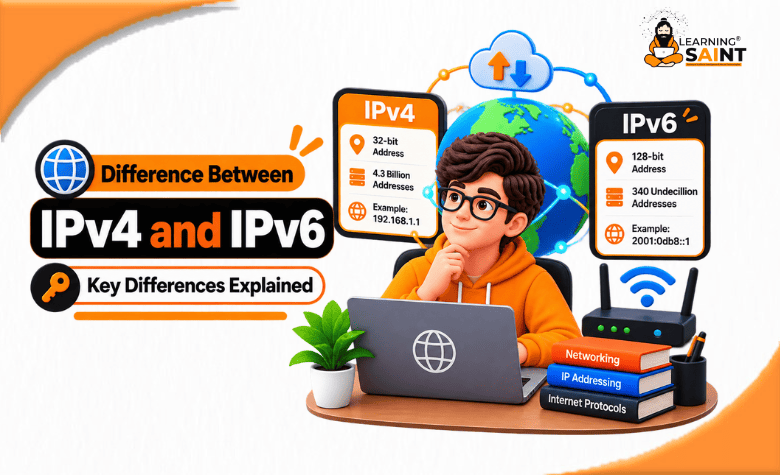
The IPv4 addresses are written in a particular pattern, such as 4 separated by periods, like 192.168.1.1. Each of these numbers can range from 0 to 255, depending upon a 32-bit address structure. This structure allows for a total of about 4.3 billion unique addresses.
When IPv4 was first created, 4.3 billion addresses felt like more than enough. However, with the increasing number of internet-connected devices, specifically the rising number of smartphones and smart devices, this address pool has become rapidly limited.
What do you mean by IPv6?
IPv6, also known as Internet Protocol version 6, is the newer addressing system that was created and built to solve the address shortage that was created by IPv4. The structure it uses is completely different. It is based on 128-bit addresses that allow a huge number of possible addresses, which would be around 340 undecillion in total.
IPv6 addresses are a lot different from how IPv4 addresses look. The numbers in the IPv6 address are not separated by periods; instead, they use a series of hexadecimal characters that are separated by colons. For example, 2001:0db8:85a3:0000:0000:82ade:0370:7665. This format helps them allow a much larger and more flexible addressing system.
Difference Between IPv4 and IPv6: Core Technical Differences
Now let's go through the main points that explain the difference between IPv4 and IPv6 in more detail.
|
Category |
IPv4 |
IPv6 |
|
Length and format of the address |
IPv4 uses the length of 32-bit addresses. It is written in a familiar and dotted-decimal format. For example, 200.007.0.1 |
IPv6, on the other hand, uses a 128-bit address length. It is written in a hexadecimal format, separated by colons. This shift in structure is the only reason that IPv6 supports such a huge increase in the number of available addresses. |
|
Total number of available addresses |
IPv4 is able to support approximately 4.3 billion unique addresses. This range, however, once felt sufficient, but the increasing number of internet-connected devices makes it seem too low for the global demand currently. |
IPv6 supports a massive number of addresses. It effectively solves this shortage for the near future. |
|
Address configuration |
IPv4-preferred devices usually need manual configuration or a system called DHCP (Dynamic Host Configuration Protocol) to automate address assignment. |
IPv6 includes a default feature called stateless address autoconfiguration (SLAAC). It allows devices to configure their own addresses better and more easily, without always requiring a separate configuration server. |
|
Header structure |
The headers of IPv4 include various fields, along with a checksum used for basic error-checking at the network layer. |
Whereas the IPv6 headers are simpler and more streamlined. It removes the header checksum, as error-checking has become more common and is handled at other layers of network communication. |
|
NAT |
NAT stands for network address translation. As the IPv4 addresses are limited, there is a technique called Network Address Translation that is commonly used to allow multiple devices on a local network to easily share a single public IP address. |
IPv6 has a comparatively larger address space that ultimately reduces the requirement for NAT. As there are enough addresses for devices to have their separate and unique addresses. |
|
Security features |
Originally, IPv4 was not created with default security features. It refers to the fact that secure communication has to be added separately. |
IPv6 was created with support for IPsec, also known as Internet Protocol Security, as a part of its core design. It supports encrypted and authenticated communication implementation, which still depends on how a network is configured. |
|
Broadcast vs Multicast |
IPv4 is dependent on broadcast addressing, sending data to every device available on a local network, irrespective of the fact if each device actually needs it or not. |
IPv6 removes broadcast completely and instead depends upon multicast and anycast addressing. It sends data more efficiently, specifically to devices that particularly require it. |
|
Fragmentation Handling |
In IPv4, both the sending device and routers along the way can fragment data packets that are very large. |
In IPv6, the sending device is only responsible for fragmentation. This basically simplifies the job routers need to do and can modify overall network performance. |
What is the history behind the creation of IPv6?
You have seen the technical difference between IPv4 and IPv6, but to understand them completely, you must know briefly about why IPv6 was created along with IPv4. IPv4 was created decades ago, specifically at a time when the internet connected a comparatively small number of research institutions and computers. It is a 32-bit address system that offers around 4.3 billion unique addresses. It felt more than sufficient for the coming future at that particular time.
With the rising scope of the internet from its origin to homes, businesses, mobile phones, and apparently uncountable smart devices, it was clear that IPv4 and its address space would run out soon. Engineers started creating IPv6 in the 1900s, especially in order to solve this growing shortage completely before it became a real and practical problem. Regional internet registries have reported running low on IPv4 addresses to allocate, which is why there was a need to create IPv6.
What are the benefits of IPv6 over IPv4?
After all this information, you must be wondering what advantages that IPv6 offers over IPv4, right? The following are the benefits of IPv6 over IPv4:
- IPv6 has an enormously large address space that solves long-term address shortage problems.
- It has a more simplified header structure that ultimately supports more efficient routing
- It has default support for automatic address configuration
- It is created with reduced dependency on NAT, which basically allows more direct device-to-device communication.
- It was created with core design support for security features such as IPsec.
- It has more efficient multicast and anycast addressing rather than broadcast.
Conclusion:
Understanding the difference between IPv4 and IPv6 can help explain one of the most important ongoing changes happening behind the scenes of how the Internet works. IPv4 has a limited 32-bit address range. It has worked well for the Internet for decades but has struggled to keep pace with the explosive growth in the number of connected devices. IPv6 is a long-term solution to this problem with its vastly larger 128-bit address space and built-in improvements like simplified headers and native support for security features. Knowing the difference between IPv4 and IPv6 also helps to provide clearer context for ongoing network upgrades and questions of device compatibility.
This comparison between the two IP versions may seem very technical at first, but it’s a practical, ongoing effort to keep the Internet working and scalable as more and more devices connect every year. If you’re a casual internet user or even someone who manages network infrastructure, understanding these basics and realising that terms like ‘the difference between ip4 and IP6’ are just talking about this same shift helps to make sense of an important part of how modern technology continues to evolve.


Reply To Elen Saspita