 United States
 India
 United Kingdom
 Australia
 Canada
 Nigeria
 Others


 Learning Saint
Are you someone who enjoys puzzle-solving, and are you looking for a career in the same field? Do you want to pursue a profession that includes protecting people from online criminals? Then ethical hacking is a great choice for you. But there is so much information out there that it can easily confuse you about the term 'ethical hacking' and its components. This article will act like an Ethical Hacking Roadmap for you in choosing the right process to be an ethical hacker. It will give you an easy pathway to follow so that you do not have to jump randomly between various tools and topics.
In this guide, you will walk through the skills you need, the tools you can use, the certification that you can gain for a portfolio, and the career path ahead as an ethical hacker. This guide will help you learn and understand everything in simple and readable language.
What do you mean by ethical hacking?
Ethical hacking means cracking computer codes, testing entry into a computer, and going through its networks and applications, but with all the legal permissions to do so. People who do this kind of job are called ethical hackers. Ethical hacking allows you to be a hacker but only to find a spot that is prone to real cybercriminals. Ethical hackers are also known as white-hat hackers. They use the same tools and methods as cybercriminals, but to do legal work. They do not cause any harm to normal people or their online data.
This is one of the most important steps to focus on in your Ethical Hacking Roadmap: everything that you do as an ethical hacker must be authorised and fall under a clearly agreed scope. Testing a computer system without the government’s permission is unethical and illegal.
You can also read how to become an ethical hacker from scratch in detail here.
Why do you need an Ethical Hacking Roadmap?
Many beginners try to move forward to the final part of ethical hacking without having a proper understanding of the basics. Following this action plan can backfire on your career and your future opportunities. If you do not have a proper understanding of the core fundamentals of networking and operating systems, the tools can become confusing instead of assisting instruments. A good Ethical Hacking Roadmap always follows the right order so that each new skill is valued.
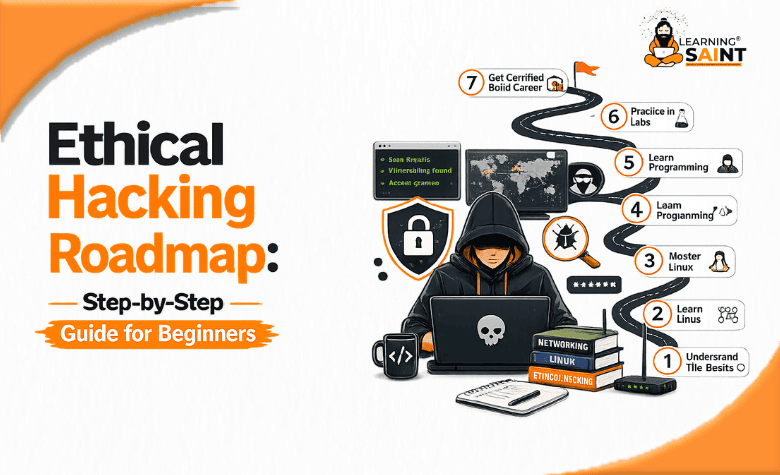
The following is an accurate Ethical Hacking Roadmap that will save you time along with providing you with the correct way to be an ethical hacker. By reading and understanding this roadmap, you do not have to guess which course or certification. You will have exactly what you need to be focused on in your learning journey.
Step 1: Create firm networking cores
Every strong learning path begins with creating strong networks. In an Ethical Hacking Roadmap, most security tests involve understanding the technique behind how computers communicate. If you skip this step as a beginner, you will have to struggle later. Having knowledge about networking helps you understand how the data flows across a system.
The following are the core factors that you must focus on while creating networks:
- TCP/IP basics – You must learn how the data travels from one device to another across various networks.
- DNS – Ensure that you have enough knowledge about converting website names into IP addresses.
- HTTP and HTTPS – This includes learning about how web traffic operates and the importance of encryption.
- Firewalls – You must learn about how firewalls decide what traffic will enter or stay out.
- Subnetting – This step includes breaking networks into small sections.
These protocols are important, but you do not have to learn them by heart. Rather than that, you just have to focus on understanding how data travels and what the weak points of it are. This knowledge and information will act as a base for the rest of the stage in your Ethical Hacking Roadmap.
Step 2: Start learning Linux and operating systems
Being an ethical hacker basically means being a cybersecurity specialist. Most of their security tools operate on Linux, which is why it has become a major factor in every beginner’s Ethical Hacking Roadmap. The newcomers must get hands-on practice working from the command line rather than relying on the graphical interface. Working this way might feel slow initially, but it gives you a lot more control and understanding than scrolling and clicking through menus.
The following are the areas that you must focus on:
- Making your way through various files and folders with the help of terminal commands
- Understanding file permissions and user roles
- Learning basic system administration assignments
- Rehearsing with a beginner-friendly Linux distribution such as Kali Linux
Along with this, keep your focus intact on Windows. Many organisations operate Windows systems, specifically in corporate settings. This is why understanding both operating systems will make your Ethical Hacking Roadmap a lot more detailed and important in practical jobs.
Step 3: Practise Basic Programming and Scripting
To be an ethical hacker, you do not need to become a professional software developer. But you must be aware that every step toward ethical hacking involves some sort of scripting skills. Writing small scripts saves a huge amount of time in comparison to doing repetitive tasks.
The following are the most useful languages that you must learn:
- Python – Use it as an automation, scanning, and scripting expert.
- Bash – It will help with working directly in Linux systems.
- SQL – You can choose it to understand database queries and connected vulnerabilities.
You must start with small steps. The habit of writing simple scripts that can scan a list of IP addresses will give you more knowledge than the theoretical part, and it will remain useful in the complete Ethical Hacking Roadmap.
Step 4: Get your hands on major security concepts
As a beginner in ethical hacking, avoid jumping into advanced tools. It is important to understand the core basics completely. At this point in your Ethical Hacking Roadmap, you are required to focus on the theoretical concepts instead of tools. These concepts are the answers to questions like "Why do attacks happen?” and many more.
The following are some important topics that you must be aware of:
- Popular vulnerabilities such as SQL injection and cross-site scripting
- Distinguishing between white-hat, black-hat, and grey-hat hackers
- The basics of authentication and encryption
- Concepts about risk assessment and scanning
- The legal fences or boundaries around authorised testing
Many beginners prefer skipping this step and going directly to certifications like CEH with no core understanding. This step can lead you to learning answers without getting the concepts understood.
Step 5: Practise your skills in legal and authorised labs
Hacking is a practical job that requires practice. You cannot be an ethical hacker while being dependent on books and videos. The next stage in an Ethical Hacking Roadmap is practising the skills in an environment built for legal and authorised use.
The following are some of the most popular tools for practising:
If you practise dedicatedly and consistently in these labs, it will help you in doing the real job with all the concepts learned in the previous steps. Most of the recruiters ask for proof that shows your real and practical experience using a self-learned Ethical Hacking Roadmap.
Step 6: Learn Important tools for hacking
Now, you are done with your basics and practical knowledge. It will now become very easy for you to learn and understand the tools.
The following are the major tools that you, as a beginner, must learn:
Learning and understanding these tools after your basic knowledge proves that you are aware of the activities happening behind the scenes by various tools. This shows that you are not just blindly following the steps of a tutorial with no basic understanding.
Step 7: Select rthe ight certifications for you
When you go for job hunting, the employers will not have time to go through every skill and detail in your CV, which is why certifications become an important part in showing your skills and experiences. But you should be careful that those certifications must match your Ethical Hacking Roadmap. There should not be any contradictions between yourcertificationsn and the skills that you have learned.
The following are the most common certifications that are recommendedbased onf the current industry information:
- CompTIA Security+
- Certified Ethical Hacker (CEH)
- eLearnSecurity Junior Penetration Tester (eJPT)
- CompTIA PenTest+
- Offensive Security Certified Professional (OSCP)
Adding certifications is a good approach, but adding the right certifications is a smart approach in an Ethical Hacking Roadmap. Your certifications must confirm that you have acquired the given skills, instead of contradicting them.
Step 8: Create a portfolio full of real and practical projects.
TEmployersand the recruiters look for evidence that can back your skills and experiences. Creating a portfolio means stacking all your real-life projects in one place so that it is easy for employers to see and judge them.
The following are some must-haves for you to include in your professional portfolio:
- Your CTF challenges and lab solution drafts
- Automation scripts that you have shared on platforms such as GitHub
- Vulnerability reports documentation, if you have participated in bug bounty programmes
- Brief notes discussing the concepts you have learned and the way you solved the specific problem.
This kind of proof creates certainty for employers that your skills are not just dependent on certifications. It shows that you have real thinking and problem-solving skills.
Step 9: Start hunting for practical jobs
You have the basics, did the labs, earned a cert, and built a portfolio, so you are ready to start applying. Look for junior pen tester roles. You could also be a security analyst. Some jobs are for vulnerability assessment. Starting pay is fair. It goes up fast once you have more years on the job or a cert like the OSCP. Tech shops and banks hire all the time. The government also needs help. These groups want to see that you can do the work. They like a clear learning path and real, hands-on skills.
What are the soft skills important in an Ethical Hacking Roadmap?
Hacking is a technical job that is completely related to computers. It requires technical skills and knowledge to perform advanced functions. But along with that, there is still importance for some soft skills in an Ethical Hacking Roadmap. The following are some of the most important soft skills that will support you in every stage of learning and working as an ethical hacker:
- Transparent writing – Being an ethical hacker, you are supposed to work under government authorities. This is why you should be able to explain your technical findings in your reports clearly.
- Commitment – Being an ethical hacker, everything needs to be under control. Everything needs secure authorisation. Many security tests include long hours to complete, which is why patience and commitment are needed.
- Truthfulness – This job includes getting into computers through hacking, which can easily harm people if it is not done properly. You need to be truthful and honest about the work you are doing and the intentions you are doing it with.
- Curious and Imaginative – The best workers are those who are never done learning new things. Ethical hacking involves hacking, and it gets updates daily. Whenever there is a new cybercrime introduced, an ethical hacker must be ready to learn a new way to stop it.
- Discussions with teams – In the practical world, security work involves working with the developers, managers, and the rest of the security staff. One of the most important skills is communication. You should be comfortable communicating with your teammates and other employees to work faster and better.
These soft skills can upgrade your corporate life as an ethical hacker a lot. If you keep building these steps in your life daily, you will see that your further steps are getting better and smoother.
Conclusion:
Becoming an ethical hacker is a realistic goal for anyone willing to follow a clear, structured path. This Ethical Hacking Roadmap starts with strong fundamentals in networking, Linux, and basic scripting, then builds toward security concepts, hands-on lab practice, essential tools, and relevant certifications. From there, building a visible portfolio and choosing a specialisation can help you stand out in a competitive but growing field.
There are no shortcuts that substitute for real understanding. However, if you follow this Ethical Hacking Roadmap step by step and with patience and consistent practice in legal and authorised environments, you will develop real skills and can confidently move towards a successful career in cybersecurity.


Reply To Elen Saspita