 United States
 India
 United Kingdom
 Australia
 Canada
 Nigeria
 Others


 Learning Saint
Choosing the right career out of all the tech-based careers can be difficult. There are various paths, and each of the paths sounds good on paper. 2 of the most popular tech fields in the current market are data science and cybersecurity. Both of them are growing, and both of them offer good
So how do you choose? That is the question this guide on Data Science vs. Cybersecurity answers. We will look at what each job really involves, what you need to learn, how much you can earn, and what a normal workday feels like. We will keep the words simple and the facts honest.
By the end, you will know which path fits your mind, your habits, and your goals. Let's start with the short version.
What do you understand by Data Science?
Data science is the idea of answering questions with the help of data. Almost every company collects a huge amount of data every day. The data can be collected in the form of sales numbers, website clicks, application usage, and customer feedback. However, all of this data is just a huge pile of numbers. A data scientist is responsible for turning that data pile into useful insights that can help a company grow.
For example, a data scientist might help an e-commerce store to learn which products will be the best-sellers in the coming month or even help a hospital in identifying which patients need extra attention or care. The streaming platform that suggests to you what movies you might enjoy also comes under data science.
The following are core functions of the job:
- Gathering data from various platforms
- Organising data to eliminate errors and gaps so that it does not lead to wrong answers.
- Analysing data to spot trends and patterns in the data.
- Developing models that are able to estimate what might happen next.
- Visualising data to present the results with charts and graphs.
Many data scientists even use the techniques of machine learning. This is a procedure of teaching a computer how to learn from its past data and come up with a good estimation about the new data. For example, you must have seen your mail system flagging some of the mail as spam; that is a good example of data scientists using machine learning techniques.
A huge part of a data scientist's job is not about coding. It is about talking to people. You are supposed to ask good questions, listen to the requirements of the brand, and present them in easy and understandable language.
What do you understand by Cybersecurity?
Cybersecurity refers to the work of keeping computers, networks, applications, and data safe from attacks and threats. Attackers might want to steal money, private information, or lock files for a ransom, or even just to cause trouble. Cybersecurity professionals are responsible for stopping them.
To understand it better, imagine cybersecurity as guarding a building. You lock the doors, keep the cameras on check, be careful of who comes in, and keep a backup plan ready in case anything goes wrong. In the world of cybersecurity, the building is a company’s digital world.
The following are the core functions of this job:
- Securing the network to make sure that the data travelling path is protected.
- Detecting attacks to identify off and risky activities in time.
- Analysing the risks to know the weak points of the system before they are exposed to attackers.
- Responding to incidents so that the professionals can act fast in response to any data breach or attack.
- Penetration testing (also referred to as ethical hacking), in which the professionals try to break into a certain system on purpose, with all the necessary permissions, to see where the flaw resides.
This field has multiple job roles. Some people are responsible for watching out for alerts in the security operations centre, usually known as a SOC; some are given the job of testing the systems; some create safer software, and some even draft the rules and regulations that are to be followed by the company.
You can also read about how to become a cybersecurity expert in detail here.
What is the core of Data Science vs CyberSecurity?
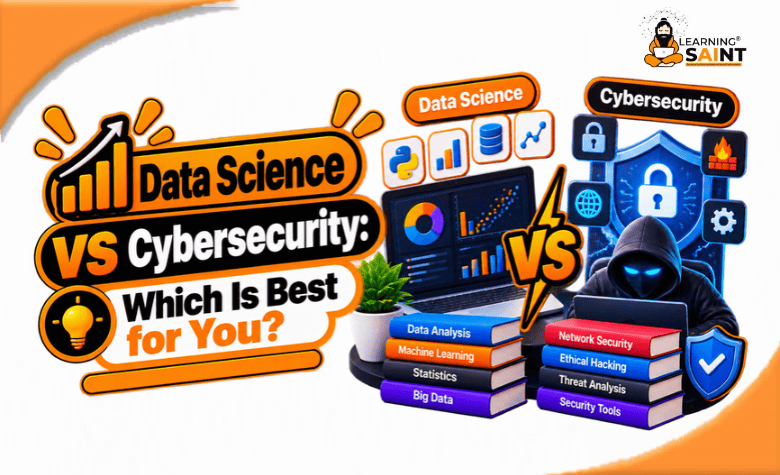
By now, you have seen and read about data science and cybersecurity individually. But this is the time to handle the biggest question in the row – “data science vs cybersecurity”.
The following is the detailed tabular comparison between data science and cybersecurity:
|
Characteristics |
Data Science |
Cybersecurity |
|
What is the normal workday in their life? |
A data scientist usually begins their day with checking on the project. There might be possibilities that a manager wants to know the reason that sales dropped last week. The data scientist sorts out the numbers from a database with the help of SQL. Then they perform some cleaning, which might end up taking some extra time. In the next step, the data scientist studies the numerical data. Lastly, they present whatever they have found in a meeting or a short report. |
A security analyst usually starts their day by reading alerts. Alerts are the warnings made by the tools that watch over the network. Most of the alerts are false alarms. However, a few might be real. The cybersecurity analyst checks every alert and then decides on the next steps. Other tasks for them might include updating security settings, checking if there are software missing patches, performing scans, and drafting reports. In case a real attack takes place, the normal routine of the day can change fast. The team will have to work together to spot the problem, stop it from spreading, and fix the damage that has already happened. |
|
Required skillset |
Data science is a field that requires the following skill set in its candidates: |
Cybersecurity is a field that requires the following skill set in its candidates:
|
|
Statistics and Maths requirement |
In data science, you are not required to be a genius at maths. However, you are required to be known to the basic ideas, such as averages, ranges, and probability. |
In cybersecurity, it is important to understand security metrics, analyse trends, and spot strange patterns in network activity. |
|
Programming/Scripting |
Coding or programming is one of the most important parts of data science. Python is the most common and beginner-friendly programming language. However, R and SQL are other important choices for the field of data science. |
In cybersecurity, coding is not an ultimate necessity. However, Python is important in this field too. |
|
Data visualisation |
Data science is a technical job, but a data scientist is required to present all the technical stuff to the brand's heads in understandable language. This is why it is important to show results in a clear chart. |
As a cybersecurity professional, you will be required to translate the security dashboard, understand threat alerts, and present the insights clearly. |
|
Communication |
Data science does share an important space for communication. A great model will make no sense if nobody will be able to understand it. |
However, cybersecurity does not mention communication as an absolute necessity. You should just be able to explain security risks, incidents, and suggested flaws to the technical teams. |
|
Core of networking |
In data science, it is important to know about SQL, database structures, and data collection methods. It helps you access the information to analyse. |
In cybersecurity, you only need to know how computers talk to each other. |
|
Operating systems |
As a data scientist, you should be familiar with Windows and Linux while working with data tools, development environments, and servers. |
In cybersecurity, it is not an absolute requirement, but having knowledge about Windows and linux does help a lot. |
|
Ideas about security |
As a data scientist, you will be responsible for the data of hundreds of people, which is why you must understand data protection, using data responsibly, and the risk of exposing sensitive information. |
In the field of cybersecurity, the basic idea about safety is encryption, firewalls, and user access control. |
|
Problem solving and handling pressure |
As a data scientist, you will be required to solve problems strategically, as there is not much pressure for instant results. You will be investigating data-quality issues, testing possible explanations, and correcting the visible errors in your analysis. |
Cybersecurity does not have much responsibility for problem-solving; however, you must stay calm when anything goes wrong to handle the pressure. |
|
Curiosity about how all the things operate? |
Data scientists are known for their curiosity about patterns. They are supposed to question why trends exist, what the explanation is behind strange results, and whether the proofs support the conclusion. |
The only and the best question that comes out of the curiosity of a cybersecurity specialist is that – “How could someone misuse this?” |
|
Education |
To become a data scientist, a degree in computer science, maths, or a related field is required. |
To become a cybersecurity professional, a degree in computer science, information technology, or cybersecurity is needed. |
How can you choose between Data Science vs Cybersecurity?
If you have reached the end of this article and yet feel confused about choosing between data science vs cybersecurity, the following are the steps that you can follow to clear your confusion and choose consciously:
- Try to spend an unpaid lesson in each field. For example, spend 1 week on a beginner Python and data analysis course and the next week on a beginner security course.
- Analyse your interests and what you feel about each field. Notice which week made you feel like learning more, and keep going.
- Have real conversations with real people. Look for a real data scientist and a cybersecurity analyst on a professional network and enquire about their likes and dislikes about the job.
- Ensure your goals. Make sure you know if you want higher pay, slow and steady growth, remote work, or a remote job, or a certain kind of company to work for.
- Start building a project, even a small one. For example, build a simple chart from a public dataset. Then try out a beginner security challenge. Notice which one interests you more.
If you are planning to build a career in data science, understanding the right skills, educational qualifications, and career opportunities is essential. Explore our detailed guide on How to Become a Data Scientist to learn the steps involved in starting your data science career and preparing for future opportunities.
Conclusion:
No one wins the debate of Data Science vs. Cyber Security. The correct answer is up to you.
If you love numbers, patterns, and clear stories, you should go for data science. If you love protecting things, spotting threats, and solving problems fast, then choose cybersecurity. Both pay well, both are growing much faster than average jobs and both give you room to learn for many years.
Keep these key points in mind:
- Data science makes data meaningful.
- Cybersecurity defends systems and data from attacks.
- Both use Python, and both require strong thinking skills.
- The BLS projects strong growth for both careers through 2034.
- The best choice is the one you will enjoy doing on a daily basis.
Start tiny. Take a free course in each. Create one project. Then listen to how you feel. That feeling will lead you to the right place.


Reply To Elen Saspita