 United States
 India
India United Kingdom
 Australia
 Canada
 Nigeria
 Others


 Learning Saint
Artificial intelligence is evolving fast and rapidly. New words are introduced every few months. It is normal to feel complicated keeping up with it. You must have heard the two terms a lot around you: “generative AI” and “agentic AI”. They might sound similar to you, but they have a lot of differences between them. You will come across many comments by various people where they are mixing these terms. This article will help you know the difference between them and clear out any confusion that you are facing regarding them.
If this question has ever gone through your brain: “What is the difference between gen AI and agentic AI?” You are not the only one thinking about it. This question is one of the most asked questions in blogs, business meetings, and even non-technical conversations. When you reach the end of this article, you will be crystal clear about the difference between gen AI and agentic AI and what these terms are individually.
A glance at both terms.
Before you dig deep into any topic, you should get a brief description of it. It will help you navigate your way and figure out what you are going to study further. The following is a glance at both topics, explaining what their basics are about:
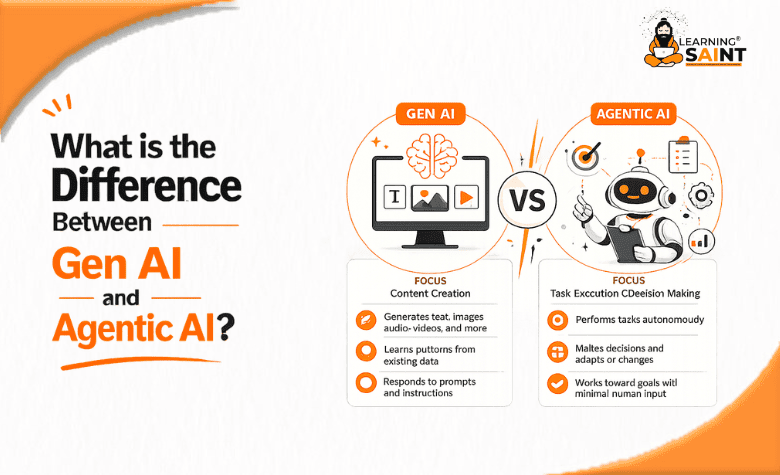
- Generative AI: This one focuses on creating. It will create things for you, like images, videos, music, or even code.
- Agentic AI: Here comes the different one. Agentic AI believes in taking actions. It will make plans, choices, and task completions without any guidance from a human.
To make it even clearer to you, imagine gen AI as a talented artist who creates a picture for you based on your prompt. Meanwhile, agentic AI is a personal assistant who creates a picture along with framing it, shipping it, and updating you with every step.
The following is the detailed breakdown of both terms individually:
What is Generative AI?
Before you move on to the difference between gen AI and agentic AI, it is important to know what these terms actually are. Generative AI is a kind of artificial intelligence that is completely concerned with creating new content. It takes inspiration from or learns from piles of data like books, images, audio, or even videos. It uses that collected information and creates new things based on your prompt and interest.
Everyone uses generative AI in their daily lives. You must have used Chatbots that write essays, tools that create images from a text prompt, and applications that write software code. These are some of the most common examples of generative AI that are currently used.
How does Generative AI operate?
Generative AI models, usually known as large language models (LLMs), are trained on huge piles of datasets. While training, the model goes through patterns like “how words follow each other?”, “how pixels create a shape?”, or “how musical notes blend?" After the model is trained, it can create fresh content in the same styles that it has learned.
If you want to picture it in a simpler way. Imagine you love cooking. You read hundreds of recipe books. With time, you will start recognising the pattern. You will start identifying how recipes are written. You will understand that the ingredients are written first, then the recipe steps, and then lastly the comments. Now, if anyone ever asks you to write a recipe about a dish that you have never seen before, you will be able to write it perfectly without worrying that it will look like a recipe. Generative AI does the same thing; the only difference is that it uses a far greater amount of data and speed.
You can also read how to learn Generative AI from scratch in detail here.
What are the common uses of Generative AI?
- Drafting blogs, emails, or social media captions
- Creating pictures or artworks from text prompts
- Generating computer code
- Creating music or voice recordings
- Giving answers to questions in a conversation format
- Concluding lengthy documents
Generative AI is useful and powerful, but there is one drawback or characteristic: it waits for our instructions. It will generate anything you want after you have given a prompt. It will not act unless you have asked it to do so. Along with that, it does not remember the last conversation it had with you. You will have to remind it again, and it cannot strategise multiple action plans unless you guide it in-depth.
What is Agentic AI?
Now it is time to move on to another factor of this discussion about the difference between gen AI and agentic AI. Agentic AI is a bit more current and modified idea of artificial intelligence. Rather than just creating content that you have asked for, agentic AI is capable of thinking while performing a task and breaking down the action steps. It can even carry out those steps by itself. It acts like an independent worker rather than being an assistant who takes action only after you order.
The term is made up of two words: “agentic” and “AI”. The word “agentic” refers to “agent”, which means something that takes action. This makes agentic AI software that performs, chooses, and keeps track. It does all this with a very small amount of input once a goal is assigned to it.
How does Agentic AI operate?
Agentic AI systems generally put various parts together while working. The following are the components that agentic AI combines:
- An aim or a task: Agentic AI is another version of AI. You will have to provide it with a text-based prompt about the result that you want to see. For example, “book the cheapest flight tickets to Mumbai next month."
- An action plan: Agentic AI goes through the process that needs to be followed to complete the task. In this step, it breaks the process into small steps.
- Toolkits used: If you are assigned any task, you will use some resources that will help you complete it. In the same way, agentic AI also searches the internet, uses applications, or performs programmes to complete every task assigned.
- Taking action: After all the important steps, it is important to decide further steps too. In this step, the agentic AI checks the results of the steps performed till now and also plans strategies for the next move.
- Memory: Imagine you had a long conversation about the task with AI and you fell asleep in the middle. You wake up and try to continue the old conversation, but it does not remember anything about the previous conversation. It will be a task to remind it of everything from the beginning, right? This is why, in this step, agentic AI keeps track of the conversations or actions that happened before. It does not repeat steps or lose the progress tracks.
For example, imagine you are in charge of the birthday party planning for your best friend's birthday. You command AI to “Plan my best friend’s birthday party." Rather than simply handing you a list of all the possible ideas for a birthday party, agentic AI can actually check the appropriate date on the calendar, look for nearby venues, compare prices and come up with the best deal, send messages to the guests, and even set multiple reminders. It can perform all these steps without any need for you to check on it at every single step.
What are the most common uses of agentic AI?
- Automating multi-step business workflows
- Taking care of customer support tickets from the beginning to the end
- Performing research tasks that need various searches and comparisons
- Controlling online bookings, orders, or scheduling.
- Looking after systems and resolving every small error automatically.
- Coordinating various software tools together to complete one bigger job.
Agentic AI does not focus only on responding or replying to a certain query. Instead, it performs with a purpose and continues working towards a goal. It keeps adjusting its plan of action if something does not result in the way it was expected to.
What is the core difference between gen AI and agentic AI?
Now you must understand the basics of generative AI and agentic AI individually. It is time to address the elephant in the room: the difference between gen AI and agentic AI. The following are the in-depth differences between gen AI and agentic AI about various characteristics:
|
Characteristics |
Gen AI |
Agentic AI |
|
Aim |
The purpose of generative AI is to create. It is mainly focused on producing new content like words, images, videos, sounds, or code. It is all based on the prompt that you provide. |
The purpose of agentic AI is to complete the given tasks. It primarily focuses on achieving an assigned goal by taking steps in an action plan. |
|
Human assistance |
While you are working with gen AI, you will be needed to assist it at every step. It needs a prompt for even the smallest things required in the final result. |
Working with agentic AI is different. As a user, you just need to provide the command once. The rest is handled by AI. It checks the requirements and takes action on its own. |
|
Taking action |
Generative AI is not capable of taking actions or making choices. It does predict the upcoming best word, pixel, or sound based on the previous patterns. |
Agentic AI is capable of making choices on its own. It looks at any situation in front of it, compares the 2 best options, and chooses the best option for the path ahead. It is very much similar to a person solving a problem in steps. |
|
Memory and context |
The core basic tools of generative AI usually lose track of their previous conversations. Every time you request a change, it might feel like a fresh start. |
Whereas agentic AI generally requires the trace of the memory to work well. It tracks what is performed, what is left, and what needs to be performed. |
|
Tool Kit used |
Generative AI primarily works with the datasets that it used for training. It does not have the nature of going out and using other applications or websites to search unless it is specifically asked to do it. |
In the case of agentic AI, it is created with the aim of using tools like search engines, applications, calendars, and databases. It is one of the steps of completing the task. |
|
Creative independence |
This factor is one of the biggest factors in the difference between gen AI and agentic AI. Generative AI does not enjoy any independence. It simply waits for your command on even the simplest task. It is reactive |
Whereas agentic AI is capable of moving ahead with the action plan once it is assigned the task. It is proactive. |
|
Result complications |
Generative AI generally gives you one crystal-clear output in the form of a paragraph, image, or maybe a piece of code. |
Agentic AI usually gives out a chain of actions and results. |
You can also read about the difference between Generative AI and Machine Learning in detail here.
Conclusion:
In summary, the difference between gen AI and agentic AI is that gen AI is about creation; agentic AI is about action. Generative AI is a creative technology. It can write, draw and create content from your prompts. But it waits for your instructions every time. Agentic AI is about doing tasks. Once you have a goal, it will plan, decide and act, using tools and memory to complete the current task.
They do not do the same thing; they do different things. Generative AI allows you to create faster. Agentic AI does things for you without you having to do each step. AI is only going to grow, so we’ll probably see more tools that combine the two and offer the best of creativity and action in one place.
Now that you understand the difference between gen AI and agentic AI, you can select the appropriate kind of AI assistance for whichever task is in front of you — whether it’s writing a quick message or completing a full project from start to end.


Reply To Elen Saspita