 United States
 India
 United Kingdom
 Australia
 Canada
 Nigeria
 Others


 Learning Saint
Are you someone who uses a smartphone? Then you are surrounded by the concepts of deep learning in more ways than you can imagine. Deep learning is the technology behind unlocking your phone with your face and using an AI chatbot to answer your questions.
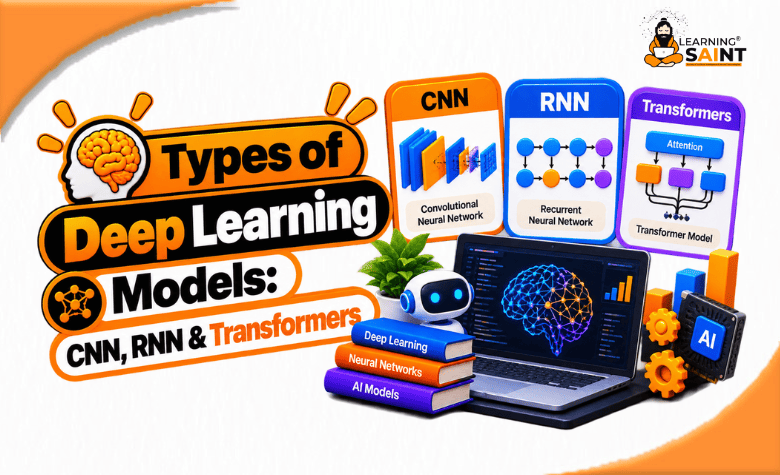
But have you wondered what is happening behind the scenes? There is a group of tools here; each tool has its designated job. This article will be your guide to understanding the main types of deep learning models in easy and understandable language. You will understand CNNs, RNNs, Transformers, and many more. We will look at CNNs, RNNs, Transformers, and a few more.
What do you understand by deep learning?
Deep learning is a part of machine learning that uses neural networks. A neural network is a computer system that is somewhat inspired by the brain. It contains various small units known as neurones. They basically sit in layers. The data flows in the first layer, travels through the middle layers, and finally comes out as an answer at the end.
The word “deep” refers to the fact that this technology contains various layers. The more layers there are, the better patterns the network learns.
The following is how the procedure of deep learning works:
- The model spots an example, such as a picture of a tree.
- It tries to make a guess, such as a cloud.
- Then it verifies if the estimation was right or wrong.
- If the answer is wrong, it changes its inner numbers, known as weights.
- It repeats this process at least a million times.
The step where the model makes changes to its weights is known as backpropagation. With time, the estimations start becoming better. This is the reason that deep learning requires a huge amount of training data and strong computer chips called GPUs.
What are the main types of Deep Learning models?
1. Feedforward Neural Networks (MLP)
MLP is the simplest out of all the main types of deep learning models. In this model, the data only moves in a single direction, from input to output. It does not loop back. Its full name is multilayer perceptron, also known as MLP.
Every neurone in a single layer connects to every neurone in the next layer. The model gradually learns which of the links are important and basically gives them the bigger weights.
2. Convolutional Neural Networks (CNN)
A CNN is one of those types of deep learning models that is created to analyse and look at pictures. The early version of it, known as LeNet, was created by Yann LeCun and his team. CNNs gained popularity in 2012, when a model named AlexNet stood as the winner of the ImageNet image contest.
Now you must be wondering, how does a CNN work? A CNN pushes small filters over an image. Each filter looks at only one thing, such as an edge or a curve. Initial layers identify lines; the middle layer joins those lines and creates a shape, such as eyes or wheels; and the final layers join shapes into complete objects, such as a face or a vehicle.
The following are core parts of a CNN:
- Convolution layer: This layer focuses on identifying patterns using filters.
- Pooling layer: The pooling layer is responsible for shrinking the image and maintaining the key parts.
- Fully connected layer: This is the final layer, and this is why it makes the final decision.
A CNN design, known as ResNet, from 2015, added shortcuts between the deep layers in the model. This allowed the engineers to create networks with even more than 100 layers that could still train well.
3. Recurrent Neural Networks (RNN)
In many tasks that are performed by deep learning, one of the most important things is order. This is why there is a type of deep learning that is created specifically for this purpose. For example, the statements "A girl eats an apple” and “An apple eats a girl” use the same words for their formation but have completely different meanings. An RNN is responsible for reading one step at a time and keeps a certain memory of what came earlier.
4. LSTM and GRU: Work like a better memory for RNNs
LSTM refers to Long Short-Term Memory. It was introduced by Sepp Hochreiter and Jürgen Schmidhuber in 1997. It has gates in the model that act like doors. One gate gets to decide what to forget.
GRU stands for Gated Recurrent Unit. GRU came into existence with Kyunghyun Cho and his team in 2014. It is basically a simpler version with fewer parts.
5. Transformers
Transformers are a kind of deep learning model that changed the field of AI and even shaped the new types of deep learning models. Researchers at Google published a paper named “Attention Is All You Need” in 2017. This paper introduced the transformer as a designed model of deep learning. In the current scenario, most chatbots, translators, and writing tools are powered by transformers.
The broader idea of this model is attention. Instead of reading a single word at a time, a transformer analyses all the words together. Then it chooses the words that are the most important to each other.
The following are the 3 main types of transformers:
- Encoder-only: The Encoder-only model of a Transformer is good at understanding text. For example, BERT, from Google in 2018.
- Decoder-only: The Decoder-only model is a bit different. It is good at writing text that the Encoder-only model analyses.
- Encoder-decoder: This is the final part of the Transformer architecture. This model is said to be good at converting one text into the other, such as translation.
6. Autoencoders
Autoencoders are another type of deep learning model. They are divided into 2 parts. The encoder converts the input into a tiny code, and the decoder is responsible for creating the original from that code.
It is most commonly used for purposes like eliminating noise from pictures, compressing data to save maximum space, and identifying odd situations, such as weird card payments.
In case the model is not able to reconstruct an item properly, that item might turn out to be unusual.
A close cousin of autoencoders is the variational autoencoder, or VAE, which was introduced by Diederik Kingma and Max Welling in 2013. A VAE can also create new samples that look like the training data.
7. Generative Adversarial Networks (GAN)
Deep Learning is an AI technology that is supposed to answer your questions. It also answers queries about generating something new. This is why Ian Goodfellow and his team introduced GANs in 2014. A GAN is one type of deep learning model that is responsible for generating new content.
It has the following networks inside that create the whole game:
- The Generator, which creates fake samples, such as a face that might not exist.
- The Discriminator, which tries to sort and differentiate between the real and the fake ones.
8. Diffusion Models
This might be something new to you. Diffusion models are responsible for creating images in a gentle way. During their training, the model picks real pictures and adds a bit of noise again and again until there is only static left. Then it tries to understand how to undo each of the steps.
In order to create a new image, it starts with the original noise and later cleans it up little by little. This idea is used by tools such as Stable Diffusion, which came out in 2022.
9. Graph Neural Networks (GNN)
You must be wondering, what about the data that is not in the form of a picture or a line of words? Sometimes the data is in the form of a web of links. Imagine it like a social network, a road map, or even a molecule made of atoms. A graph has dots, known as nodes, and the lines between them, known as edges.
The training process of a GNN includes the messages between connected nodes. Each node learns from its neighbours. Most other types of deep learning models assume or prefer grids or lines, which is why a graph requires its own separate tool.
10. Deep Reinforcement Learning
Lastly, there is deep reinforcement learning that gets trained through acting. In this part, the model is like an agent that is supposed to act in a world and will receive a reward or a penalty. For example, while training your dog, you give it a treat if it follows your commands, and this is how a dog learns to do the right thing over time.
You can also read about deep learning vs machine learning in detail here.
Conclusion:
Deep learning sounds big, but the types of deep learning models are simple once you break it down. A CNN sees. Then we have RNNs, LSTMs, and GRUs. A Transformer looks at all of the text. Build a GAN and a diffusion model. Deep reinforcement learning learns from rewards.
Every class of deep learning models has its own pros and cons. The newest varieties of deep learning models are not magic either. Best for nothing. Which one is better depends on the data you have and what you are trying to achieve.
If you only remember one thing, let it be this: match the model to the job. Start simple, test often, and continue to learn about the types of deep learning models. Now that you know the main types of deep learning models, you can read AI news with more confidence.


Reply To Elen Saspita