 United States
 India
India United Kingdom
 Australia
 Canada
 Nigeria
 Others


 Learning Saint
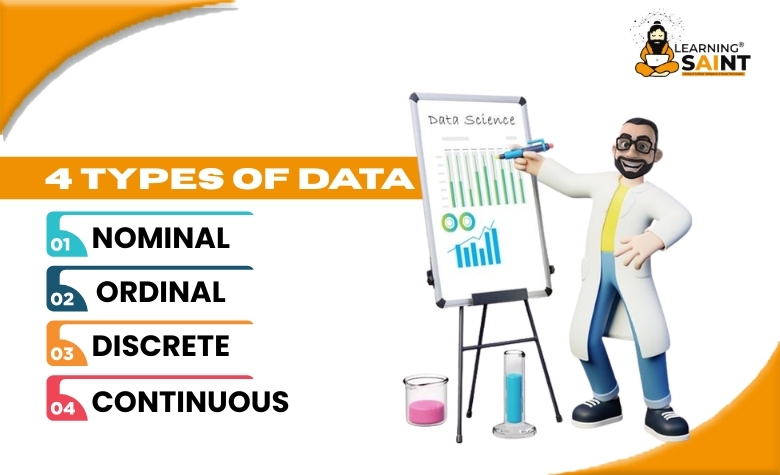
Data is the backbone of modern decision-making, whether in business, healthcare, or technology. Understanding the 4 Types of Data—Nominal, Ordinal, Discrete, and Continuous—is essential for students and professionals alike. Each type has unique characteristics that determine how it can be collected, analyzed, and interpreted. From surveys to scientific research, choosing the correct data type improves accuracy and insights. This guide will help you clearly understand each type with examples and practical applications.
What is Data in Statistics?
In statistics, data refers to facts, observations, or measurements collected for analysis. It can be numerical or categorical, depending on the nature of information. Data helps in identifying patterns, making predictions, and solving problems. For example, age, gender, income, and temperature are all forms of data. Understanding how data is classified into the 4 Types of Data is crucial for selecting the right statistical methods and tools.
Why Understanding Data Types is Important
Knowing the 4 Types of Data helps in choosing appropriate analysis techniques. Misclassifying data can lead to incorrect conclusions. For instance, you cannot calculate an average for nominal data like colors or names. In fields like data science, business analytics, and research, correct data classification improves decision-making. It also helps in selecting visualization methods like charts and graphs. For students and professionals in India and the USA, mastering data types is a foundational skill.
Overview of the 4 Types of Data
The 4 Types of Data are broadly divided into two categories: qualitative and quantitative. Nominal and ordinal data fall under qualitative (categorical), while discrete and continuous data are quantitative (numerical). Each type serves a different purpose and requires different methods of analysis. Understanding their differences ensures accurate data interpretation and effective communication of insights.
Nominal Data: Definition, Characteristics & Examples
Nominal data is the simplest form among the 4 Types of Data. It represents categories without any order or ranking. Examples include gender (male/female), colors (red, blue), or nationality (Indian, American). The key characteristic is that values cannot be compared numerically. You can only count frequencies or identify categories. Nominal data is widely used in surveys and demographic studies. It is often visualized using pie charts or bar graphs.
Ordinal Data: Definition, Characteristics & Examples
Ordinal data represents categories with a meaningful order but without fixed intervals. Examples include rankings (1st, 2nd, 3rd), satisfaction levels (happy, neutral, unhappy), or education levels. Among the 4 Types of Data, ordinal data allows comparison but not precise measurement. For instance, you know one rank is higher than another, but not the exact difference. It is commonly used in feedback forms, ratings, and surveys.
Discrete Data: Definition, Characteristics & Examples
Discrete data consists of countable values, often integers. Examples include the number of students in a class, number of cars, or number of employees. It cannot take fractional values. In the 4 Types of Data, discrete data is quantitative and suitable for statistical calculations like mean and median. It is commonly used in business analytics and inventory management. Bar charts are often used to represent discrete data.
Continuous Data: Definition, Characteristics & Examples
Continuous data includes measurable values that can take any value within a range. Examples include height, weight, temperature, and time. Unlike discrete data, it can include decimals and fractions. Among the 4 Types of Data, continuous data is the most detailed and flexible. It is widely used in scientific research, engineering, and healthcare. Line graphs and histograms are commonly used for visualization.
Key Differences Between the 4 Types of Data
The main difference among the 4 Types of Data lies in their nature and usage. Nominal data is categorical without order, while ordinal data has order but no fixed scale. Discrete data is countable, and continuous data is measurable. Understanding these differences helps in selecting the right analysis methods. For example, averages are meaningful for continuous data but not for nominal data.
Real-Life Examples of Data Types in Different Industries
In healthcare, patient gender is nominal, pain level is ordinal, number of patients is discrete, and body temperature is continuous. In business, product categories are nominal, customer satisfaction ratings are ordinal, sales count is discrete, and revenue is continuous. Understanding the 4 Types of Data helps professionals apply the right analytics techniques in real-world scenarios across industries.
How to Identify the Type of Data Easily
To identify the 4 Types of Data, ask simple questions:
- Is it a category? → Nominal
- Is there an order? → Ordinal
- Is it countable? → Discrete
- Is it measurable? → Continuous
This quick method helps students and professionals classify data correctly and avoid confusion during analysis.
Common Mistakes When Classifying Data Types
A common mistake is treating ordinal data as continuous, such as calculating averages for rankings. Another error is confusing discrete and continuous data. For example, age can be discrete (years) or continuous (exact age). Misclassification affects analysis accuracy. Understanding the 4 Types of Data helps avoid these mistakes and ensures better results in research and analytics.
Applications of Data Types in Data Science and Analytics
In data science, the 4 Types of Data determine the choice of algorithms and models. Machine learning models require proper data classification for accuracy. For example, classification models work with nominal data, while regression models use continuous data. Businesses use data types for customer segmentation, forecasting, and decision-making. Mastering data types is essential for a successful career in analytics.
Tools Used to Analyze Different Types of Data
Popular tools like Excel, Python, R, and SQL are used to analyze the 4 Types of Data. Excel is beginner-friendly, while Python and R are advanced tools for data science. Visualization tools like Tableau and Power BI help present data effectively. Choosing the right tool depends on the type of data and analysis requirements.
Conclusion:
Understanding the 4 Types of Data—Nominal, Ordinal, Discrete, and Continuous—is essential for accurate analysis and decision-making. Each type serves a unique purpose and requires specific methods. Whether you are a student or a professional in India or the USA, mastering data types will enhance your analytical skills and career opportunities. Always classify your data correctly before starting any analysis.
FAQs:
Q1. What are the 4 types of data?
Nominal, Ordinal, Discrete, and Continuous are the four main types of data.
Q2. What is the difference between discrete and continuous data?
Discrete data is countable, while continuous data is measurable and can take any value.
Q3. Is age discrete or continuous?
Age can be both, depending on how it is measured.
Q4. Why are data types important?
They help in selecting the correct analysis methods and tools.
Q5. Which data type is used in surveys?
Nominal and ordinal data are commonly used in surveys.


Reply To Elen Saspita