 United States
 India
India United Kingdom
 Australia
 Canada
 Nigeria
 Others


 Learning Saint
What Does A Full Stack Developer Do?
If you have ever spent your time job hunting in technical fields, you must have come across the term “Full Stack Developer” in your job-hunting journey. This term must have come along the way more than once. It is one of the most asked-for and most demanded job profiles in the current situation of the software industry. But many people still do not know what this job profile involves. They still feel confused if a Full Stack Developer is someone who performs every technical job or a regular web developer.
This article will answer all your questions in a simple and readable language. You will understand what this role actually does, what skills are needed for this job, and the most common tools a Full Stack Developer uses. By the time you reach the end of this article, you will have a clear picture of what a Full Stack Developer actually does.
What do you understand by a Full Stack Developer?
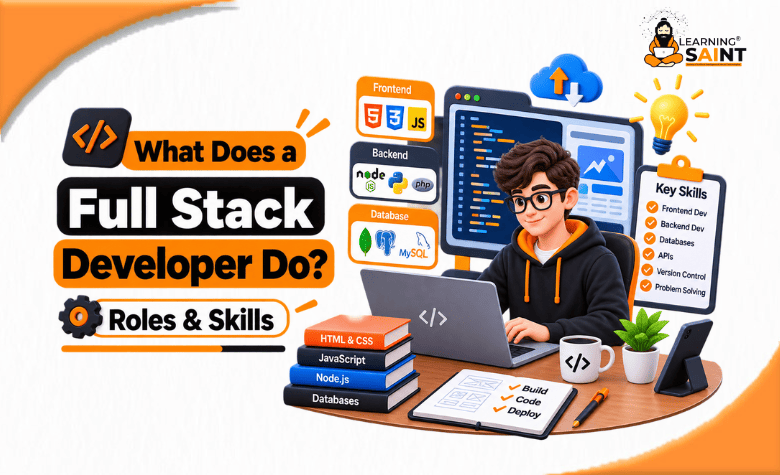
A Full Stack Developer is an individual who is capable of working on both the front-end and the back-end of a website or application. To simplify it, “front-end” means everything that is completely and clearly visible to the user on the screen. For example, the services that the user interacts with include buttons, forms, and page layouts. “Back-end” means everything that is kept hidden from the user. For example, databases, servers, and the logic that makes an application perform or operate.
As a professional Full Stack Developer, you must focus on both sides of the Full Stack Journey. Understanding both front-end and back-end will help you create a complete application from beginning to end, or at least it will help you understand what the connection is between all the parts.
You can also read how to become a full-stack developer in detail here.
What do you mean by ‘front-end and back-end’?
If you want to fully understand this job profile of a Full Stack Developer, you must break down the front-end and back-end individually. The following is a quick refresher about front-end and back-end individually:
Front-end:
The front end is the part of a website or application that is directly and clearly visible to the user, and they can interact with it. The following are some of the examples of front-end:
- Page layouts and design elements
- Buttons, menus, and forms
- Animations and interactive components
- How the website responds or looks on different devices, such as phones or laptops.
Back-end
The back-end part is responsible for handling the behind-the-scenes work that is the main reason for every smoothly operating website. The following are examples of back-end:
- Organising and managing data in databases
- Taking care of user accounts and login systems
- Processing requests or queries that are sent from the front-end
- Connecting various parts of an application together through servers
A Full Stack Developer is comfortable working across both front-end and back-end. Instead of specialising in just one field, they specialise in both of them.
What does a day in the life of a Full Stack Developer look like?
The daily life of a Full Stack Developer looks very different from that of other working professionals. The everyday tasks in this job profile can change on the basis of the company and project. But there are a few common tasks that are common in every company. The following are the common daily tasks of a Full Stack Developer:
- Building User Interfaces – This task involves simply writing code that can create or develop the parts of a website or an application that are visible to the user on the screen.
- Writing server-side logic – Server-side logic is the rules and processes that are responsible for handling data and requests.
- Managing databases – Managing databases includes setting up the databases, updating them, and organising where the information is stored.
- Testing and debugging – A website is an online-based service that needs to be managed on a daily basis. A full-stack developer ensures that they check both front-end and back-end work accurately together.
- Fixing errors – If the website or the application faces any sort of bug during development or after deployment, a full-stack developer is responsible for solving those bugs.
- Experiencing teamwork – As a full-stack developer, you will be required to collaborate with designers, other developers, and project managers on a daily basis to either present your most recent work or discuss the upcoming actions.
- Deployment guidelines – Deployment of the programme is the most important part of a full-stack developer’s day. This step simply includes moving finished projects from a testing environment to a live and operating website or app.
A Full Stack Developer understands both sides of development, which are front-end and back-end. This is why this professional usually performs like a bridge between specialised front-end and back-end teams to help projects to operate more smoothly.
What are the basic skills required in a Full Stack Developer?
If you want to become a Full Stack Developer, you must have some required skills. The following are the technical skills that a Full-Stack Developer needs:
If you are planning your learning journey, you can also explore this full-stack development roadmap to understand the key technologies and skills to learn step by step.
1. Front-end technicalities
The following are the skills that are specifically required on the front-end side:
- HTML: HTML is the most common programming language that is used to provide the basic structure of web pages.
- CSS: CSS is a programming language that is responsible for styling and creating a layout.
- JavaScript: JavaScript is a programming language that is used to make web pages interactive.
Various developers have learnt and practised front-end frameworks. They are pre-built tools that help create building interfaces faster and more structured.
2. Back-end technicalities
The following are the skills required on the back-end side:
- Server-side programming languages: Server-side programming languages are languages like Python, Java, PHP, or Node.js.
- Database management: Database management includes using systems like MySQL, PostgreSQL, or MongoDB.
- Building and using APIs: creating websites using APIs allows different parts of the website or the application to communicate with each other.
If you are interested in building a career specifically in Java-based full-stack development, explore this Java Full Stack Developer roadmap to understand the skills and technologies you may need to learn.
3. Version Control
Most back-end developers or full-stack developers use version control tools such as Git. It helps them track changes in their code and work well with other team members without ending up overwriting each other’s work.
4. Core understanding of servers and hosting
The job profile of a Full Stack Developer also includes understanding how applications are hosted and deployed. They are supposed to or expected to have a basic knowledge of cloud platforms or hosting services.
5. Problem-solving skills
The knowledge about tools and platforms is important, but having critical thinking and problem-solving skills is equally important. Strong logical thinking and breaking a problem into small parts to know how it can be resolved are the key skills for any individual who wants to apply for the role of a Full Stack Developer.
Why are so many companies hiring Full Stack Developers?
Brands or companies usually prefer having those individuals as developers who are capable of handling both back-end and front-end work. Specifically, in the smaller teams or fast-moving projects. The following are the reasons why companies hire Full Stack Developers:
- Cost efficiency – Wages and salaries of all the employees are the biggest financial responsibility of a company. By hiring a single individual who can cover work that would require 2 or more employees in other situations, companies save the salaries of 2 or more employees by paying that of one.
- Faster growth – When a single individual can perform multiple jobs at the same time, it significantly reduces the communication gap as the number of employees reduces, and it leads to better and faster growth.
- Improved problem-solving – Imagine you have a separate employee to handle the front end and another separate employee to handle the back end. Now, if any issue arises, they both will have separate timelines and problems, and they will struggle to communicate with each other. To resolve this, companies hire a single person to handle both sides and resolve problems with no confusion. This improves the company’s problem-solving skills.
- Flexibility – The companies or brands that have limited resources or those that operate on a lower scale prefer hiring members in their team who can perform various tasks as required.
What are the most common tools and technologies used by Full Stack Developers?
Along with the particular tools varying by company and project, there are a few tools that are specifically common across the industry.
- Front-end frameworks and libraries – Front-end frameworks and libraries are used to build interactive and responsive interfaces better and more effectively.
- Back-end frameworks – Back-end frameworks are used to organise and simplify server-side code.
- Database systems – Database systems are used to store and manage application data.
- Version control platforms – Version control platforms that are used to track and manage shifts and changes in code over time.
- Cloud hosting services – Cloud hosting services are the facilities that are used to deploy and run applications online.
- Testing tools – Testing tools are the tools that are used to check if the code is working correctly before it reaches real users.
When you learn these tools slowly and gradually instead of cramming them all at once, you choose a common and practical approach to enter this field as a beginner.
What are the industries that depend on Full-Stack Developers?
The job profile of a full-stack developer is not limited to a singular kind of company. There are various industries that depend on this sort of wide and flexible skill set. The following are the industries that actively look for Full Stack Developers:
- Startups – Startups are the newly established organisations that initially operate on a smaller scale. They usually look for developers who can work on various projects and move quickly across various parts of a product.
- E-commerce companies – E-commerce brands or companies are the organisations that are established or based on the internet. They require reliable front-end shopping experiences secured by safe and structured back-end systems.
- Healthcare technology – Healthcare technology or medical industries need individuals to pay attention to user experience and secure data handling.
- Education platforms – Academic or educational institutions or platforms usually blend engaging front-end learning tools with back-end systems that track the progress that students are making.
- Finance and banking apps – Organisations or industries that are related to the finance and banking applications require firm back-end security along with clear and readable front-end interfaces.
What are the skills required beyond coding?
Technical skills are the base of becoming a full-stack developer, but it is not enough. There are some soft skills too that help you succeed in your career as a full-stack developer.
- Communication skills – As a full-stack developer, you will be required to explain your technical ideas and discoveries in understandable language to team members coming from non-tech departments.
- Time management skills – A full-stack developer has to balance multiple tasks across various parts of a single project.
- Adaptability – With every brand or industry, the technologies or tools might change. As a full-stack developer, you must be able to adapt to those shifts and understand how to work with new technologies comfortably.
- Attention to detail – While writing code or deploying it, there might be some complications or small mistakes. The job of a content writer also includes catching small mistakes that could possibly affect how an application or a website works.
- Teamwork – A full-stack developer only creates applications, but the designer, other developers, and project managers provide the essence to it. This is why teamwork is an essential soft skill that a full-stack developer must have.
Conclusion:
A Full Stack Developer plays a valuable role in building complete, working applications, handling everything from the visual interface users interact with to the behind-the-scenes systems that keep everything running smoothly. This role requires a mix of front-end and back-end skills, along with strong problem-solving abilities and the willingness to keep learning as tools and technologies change.
Whether a company calls the role a full-stack web developer or a full-stack engineer, the core idea remains the same: someone capable of working across the full technology stack to bring an application to life. For anyone interested in a flexible, in-demand tech career, learning this skill set offers a strong, practical path forward, built step by step through steady practice and real-world project experience.


Reply To Elen Saspita