 United States
 India
India United Kingdom
 Australia
 Canada
 Nigeria
 Others


 Learning Saint
Earlier, computers were simple. They were tools with standard functions. If you type 2 numbers in the spreadsheet, the standard computer uses them to calculate the sum by default. If you typed a letter, it used to save those letters exactly the way you wrote them. The standard computer would do exactly what you would ask it to do. They used to follow the steps they were told. But now the scenarios have changed. Computers today are technically advanced. They can do things that seem like magic. Everything is possible through computers, such as driving cars, finding diseases, and even creating things.
There is one thing that makes all these amazing things possible in a computer. That is “Artificial Intelligence (AI)”. The world of AI makes everything possible for everyone. You must wonder why people talk about “Machine Learning” and “Generative AI” while discussing modern technology. But have you wondered if there is any actual difference when you look at Generative AI vs Machine Learning?
Are these terms confusing you? It is easy to get lost in the technical world. This article will act as a guide for you to understand everything about the technical world.
How do Generative AI and Machine Learning work together?
Before you jump to Generative AI vs Machine Learning, you must understand how they blend. They are not completely different entities fighting against each other. They do blend and help humans and computers evolve together.
The following are the main layers of this technology that will give you the complete outlook you need to know:
- Artificial Intelligence (AI): Everybody in the current scenario knows about AI. AI is everywhere. It is the biggest layer. It is a broad field of computer science that primarily concentrates on creating smart machines. Those machines are built with the capability of mimicking human behaviour. Whenever a computer performs a task that usually requires human creativity, such as understanding speech, playing chess, or identifying a face, it is actually using AI.
- Machine Learning (ML): Machine learning is a subpart of the bigger circle called AI. It is a process that is specifically used to achieve AI. Rather than writing long terms and conditions to train the computer about how to operate, you can simply give thousands of examples to your computer and let it learn from those patterns.
- Generative AI (GenAI): This is a small and extremely specific sub-part that lies under machine learning. It is a particular kind of machine learning that is concerned with building new things. For example, it focuses on writing a new and original paragraph or creating a new image.
All the tools of Generative AI are also a sort of machine learning. Every machine learning tool comes under the biggest circle of Artificial Intelligence. Now, you must have understood how Generative AI vs Machine Learning works together; it is time to understand both of them individually.
What is Machine Learning?
Understanding machine learning is an important part of knowing Generative AI vs Machine Learning. If you want to understand Machine Learning better, try to understand it with an example. Imagine a human child is learning to recognise fruits. You are not required to create a book with all the rules about fruits and their appearance and hand it to the child. Rather than that, you can hold an apple in your hand and point towards it while calling it an apple in front of the child. After watching and understanding enough real-life fruits, the child will automatically feed the pattern to his brain.
Machine Learning has the same way of working. Some engineers feed huge piles of data to the computer system. This data can be anything, such as customer receipts, previous weather details, or labelled pictures of animals. The computer will use some math formulas known as 'algorithms' and study this data completely, understand the repeated patterns, and create an internal template. This internal template is known as models.
You can also read about the importance of Machine Learning in business to understand how it affects or helps a brand.
What are the types of machine learning?
Standard and primitive machine learning systems are usually classified into the following kinds:
- Supervised Learning: Do you remember those days when you were in school and the teacher used to teach you everything? Supervised learning is the same. The computer is provided with the data along with the correct answers. For example, the system receives 20,000 emails that are marked as “spam” or “not spam”. The system will gradually learn what the spam mails look like, and it will categorise your incoming emails the next day.
- Unsupervised Learning: This is a bit different. Imagine you are on a solo trip and you have to explore the whole destination by yourself. Unsupervised Learning works the same. The computer is provided with a pile of data with no answers labelled. The computer has to find secret groups or clusters. For example, the computer will look at a store’s customer list and identify that on Mondays, there is a sudden rush for groceries, while on Saturdays, snacks and munchies are in demand.
- Reinforcement Learning: Have you trained a child with words? You have to repeat things and keep going even after mistakes. Reinforcement Learning works the same. The computer will perform some functions and will learn from trials and errors within a digital environment. If it performs well, it will get virtual points. If it makes a mistake, it will lose the points. This is the way computers learn to play complicated video games or ace the robotic movements.
What are the uses of Machine Learning?
Standard machine learning is very quantitative. It focuses on the existing data to sort, organise, rank, or guess what is going to happen next.
The following are the most common examples of machine learning used in daily life:
- Streaming suggestions: You must have seen some video applications suggesting a new movie to you based on your previously watched movies. A machine learning model is always analysing your previous viewing history and comparing it with thousands of other users.
- Scam Identification: Everyone is keeping their money in banks. Have you ever imagined how banks protect your money? They use machine learning. If someone buys an expensive product in a foreign country while they are not physically present there. Your system will mark it as an unusual activity.
- Automatic Services: Do you think big companies have time to inspect every product manually to see which one of them needs maintenance? No, this is not practically possible to do. For example, big airline companies use machine learning to check sensor data from aeroplane engines. The system identifies which mechanical part is getting old and needs service.
What is Generative AI?
Understanding of Machine Learning is complete. Now, you must move on to another side of Generative AI vs Machine Learning. Which is understanding Generative AI and how to learn Generative AI from scratch. Standard and old machine learning systems can observe, sort, and predict, but they cannot create something original by themselves.
For example, if you show a standard machine learning model 1000 pictures of dogs, it will look at the next picture and confidently identify it as a dog. Whereas “Generative AI” does not limit itself to identifying the pattern. It moves one step forward. It will look at those 1000 pictures of dogs and will study a pattern of how an average dog looks. It will study the facial structures, the body movements, the physical details, the body pattern, the body texture, eye colours, and much more. So when you enter a request about creating an image of a realistic dog with white fur and golden eyes, it will give you an exact image, even though such a dog does not even exist.
What are the uses of Generative AI?
Generative AI works as an assistant for content creators. It converts human prompts into new digital assets.
The following are the most common uses of Generative AI currently:
- Written support: Generative AI can help you with drafting business emails, composing songs and poems, and even summarising the textbooks that might be long and difficult to read word by word.
- Art and creativity: If you have ever been in a creative field, you must know the struggle behind creating logos and other creative stuff. Generative AI will help you with creating logos, background music, editing pictures using textual descriptions, and creating architectural concepts.
- Software Development: The Computer and technical world is all about coding. Generative AI can help you with writing computer code in different programming languages and finding bugs and errors. It can also help you explain how complicated computers operate.
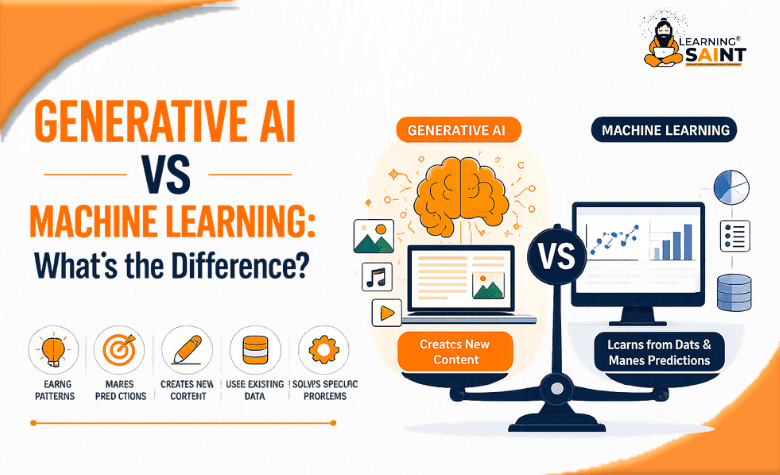
Generative AI vs Machine Learning: Key Differences explained
Now, it is time to target the main fish in the net, which are Generative AI vs Machine Learning. You have understood how they work together; now you must understand the comparison between them.
The following are the categories and the difference between Generative AI and Machine Learning:
1. The main aim
The first and main difference lies in the main accomplishment of the tool. Standard machine learning models will help you with analysing and evaluating. It will convert a messy pile of data into categorised information. Its basic aims are to sort, find patterns, and predict the next data.
Whereas Generative AI aims at creating and producing. It will utilise the hidden patterns to learn and understand the core behind the data. It will try to create something new for it.
2. The final result
A standard machine learning model provides short, targeted results. It will give you answers in numbers, percentages, a label, or a decision. For example, if you ask it about the weather tomorrow, it will answer you with, “There is a 70% chance of hailstorms tomorrow."
Whereas if you are using Generative AI for the same work, it will give a different answer. It gives you a complicated and human-like answer. It will generate an essay explaining everything about the question, a high-resolution image, and much more.
3. Requirements for Data and Scale
Standard machine learning models are able to run smoothly on an average amount of data. A brand can train an effective model with a single spreadsheet, including some rows of customer sales history.
On the opposite side, Generative AI needs a large data scale. If you are willing to build a foundation model that can understand art and creativity, you must have a massive computing warehouse full of specialised computer chips running and operating, for weeks at a time, eating through terabytes of data collected from all over the internet.
4. How do they manage errors
Spotting mistakes and errors is easy in the standard or traditional machine learning models. For example, if a system is predicting rain tomorrow and it turns out to be a sunny day, it is evident that the system is in error.
On the other hand, Generative AI usually fails due to a very different error called “hallucinations”. These tools are created to predict what sounds right based on mathematical probabilities. It can sometimes generate wrong answers, and that too with absolute confidence. They might state an incorrect historical event or a case that never happened. This is why human rechecking is important while using Generative AI in a serious or important task.
You can also read about the differences between Machine Learning and Artificial Intelligence.
Conclusion:
You do not require a degree in maths and statistics to understand the science behind how the AI operates. Everything is quite simple. AI is nothing but a technology that reads stuff and creates stuff.
Machine learning focuses on past data to analyse and predict the future. It can help you with planning a budget for a trip. Generative AI is different from machine learning. It focuses on learning from the provided data and creating something new from it. This tool aims to help every individual with ideas and new data.
Understanding the core of Generative AI vs Machine Learning will help you find the right job according to your preferences and skills. You can understand the field that excites you more. This article is your guide to learning the difference between Generative AI and Machine Learning.
Frequently Asked Questions (FAQ)
1. Which is best, Generative AI or Machine Learning?
None of them is better. It depends on the field requirements and personal skills development.
2. Are Gen AI and Machine Learning the same?
Generative AI and Machine Learning are closely related concepts that cater to different areas of artificial intelligence.
3. Can I learn ML in 3 months?
Yes, you can learn ML in 3 months if you have basic programming experience and you follow a consistent routine.
4. Can ML work without AI?
No, ML cannot work without AI. It needs AI principles to interpret, analyse, and perform.
5. Which country is No. 1 in AI?
The U.S. is the No. 1 country in AI development and operations.


Reply To Elen Saspita