 United States
 India
 United Kingdom
 Australia
 Canada
 Nigeria
 Others


 Learning Saint
Have you ever wondered what you will actually learn in a data science course once you get enrolled? As data is becoming the world’s No. 1 valuable resource, organizations across industries are looking for professionals who can turn raw data into meaningful insights. But before you begin this journey, it’s very important to understand what the course will cover and whether it matches your goal. This guide is going to help you with a data science course syllabus: what topics will you cover, what skills are required, and the career opportunities after completing the course. Whether you are a beginner, a graduate, planning for higher studies, or a working professional who wants to upskill and get a new job that pays well, this article is going to help you to understand everything you need to know about the modern data science program.
What Is a Data Science Course?
A data science course is designed specifically to teach you how to collect, organize, analyze, and interpret data from raw sources, solve problems, and provide the best solutions. It helps the learner make data- driven decisions and combines with subjects that include programming, mathematics, statistics, machine learning, and real-world business knowledge.
These days, companies have a lot of data and information every minute from every source, whether it’s an online shopping website, a healthcare department, or an online streaming platform; these days, industries want properly structured data that meets the needs of the customer and is able to understand customer behaviour, improve overall performance and operations and predicts all the future trends that are going to help the company. These are the demands that a industries searches in skilled data science professionals.
A well-structured data science course syllabus involves so many things; it does not mean that you will just write the code to make things happen. It focuses on building and enhancing your analytical thinking skills, problem-solving capabilities, and the ability to apply practical skills that allow students to work with databases and use their brains to solve problems and give intelligent solutions.
Why Is Data Science in Such High Demand?
Businesses today depend completely on data and want to make smarter decisions from it. For example, there is an eCommerce company that analyzes all its customers’ purchases based on their purchase history to recommend them products, while a hospital will use a predictive model that helps to identify patients who may require any kind of early medical needs. Financial institutions will detect if there are any kind of fake transactions, all with the help of machine learning; meanwhile, a marketing team will study all the customer behaviour and improve the performance through a campaign.
All these applications are run and performed by a data science expert who knows how to transform raw data into a meaningful source of information. This is the reason why many industries want to invest in a data scientist and see a boom in their respective fields.
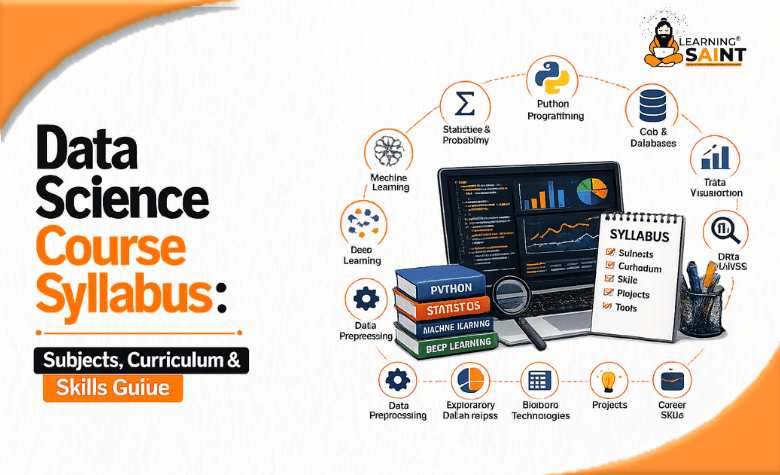
Data Science Course Syllabus Overview
If you are also planning to start your career in data science and are curious about the data science course syllabus. Here’s the full information for the course. There are many institutions that have different kinds of curricula.
Mostly, it starts with the basics and focuses mainly on strengthening your foundation in mathematics, statistics, and programming. Once all these concepts are clear, you will move towards data analysis, machine learning, artificial intelligence, and all the practical projects that will be helpful in solving the challenges that businesses usually face.
The data science programs focuses that you get both theoretical and practical knowledge. For this practice, they give students a good amount of time to get their hands set in working with the datasets, building models that solve problems, and creating dashboards that will provide solutions to your problem.
To know more about the program, here is the table that is going to help you get an overview and have a better understanding to clear all your doubts:
|
Learning Stage |
Topics Covered |
|
Foundation |
Python programming, mathematics, probability, statistics |
|
Data Management |
SQL, databases, data cleaning, data preprocessing |
|
Data Analysis |
Exploratory data analysis, visualization, business insights |
|
Machine Learning |
Supervised and unsupervised learning, model evaluation |
|
Artificial Intelligence |
Neural networks, deep learning, AI fundamentals |
|
Advanced Topics |
Big data, cloud computing, natural language processing |
|
Practical Learning |
Case studies, capstone projects, internships |
One of the major aspects of the curriculum is getting practical knowledge and facing the real world. Instead of just focusing on reading about the algorithms, students will learn how to implement them using the industry- standard tools and libraries. This helps to fill the gap between academic learning and real-world application.
Core Subjects Included in a Data Science Course Syllabus
The subjects included in the data science course syllabus are designed in such a way that the learners first start understanding the basic concepts and then slowly move to solving real-world problems with the help of data. While it mainly depends on the institutions.
Here are some of the major subjects that you are going to study in a data science course:
Mathematics for Data Science
To have a strong foundation in machine learning, it’s very important that you have strong mathematical knowledge too. Having strong skills in mathematics can help you understand how the algorithms work. Most of the courses include these topics:
- Linear Algebra
- Calculus
- Probability
- Descriptive Statistics
- Inferential Statistics
- Probability Distributions
These are used mostly for modelling, data analysis, and artificial intelligence. Even though you are starting as a beginner, mathematics can be quite challenging for you, but there are a lot of programs that will explain these topics with the help of practical examples rather than complex formulas, which will help you out for a better understanding.
Python Programming
Python is among the most famous programming languages in data science because of its simplicity, beginner friendly and having extensive library support. It allows data scientists to clean their data, automate most of the tasks, build machine learning models, and visualize the results for the future. A Python syllabus for data science includes:
- Python fundamentals
- Variables and data types
- Loops and functions
- Object-oriented programming basics
- File handling
- Exception handling
As learners progress in their work, they start working on writing programs that analyze datasets, identify future trends, and automate tasks that are repetitive. Through this procedure students have a clear understanding of the work and can work independently.
Statistics and Probability
Statistics is the main part of data science; without the proper knowledge, it becomes very difficult to understand even the basic data patterns. To understand it properly, you have to study the following subjects; here are the important subjects that include:
- Measures of central tendency
- Measures of dispersion
- Correlation
- Covariance
- Probability theory
- Sampling techniques
- Hypothesis testing
- Confidence intervals
- Regression analysis
Data Analytics
Once you have a clear understanding of programming and statistics, you will be shifted to learn about data analytics, where the main focus will be how to convert raw data into a meaningful source. Here is the introduction to the data analytics syllabus that will clear your doubts:
- Data collection
- Data cleaning
- Data preprocessing
- Exploratory Data Analysis (EDA)
- Data transformation
- Feature engineering
- Data visualization
- Reporting and dashboards
SQL and Database Management
Data is only useful for you if you know how you can access and manage it properly. That’s why SQL is an essential part of the data science course syllabus.
- Database design
- Tables and relationships
- Data retrieval
- Filtering and sorting
- Joins
- Aggregate functions
- Subqueries
- Views
- Stored procedures
Organizations usually store their information in databases; SQL helps data scientists to get the data that they actually need for the analysis. Having a strong knowledge of SQL is very important for most of the entry level data science and data analyst roles.
Machine Learning
Machine learning is the main thing that makes the data science work very exciting; instead of manually typing everything and wasting your manhours, machine learning will enable the computer to learn from past data and help you make future predictions. Students start by understanding it first and then try to implement it with the help of Python.
- Supervised learning
- Unsupervised learning
- Reinforcement learning
- Classification algorithms
- Regression algorithms
- Clustering
- Decision trees
- Random Forest
- Support Vector Machines
- Model evaluation
- Cross-validation
Artificial Intelligence
Artificial intelligence (AI) is being used everywhere; it has great importance in modern data and science programs too. As most of the organizations are using AI- powered solutions and using AI on a daily basis, many institutions have introduced artificial intelligence and data science syllabi that include several models.
- Introduction to Artificial Intelligence
- Intelligent agents
- Neural networks
- Deep learning
- Computer vision
- Natural Language Processing (NLP)
- Recommendation systems
- AI ethics
Big Data Technologies
The traditional way of processing databases has been exchanged with the new big data technologies that provide easy access to work and store large amounts of data. Here are the courses that introduce the learner to this technology:
- Big data fundamentals
- Hadoop ecosystem
- Apache Spark
- Distributed computing
- Data pipelines
- Batch processing
- Real-time data processing
Cloud Computing
Businesses believe in storing their data in the cloud; that’s the main reason that in many institutions, data science programs introduce learners to cloud platforms and several other services. Here are some of the common topics that include:
- Cloud computing fundamentals
- Data storage
- Cloud-based machine learning
- Data security
- Scalable computing
- Cloud deployment
Capstone Projects and Practical Learning
If you think that you have all the theoretical knowledge and you will become a successful data scientist, then you are wrong. To become a successful data scientist, you should have practical knowledge too; that’s why institutions include a data science course syllabus that makes sure that students work on practical projects also. Here are some of the common projects that most of the institutions have:
- Customer churn prediction
- Sales forecasting
- Movie recommendation systems
- Credit risk analysis
- Fraud detection
- Healthcare data analysis
- Sentiment analysis using social media data
- Product recommendation engines
Data Science Course Syllabus for Beginners
A well-designed data science course syllabus for beginners have it’s own importance; it is the first module that introduces a learner to the world of knowledge step by step. Most courses start with the basics things then move towards advanced concepts slowly, and make sure that the student doesn’t get confused.
But where does this journey start from?
It usually starts by using the simple Python programming language, basic mathematics, and statistics. Once you have cleared all these fundamentals, you will be moved to SQL, data analysis, data visualization, and lastly you will be introduced to machine learning. As you understand and clear all the concepts, you have to start working on the projects too to gain practical knowledge.
Here’s the full overview for a beginner:
|
Module |
Topic Covered |
|
Programming |
Python basics, variables, loops, functions |
|
Mathematics |
Probability, statistics, linear algebra |
|
Databases |
SQL fundamentals and data retrieval |
|
Data Analysis |
Data cleaning, visualization, exploratory analysis |
|
Machine Learning |
Introduction to basic ML concepts |
|
Projects |
Beginner-friendly case studies and datasets |
MSc Data Science Syllabus
An MSc in data science is designed especially for learners who want to get more deeply into the technical knowledge and want a specialization in machine learning, artificial intelligence, and big data. The curriculum for the MSc data science syllabus can be different and can be based on the universities, but for every university, the main motto is to combine theoretical knowledge with practical practices to prepare the student for the industry. Here’s a basic overview that how does a university semester structure actually looks like:
|
Semester |
Common Subjects |
|
Semester 1 |
Python Programming, Statistics, Linear Algebra, SQL |
|
Semester 2 |
Machine Learning, Data Mining, Data Visualization, Big Data |
|
Semester 3 |
Deep Learning, Artificial Intelligence, Cloud Computing, NLP |
|
Semester 4 |
Capstone Project, Internship, Dissertation or Research Project |
Skills You Develop During a Data Science Course
A data science course syllabus makes sure that the learner has strong expertise in technical terms and the workplace skills that are essential for a successful career in the field of data science.
Technical Skills
Students are going to learn technical skills along with practical skills. The technical skills include Python programming, SQL, statistical analysis, machine learning, data visualization, and database management.
Analytical Skills
Having all the technical skills is good, but what if you are not able to solve the problem? Having analytical skills is important as they help in identifying patterns, solving problems, and making data-driven decisions. Additionally, they will also be able to evaluate the datasets and have the ability to choose the perfect tools and techniques for better results.
Communication and Business Skills
Data scientists have strong bonds with the business team because of the work, so communication plays a major role in the field to have that understanding of the work and the workflows in a smooth manner. The course makes sure that the student improves their way of presentation, data storytelling, and reporting skills, so that if they want to convey it to others, they can understand it completely.
Tools and Technologies You Learn
The data science course syllabus introduces learners to the tools and technologies that are used by data professionals most of the time. These tools are mostly used to collect, process, analyze, and visualize the data, which helps to solve problems very easily. Here are some of the common tools that you will learn while studying the course:
|
Category |
Tools |
|
Programming |
Python, R |
|
Database Management |
SQL, MySQL, MongoDB |
|
Data Visualization |
Tableau, Power BI, Matplotlib |
|
Machine Learning |
Scikit-learn, TensorFlow |
|
Big Data |
Hadoop, Apache Spark |
|
Cloud Platform |
AWS, Microsoft Azure, Google Cloud |
|
Version Control |
Git, GitHub |
Read more about the data science tools for advanced analytics: Top Must-Have Data Science Tools
How Long Does It Take to Complete a Data Science Course?
The time duration for the data science course completely depends on the type of program that you choose and based on your learning pace. Here is a comparison of different courses along with the time duration:
|
Course Type |
Typical Duration |
|
Certification Course |
3 - 6 Months |
|
Diploma Course |
6 - 12 Months |
|
Bachelor’s Degree |
3 - 4 Years |
|
Master’s Degree |
2 Years |
|
Bootcamp |
4 - 9 Months |
Conclusion:
A data science course syllabus covers everything to have a very strong base and achieve a long-term goal, starting from Python, statistics, machine learning, artificial intelligence, data visualization, and solving the practical problems that businesses are facing. All these subjects make sure that the learner is not limited to theoretical knowledge but also has practical experience in solving the skill that is one of the most demanding skills in the industry.
It doesn’t matter whether you are a beginner who is just exploring around the world, a graduate who is looking for a advance degree, or selecting a course with an updated curriculum can help you throughout your journey and make a major difference while facing the challenges and solving them later. As businesses are looking for someone they can rely on opens several opportunities in the future.


Reply To Elen Saspita