 United States
 India
 United Kingdom
 Australia
 Canada
 Nigeria
 Others


 Learning Saint
You must have come across the phrase “agentic AI” in the news, at work, or from a friend. It sounds complicated and technical, but the idea behind it is quite simple. Agentic AI performs multiple needed steps in one command instead of giving a single answer. Unlike other platforms, you just have to provide a goal to Agentic AI, and it will work out the rest, such as using the tools, verifying the work, and keeping the work going until the job is completed.
This article will explain what is Agentic AI in easy and understandable language. You will understand the definition of the term, how it operates, what its benefits are, and what its challenges are.
What do you understand by Agentic AI?
The first topic of discussion is “What is agentic AI?" Agentic AI is a type of artificial intelligence that is capable of acting on its own to complete a goal. Instead of simply replying to a query. It can also decide the steps to take next, take actions, and learn from the results.
Think of Agentic AI like a helpful assistant at an office. If you command, “Book a trip for me to Manali next week," a simple tool might just end up giving you multiple flight options. Whereas an Agentic AI is capable of going further. It will compare the available options, check your calendar, choose a good option, and even book it. It can even tell you what it did.
Researchers define Agentic AI as software that is built to understand its surroundings, plan, act, and even adapt with a little bit of human help.
What is the origin of Agentic AI?
The word “agentic” is derived from “agency”. Agency means the power to act and make choices. An individual who can take action on their own has agency. An AI system that chooses its own steps to achieve the desired destination shows a sort of agency too.
This does not imply that Agentic AI can think or feel like a human. It simply states that it can take action towards a goal instead of just answering a specific prompt. The main idea is to remember the goal and act on it.
How does Agentic AI operate?
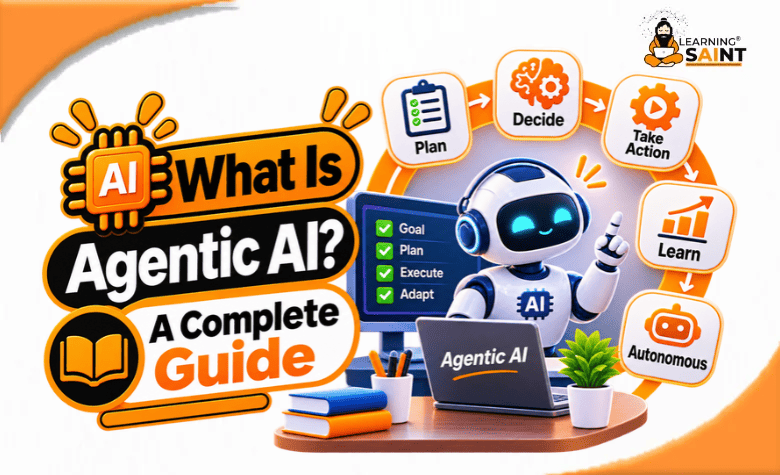
Most agentic AI systems follow a certain loop. They repeat the loop until they have to ask a person for help.
The following are 4 main steps involved in the ongoing loop:
1. Accept
The first step of the Agentic AI loop starts with accepting the information. This information could be your prompt or request, a file, a webpage, or data from a database, or even a message from another programme. This context is important for Agentic AI to understand the task.
2. Defend and strategise
In the next step, the system analyses the goal closely and breaks it into smaller actions. A huge job, such as “draft a market report", becomes a smaller job, such as “find sources”, “read them”, “pull out the core facts”, “prepare a draft", "find sources", "read them", "pull out key facts", "write a draft", and "check the numbers". This is known as multi-step planning.
3. Perform
Then the system takes action. It might search the web, run a piece of code, send an email, update a spreadsheet, or ask another program for data. These actions happen through tools, which are often connected using APIs. An API is a way for two programs to talk to each other.
4. Learn and adjust
After each action is performed, the system verifies the result if it worked or not. If it has not worked, it changes the plans and tries one more time. Some systems even maintain notes that are known as 'memories' so that they can use what they have learnt in later uses.
Now, you must be wondering what Agentic AI is doing in this loop, right? It is responsible for working until it achieves the goal. A standard or basic chatbot answers only once and stops there.
What are the core parts of Agentic AI?
Agentic systems are created with some key parts. Agentic systems are built from a few key parts. You are not required to be an engineer to understand these parts.
The following are parts that combine to create Agentic AI:
- A Large language model (LLM): An LLM is the brain of Agentic AI. It reads and writes language and supports it with accurate reasoning. All the current agents are dependent on generative models like this one, but not all of them are agentic.
- Tools: The tools allow the system to perform things in the real world, like search, calculate, send messages, or edit files.
- Memory: Memory basically helps the system remember what it has done so far in a certain task or even sometimes across tasks.
- A Planner: A planner is simple. It is responsible for breaking down a certain goal into a specific order.
- Guardrails: Guardrails are the rules and limits of Agentic AI. They tell the system what it must do and what it must ask for approval.
- Human Oversight: Human oversight means a human always checks important work, especially when money, safety, or private data is involved.
What is the difference between Agentic AI, Generative AI, and Chatbots?
The biggest confusion often occurs between the three: Chatbots, Generative AI, and Agentic AI.
The following is an easy tabular distinction between them all:
|
Chatbot |
Generative AI |
AI Assistant |
Agentic AI |
|
A chatbot answers queries in a chat window. However, older chatbots used to follow fixed rules and scripts. |
Generative AI focuses on creating new content, like text, images, or code, when you provide it with a prompt. It basically replies with one answer only. |
AI assistants will help you with various tasks, but they need you to provide guidance at each step. |
Agentic AI just requires a goal. After that, it plans the steps, uses the tools, and acts with even less guidance. |
What are the benefits of Agentic AI?
The following are the ways that Agentic AI helps people:
- Saves time: Agentic AI is capable of handling repeated tasks without any need for a person to guide it at every step.
- Takes care of complicated tasks: If you are facing a complicated issue in a task and it seems big, then Agentic AI can easily break it into smaller steps. It can even help you work through them.
- Helps you meet the deadline: Software does not feel the need to rest. It can keep your tasks going and help you meet the desired deadline.
- Open to adapting to change: Usually, some steps that AI takes might fail in achieving the desired goal. In that case, Agentic AI is always ready to try doing it in a different way.
- Allows people to free up from high-value work: Agentic AI takes up a lot of high-value work, which ultimately helps people to spend more time on judgement, creativity, and talking with other people.
What are the risks of using Agentic AI?
The following are the risks of using Agentic AI:
- Errors can pile up: If an agent ends up making a minor mistake at an early stage, it will act as a base for every next step.
- Bias: AI learns from the data fed to it. If the data itself has some unfair patterns, AI can end up repeating them.
- Security and privacy: AI agents have access to data, which means they can intentionally trick or misuse it.
- Cost and complexity: Creating and operating agents at a large scale can turn out to be expensive and complicated.
Conclusion:
Agentic AI has objectives. It plans steps, uses tools, checks results, and adjusts. It has less step-by-step direction than a normal chatbot.
It has real potential for coding, customer support, research, and other repetitive tasks. But it also carries risks, from errors to security issues to marketing hype. Gartner predicts many projects will be cancelled by the end of 2027 and warns against ‘agent washing’
If you recall only three things, let it be these. First, agentic AI acts towards a goal. Secondly, people should be in charge of important decisions. Third, always verify claims before you believe them. “Start small, put firm boundaries, and learn as you go.


Reply To Elen Saspita